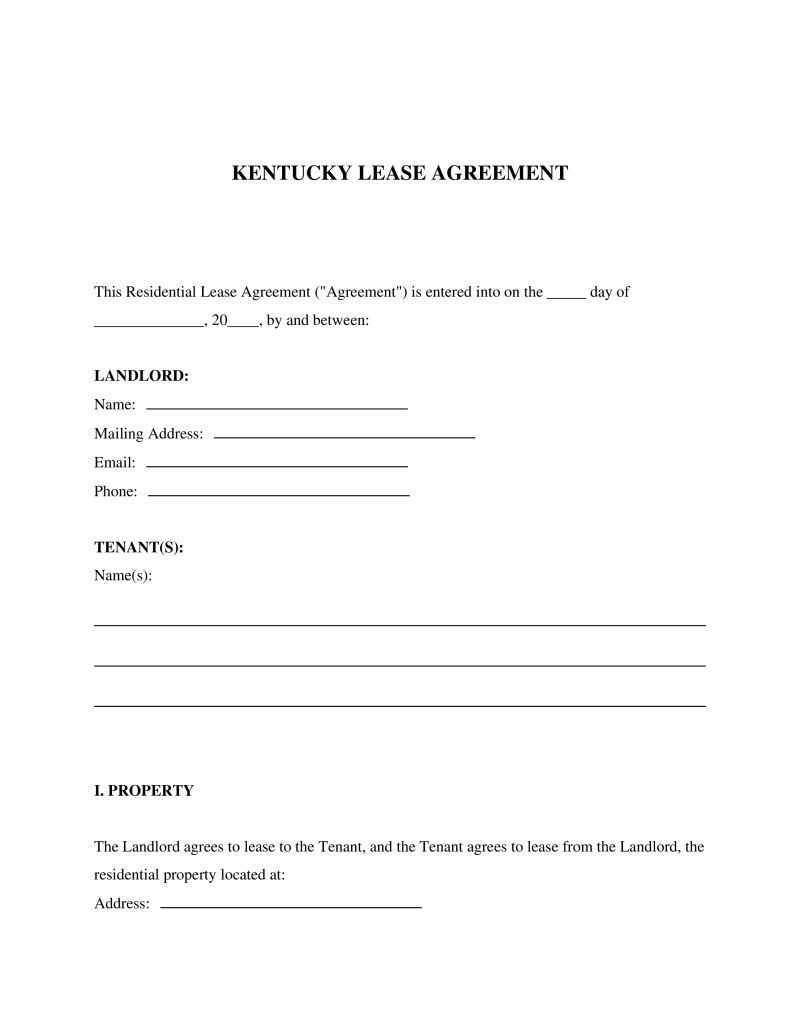
Kentucky Lease Agreement Create a Kentucky Lease Agreement

Kentucky Lease Agreement

Published Dec 07, 2025
0 Comments
1 Downloads

A Kentucky Lease Agreement is a legally binding contract that clearly explains the rental terms, payment obligations, and responsibilities of both the landlord and tenant for a property in Kentucky.

Lease Type

Select the type of property that this lease applies to from the options provided. This helps clarify the nature of the rental arrangement and can affect lease terms and tenant rights. If your property type is not listed, choose "Other" and specify what it is.

Table of Contents

0% Complete 0/0 Fields

KENTUCKY LEASE AGREEMENT

This Residential Lease Agreement ("Agreement") is entered into on , by and between:

LANDLORD:
Name:
Mailing Address:
Email:
Phone:

TENANT(S):
Name(s):

I. PROPERTY

The Landlord agrees to lease to the Tenant, and the Tenant agrees to lease from the Landlord, the residential property located at:

Address:
City:
State: Kentucky
Zip Code:

(hereinafter referred to as the "Premises").

The Premises includes the following furniture/appliances:

II. TERM

The term of this Agreement shall be (check one):

III. RENT

Rent Amount: The Tenant shall pay the Landlord the sum of $ per month.

Due Date: Rent is due on the day of each month.

Payment Method: Rent shall be paid via:

Payment Address (if different from Landlord address):

Late Fee: If rent is not paid within days of the due date, Tenant shall pay a late fee of $.

Returned Checks: For any check returned for insufficient funds, Tenant shall pay a fee of $ (not to exceed $50.00 pursuant to KRS 514.040).

IV. SECURITY DEPOSIT

Upon execution of this Agreement, Tenant shall deposit with Landlord the sum of $ as security for the performance of Tenant's obligations under this Agreement.

Kentucky Statutory Requirements (KRS 383.580):

1. Separate Account: Landlord shall deposit the Security Deposit in an account used only for that purpose, in a bank or other lending institution subject to regulation by the Commonwealth of Kentucky or any agency of the United States government.

2. Notification: Landlord shall inform Tenant of the location of the separate account and the account number.
Bank Name:
Account Number (Last 4 digits):

3. Pre-Occupancy Inspection: Prior to the Tenant tendering the Security Deposit, the Landlord shall provide the Tenant with a comprehensive listing of any existing damage to the unit. The Tenant shall have the right to inspect the Premises to verify the accuracy of the list. Both parties shall sign the list.

4. Return of Deposit: In the event that any part of the Security Deposit is withheld, the Landlord shall provide the Tenant with a comprehensive listing of the damages and the estimated cost of repairs.

V. UTILITIES AND SERVICES

Responsibility for payment of utilities and services shall be as follows:

Electricity:

Water/Sewer:

Gas:

Trash Collection:

Internet/Cable:

Other ():

VI. USE OF PREMISES

The Premises shall be used and occupied by the Tenant(s) and the following minor children/occupants exclusively as a private single-family residence:

No part of the Premises shall be used at any time during the term of this Agreement by Tenant for the purpose of carrying on any business, profession, or trade of any kind, or for any purpose other than as a private single-family residence.

VII. MAINTENANCE AND REPAIRS

Landlord's Obligations (KRS 383.595):
Landlord shall:
1. Comply with the requirements of applicable building and housing codes materially affecting health and safety;
2. Make all repairs and do whatever is necessary to put and keep the Premises in a fit and habitable condition;
3. Keep all common areas of the Premises in a clean and safe condition;
4. Maintain in good and safe working order and condition all electrical, plumbing, sanitary, heating, ventilating, air-conditioning, and other facilities and appliances supplied by Landlord.

Tenant's Obligations (KRS 383.605):
Tenant shall:
1. Comply with all obligations primarily imposed upon tenants by applicable provisions of building and housing codes materially affecting health and safety;
2. Keep that part of the Premises that Tenant occupies and uses as clean and safe as the condition of the Premises permits;
3. Dispose from the Premises all ashes, garbage, rubbish, and other waste in a clean and safe manner;
4. Keep all plumbing fixtures in the Premises or used by the Tenant as clean as their condition permits;
5. Use in a reasonable manner all electrical, plumbing, sanitary, heating, ventilating, air-conditioning, and other facilities and appliances;
6. Not deliberately or negligently destroy, deface, damage, impair, or remove any part of the Premises or knowingly permit any person to do so.

VIII. RIGHT OF ENTRY

Pursuant to KRS 383.615, the Landlord shall have the right to enter the Premises to inspect the Premises, make necessary or agreed repairs, decorations, alterations, or improvements, supply necessary or agreed services, or exhibit the Premises to prospective or actual purchasers, mortgagees, tenants, workmen, or contractors.

Except in case of emergency or unless it is impracticable to do so, the Landlord shall give the Tenant at least two (2) days' notice of the Landlord's intent to enter and may enter only at reasonable times.

IX. PETS

X. LEAD-BASED PAINT DISCLOSURE

Housing built before 1978 may contain lead-based paint. Lead from paint, paint chips, and dust can pose health hazards if not managed properly. Lead exposure is especially harmful to young children and pregnant women.

The Premises was constructed:

XI. DEFAULT AND TERMINATION

Failure to Pay Rent (KRS 383.660(2)): If rent is unpaid when due and Tenant fails to pay rent within seven (7) days after written notice by the Landlord of nonpayment and the Landlord's intention to terminate the Rental Agreement if the rent is not paid within that period of time, the Landlord may terminate the Rental Agreement.

Non-Compliance (KRS 383.660(1)): If there is a material noncompliance by the Tenant with the Rental Agreement or a material noncompliance with KRS 383.605 materially affecting health and safety, the Landlord may deliver a written notice to the Tenant specifying the acts and omissions constituting the breach and that the Rental Agreement will terminate upon a date not less than fourteen (14) days after receipt of the notice. If the breach is not remedied in fifteen (15) days, the Rental Agreement shall terminate as provided in the notice.

XII. DISCLOSURE OF MANAGER AND AGENT

Pursuant to KRS 383.585, the Landlord or any person authorized to enter into a rental agreement on the Landlord's behalf shall disclose to the Tenant in writing at or before the commencement of the tenancy the name and address of:

1. The person authorized to manage the Premises:
Name:
Address:

2. The owner of the Premises or a person authorized to act for and on behalf of the owner for the purpose of service of process and receiving and receipting for notices and demands:
Name:
Address:

XIII. ABANDONMENT

If the Tenant is absent from the Premises for a period of seven (7) consecutive days or more while rent is outstanding, the Tenant shall be deemed to have abandoned the Premises. The Landlord may enter the Premises and re-rent the Premises in accordance with KRS 383.670.

XIV. GOVERNING LAW

This Agreement shall be governed by and construed in accordance with the laws of the Commonwealth of Kentucky, specifically the Uniform Residential Landlord and Tenant Act (KRS Chapter 383) where applicable.

XV. ADDITIONAL TERMS AND CONDITIONS

Additional provisions:

XVI. ENTIRE AGREEMENT

This Agreement constitutes the entire agreement between the parties and supersedes any prior understanding or representation of any kind preceding the date of this Agreement. There are no other promises, conditions, understandings, or other agreements, whether oral or written, relating to the subject matter of this Agreement.

SIGNATURES

LANDLORD:
Signature: _________________________
Print Name: _______________
Date:

TENANT(S):
Signature: _________________________
Print Name: _______________
Date:

What is a Kentucky Lease Agreement?

A Kentucky Lease Agreement is a legally binding contract executed between a landlord (lessor) and a tenant (lessee) regarding the rental of residential or commercial property within the Commonwealth of Kentucky. This document outlines the terms and conditions under which the tenant occupies the property, including the payment of rent, the duration of the tenancy, and the specific responsibilities of both parties. It serves as the primary governing instrument for the landlord-tenant relationship and provides legal protection by clearly defining the rights and obligations of each signatory. While oral agreements can be valid for short-term tenancies, written contracts are standard for establishing clear evidence of the agreement and complying with state statutes regarding longer terms.

Legal Framework and Statutes

The landlord-tenant laws in Kentucky are primarily found in Chapter 383 of the Kentucky Revised Statutes (KRS). A unique aspect of Kentucky rental law is that the state allows local governments to adopt the Uniform Residential Landlord and Tenant Act (URLTA). Consequently, the laws governing a Kentucky Lease Agreement may vary significantly depending on the jurisdiction where the property is located. Major cities such as Louisville, Lexington, and several northern Kentucky counties have adopted the URLTA (KRS 383.500 through 383.705), which provides more detailed regulations regarding security deposits, landlord access, and maintenance obligations compared to the common law that governs other parts of the state.

Required Disclosures and Elements

To ensure validity and compliance with both federal and state regulations, specific disclosures must be included in the lease documentation. Failure to provide mandatory disclosures can lead to legal penalties or the inability to withhold security deposits.

  • Lead-Based Paint Disclosure: Pursuant to federal law (42 U.S. Code § 4852d), for any housing built prior to 1978, the landlord must provide a warning statement regarding the presence of lead-based paint.
  • Security Deposit Location: In jurisdictions following the URLTA, landlords must inform tenants of the location and account number where the security deposit is held. This account must be separate from the landlord's personal funds.
  • Move-In/Move-Out Checklist: A comprehensive list of existing damages must be provided to the tenant prior to occupancy. This allows the tenant to inspect the premises and verify the condition, which is critical for security deposit deductions upon termination.
  • Authorized Agents: The agreement must disclose the name and address of the property owner and any person authorized to manage the premises or receive legal notices on behalf of the owner.

Security Deposit Regulations

Under Kentucky law, particularly in URLTA jurisdictions, security deposit administration is strictly regulated. Landlords are required to deposit security funds into a separate account used solely for that purpose in a regulated financial institution. They cannot commingle these funds with their own assets. Furthermore, at the beginning of the lease, the landlord must provide a listing of any existing damage. If a landlord fails to provide this initial list or does not deposit the funds in a separate account, they may forfeit the right to retain any portion of the security deposit for damages or unpaid rent.

How to Complete a Kentucky Lease Agreement

Drafting or filling out a lease requires attention to detail to ensure all terms are enforceable under Kentucky Revised Statutes.

  1. Step 1: Identify the Parties and Premises – Clearly state the full legal names of all adult tenants and the landlord. Provide the exact physical address of the rental unit, including apartment numbers if applicable.
  2. Step 2: Define Lease Term and Rent – Specify the start and end dates of the tenancy. Clearly outline the rent amount, the due date (typically the first of the month), and acceptable payment methods.
  3. Step 3: Establish Security Deposit Terms – Record the amount of the security deposit and the banking institution where it will be held. Reference the move-in checklist as an attachment to the agreement.
  4. Step 4: Outline Policies and Obligations – Detail rules regarding pets, smoking, maintenance responsibilities, and utility payments. Specify which party is responsible for water, electricity, gas, and trash collection.
  5. Step 5: Sign and Date – All parties must sign and date the document. The landlord should provide the tenant with a copy of the signed lease and the move-in inspection list.

Landlord Right to Entry

The right of a landlord to enter a rented property is balanced against the tenant's right to quiet enjoyment. In areas governed by the URLTA, a landlord must provide at least two days' notice before entering the premises for non-emergency reasons, such as inspections, repairs, or showing the unit to prospective tenants or buyers. Entry must occur at reasonable times. In cases of emergency, such as a fire or significant water leak, the notice requirement is waived, and the landlord may enter immediately to preserve the property.

Termination and Eviction Procedures

When a tenant violates the terms of a Kentucky Lease Agreement, the landlord must follow specific legal procedures for eviction, known as forcible detainer. For non-payment of rent, the landlord must provide a seven-day written notice to pay or quit. If the tenant fails to pay within that window, the landlord may file for eviction. For other lease violations, such as unauthorized pets or noise disturbances, a 14-day notice to remedy the breach is generally required. If the violation is not corrected within 14 days, the lease terminates after an additional period (often 30 days total from the initial notice). Self-help evictions, such as changing locks or shutting off utilities without a court order, are illegal in Kentucky.

Frequently Asked Questions

Yes, verbal lease agreements are generally valid in Kentucky for tenancies of one year or less. However, written agreements are strongly recommended to clearly establish terms and avoid disputes regarding rent, duration, and responsibilities.
Kentucky state law does not impose a statutory limit on the maximum amount a landlord can charge for a security deposit. However, landlords typically charge between one and two months' rent to remain competitive in the market.
There is no mandatory grace period required by Kentucky law. Rent is due on the date specified in the lease, and landlords may consider it late immediately after that date unless the contract specifies otherwise.
Under the URLTA (KRS 383.635), tenants may be allowed to deduct the cost of minor repairs from their rent, up to $100 or half the monthly rent (whichever is greater), but only after giving the landlord proper notice and 14 days to fix the issue. This applies only in jurisdictions that have adopted the URLTA.
For month-to-month tenancies in URLTA jurisdictions, the landlord or tenant must provide at least 30 days' written notice to terminate the arrangement. In non-URLTA areas, the notice period generally defaults to one month.
Kentucky statutes do not set a specific cap on late fees. However, late fees must be reasonable and clearly outlined in the lease agreement to be enforceable in court.

Not the form you're looking for?

Try our legal document generator to create a custom document

Community Discussion

Share your experience and help others

0

Comments (0)

Leave a Comment

Your email will not be displayed publicly. It is used for validation purposes only and will never be used to send unwanted emails or sold to third parties.

No comments yet. Be the first to comment!

Legal Notice: Comments are personal opinions and do not constitute legal advice. Always consult a qualified attorney for matters specific to your situation.