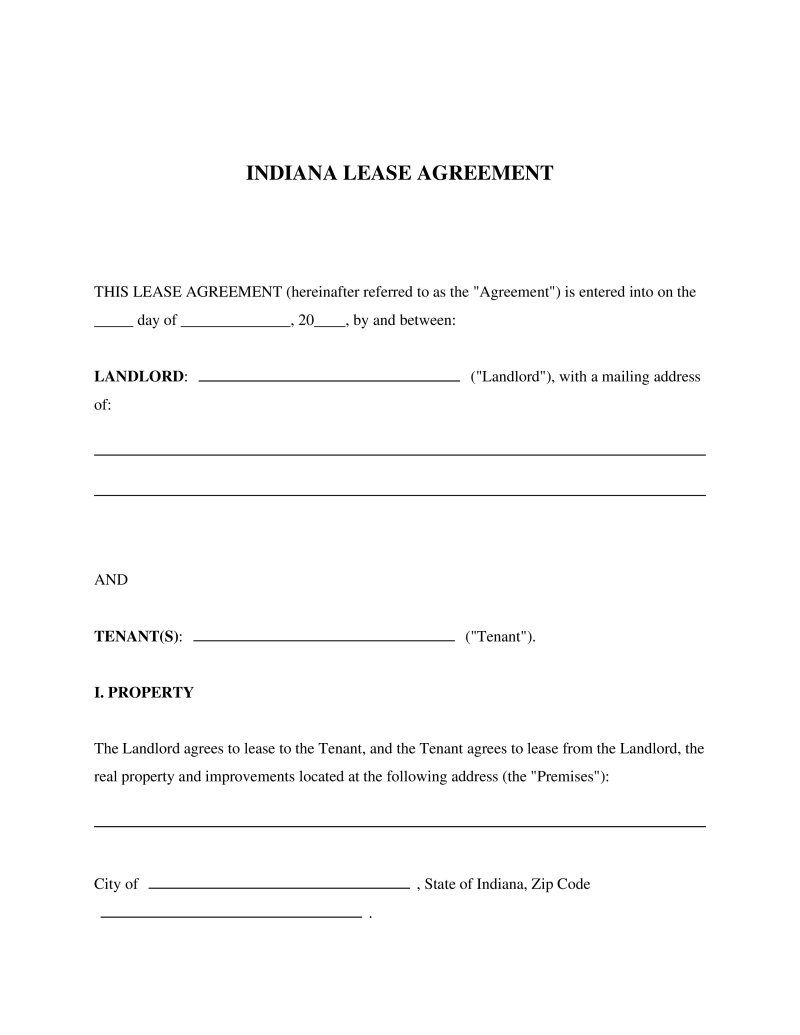
Indiana Lease Agreement
An Indiana Lease Agreement is a legally binding contract that sets the rules, rights, and responsibilities of the landlord and tenant for renting property in Indiana.
Residential Property Type
Select the residential property category that best describes the rental premises.
Use this if the rental property does not fit one of the listed categories.
Table of Contents
What is an Indiana Lease Agreement?
An Indiana Lease Agreement is a legally binding contract executed between a landlord (lessor) and a tenant (lessee) for the rental of property within the state of Indiana. This document establishes the terms and conditions of the tenancy, outlining specific details such as the monthly rental amount, payment due dates, lease duration, and the responsibilities regarding utilities and maintenance. It serves as the primary governing document for the landlord-tenant relationship and provides legal protection for both parties by clearly defining their respective rights and obligations under Indiana state law. While verbal agreements may exist for short-term rentals, written contracts are standard practice to ensure enforceability and compliance with state statutes.
Legal Framework and Statutory Requirements
The landlord-tenant relationship in Indiana is primarily governed by Indiana Code Title 32, Article 31. These statutes cover various aspects of renting, including security deposits, moving out, and the obligations of both parties. Unlike some jurisdictions with heavy rent control or extensive tenant protections, Indiana is often considered a landlord-friendly state; however, strict adherence to specific procedural laws is required for a lease to be valid and enforceable.
Under the Statute of Frauds (IC 32-21-1-1), any lease agreement for a period exceeding three years must be in writing to be legally binding. Despite this specific threshold, legal professionals universally recommend written agreements for all residential tenancies, regardless of duration, to prevent disputes regarding the agreed-upon terms.
Required Disclosures and Lease Provisions
To comply with both federal and state regulations, an Indiana Lease Agreement must contain specific disclosures. Failure to include these elements can lead to legal liabilities for the property owner.
- Identity of Manager or Agent: The landlord must disclose the name and address of the person authorized to manage the premises and receive legal notices (IC 32-31-3-18).
- Smoke Detector Acknowledgement: Indiana law requires landlords to install smoke detectors, and the lease often includes a provision where the tenant acknowledges the presence of functional units upon move-in (IC 32-31-5-7).
- Flood Plain Disclosure: If the lowest floor of a structure, including the basement, is at or below the 100-year frequency flood elevation, the landlord must disclose this fact to the tenant.
- Lead-Based Paint Disclosure: For any property built before 1978, federal law necessitates a disclosure regarding the potential presence of lead-based paint.
Security Deposit Regulations
Indiana law provides specific guidelines regarding the collection and return of security deposits, which are often a point of contention in rental disputes. There is currently no statutory limit on the amount a landlord can charge for a security deposit. However, the management of these funds is strictly regulated once the tenancy concludes.
According to Indiana Code 32-31-3-12, a landlord must return the security deposit to the tenant within 45 days of the lease termination and the delivery of the rental unit's possession. If the landlord intends to retain any portion of the deposit, they must provide a written, itemized list of damages and the estimated cost of repairs along with the check for the remaining balance. Allowable deductions include unpaid rent, damages beyond normal wear and tear, and unpaid utility charges. Failure to adhere to the 45-day rule may result in the landlord being liable for the return of the entire deposit and potentially the tenant's attorney fees.
Rights and Obligations of Parties
The lease agreement formalizes the duties imposed by the Implied Warranty of Habitability. Landlords are obligated to deliver the rental unit in a safe, clean, and habitable condition. This includes maintaining electrical systems, plumbing, sanitary systems, and heating systems in good working order. Tenants, conversely, are responsible for maintaining the cleanliness of the unit, not damaging the property, and adhering to all housing codes applicable to occupants.
How to Execute an Indiana Lease Agreement
Finalizing a rental contract involves several procedural steps to ensure the document is valid and that both parties understand their commitments.
- Step 1: Drafting the Agreement – The landlord prepares the document, incorporating all necessary state disclosures, rent details, and rules regarding pets, occupancy limits, and subletting.
- Step 2: Tenant Review – The prospective tenant reviews the terms. This is the stage where negotiations regarding rent price, lease length, or specific clauses typically occur.
- Step 3: Move-in Inspection – Before signing, both parties should conduct a walkthrough of the property. Documenting the pre-existing condition of the premises protects the tenant from being charged for prior damage and protects the landlord from unverified claims.
- Step 4: Signing and Dating – Both parties sign the agreement. While notarization is not required for standard residential leases, it may be used for high-value commercial contracts.
- Step 5: Exchange of Funds and Keys – The tenant pays the security deposit and first month's rent, and the landlord provides the keys and access information.
Termination and Eviction
The lease must specify the notice required for termination. For fixed-term leases, the agreement ends naturally on the specified date. For month-to-month tenancies, Indiana law generally requires a 30-day written notice from either party to terminate the arrangement. In cases of non-payment of rent, a landlord must provide a 10-Day Notice to Quit. If the tenant pays the full amount within those ten days, the tenancy continues; otherwise, the landlord may proceed with eviction filings.
FAQs
Already have a Lease Agreement?
Get it reviewed free — checked against your state's laws in about a minute.
Not the form you're looking for?
Try our legal document generator to create a custom document
Disclaimer: The templates available on this website are provided for general informational purposes only and do not constitute legal advice. They are not intended to be, and should not be interpreted as, compliant with any specific legal, regulatory, or privacy requirements. These templates are not a replacement for professional legal guidance and should not be relied upon for any particular matter or circumstance. Users are strongly encouraged to seek advice from a qualified attorney licensed in their jurisdiction before using, modifying, or relying on any template.
All templates are provided on an "as is," "with all faults," and "as available" basis. The provider disclaims any and all warranties of any kind, whether express, implied, statutory, or otherwise, including without limitation warranties of merchantability, fitness for a particular purpose, title, or non-infringement.
LegalTemplates.com makes no guarantees or representations regarding the accuracy, completeness, expected outcomes, or reliability of the materials contained in these templates or any materials referenced or linked from them.