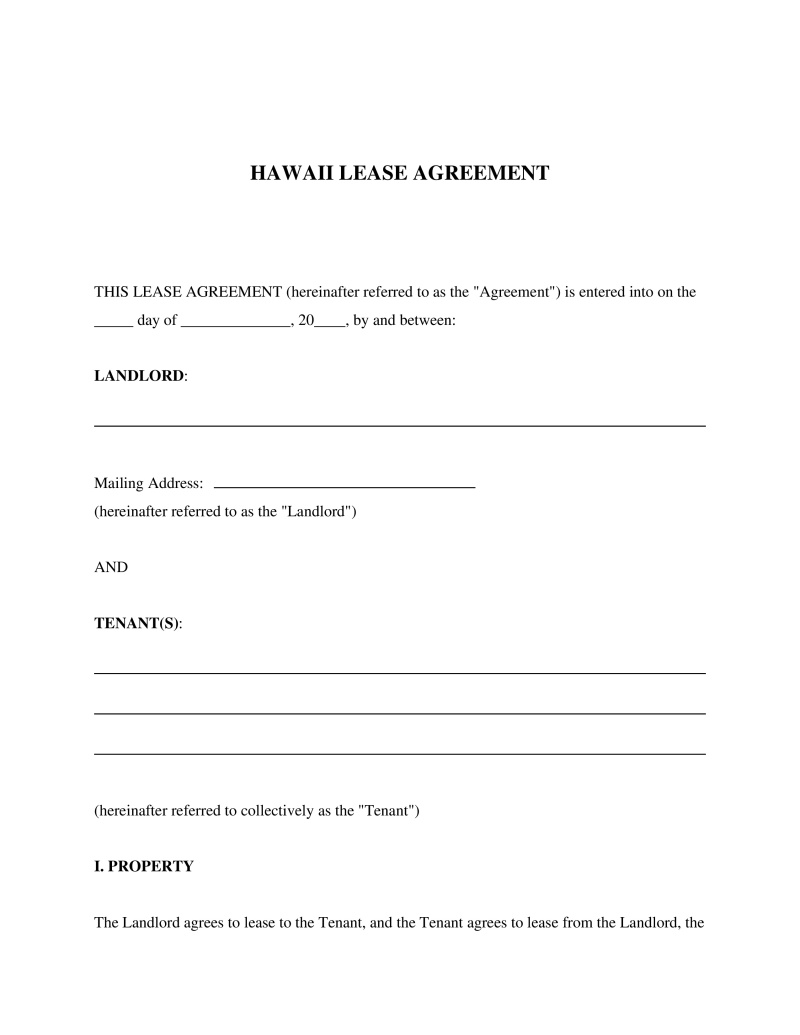
Hawaii Lease Agreement
A Hawaii Lease Agreement is a legally binding contract outlining the terms and conditions of a rental arrangement between a landlord and a tenant for real property situated within Hawaii.
Residential Property Type
Select the residential property category that best describes the rental premises.
Use this if the rental property does not fit one of the listed categories.
Table of Contents
What is a Hawaii Lease Agreement?
A Hawaii Lease Agreement is a legally binding contract between a landlord and a tenant that outlines the terms and conditions for renting a residential property in the state of Hawaii. This document establishes the rights and responsibilities of both parties, ensuring clarity regarding rent payments, property maintenance, and the duration of the tenancy. It serves as a foundational agreement for residential rental relationships, protecting both landlords and tenants by formalizing their understanding.
Governing Law and Scope
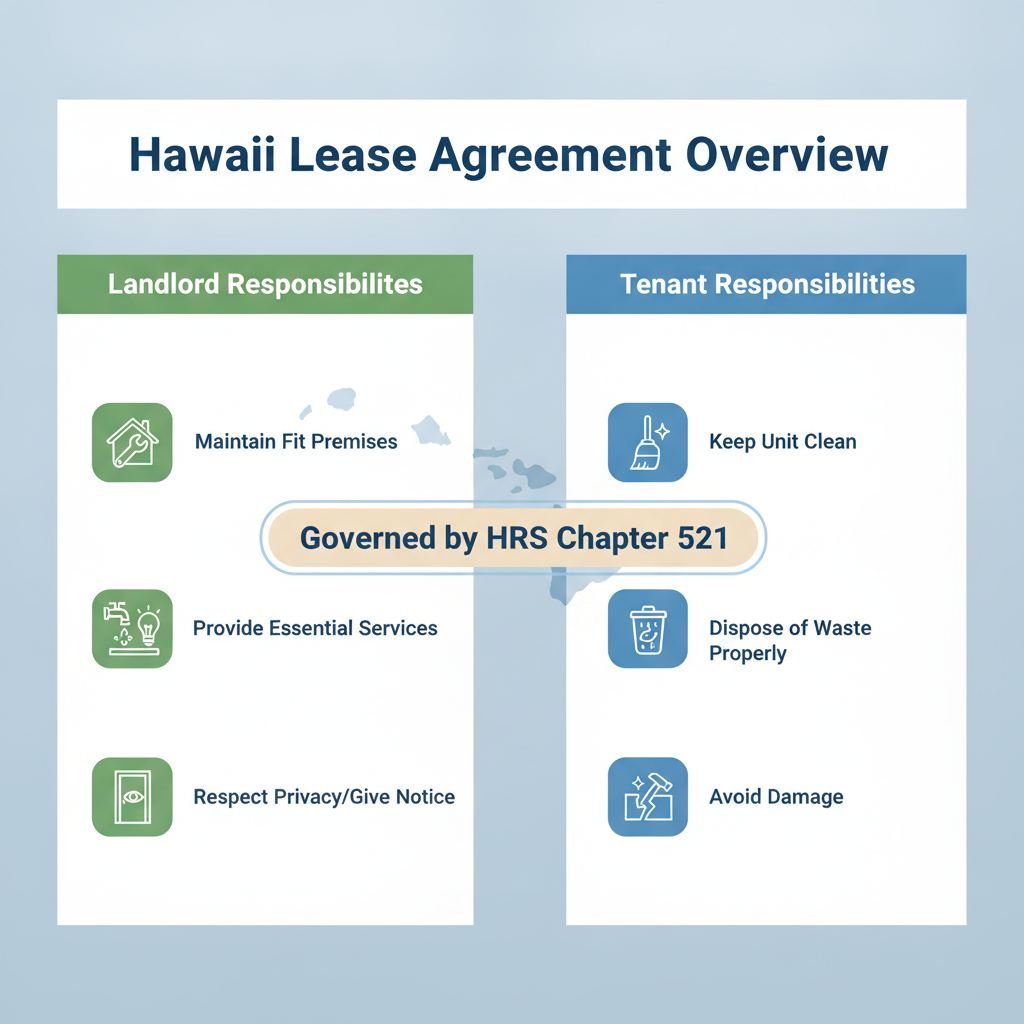
Residential lease agreements in Hawaii are primarily governed by the Hawaii Residential Landlord-Tenant Code, codified in Hawaii Revised Statutes (HRS) Chapter 521. This comprehensive statute sets forth the framework for landlord-tenant relationships, addressing various aspects from the formation of rental agreements to their termination. The Code aims to clarify obligations and provide remedies for disputes that may arise during a tenancy.
The Hawaii Residential Landlord-Tenant Code covers several key areas:
- Rental Agreements - Defines the terms and conditions under which a dwelling unit is rented, including the form and content of agreements (HRS § 521-11).
- Rent Payment - Specifies rules regarding the amount, payment, and collection of rent (HRS § 521-21 to 521-24).
- Landlord Obligations - Details the duties landlords must fulfill, such as maintaining fit premises and providing essential services (HRS § 521-31 to 521-38).
- Tenant Obligations - Outlines the responsibilities of tenants, including maintaining the dwelling unit and proper use of the property (HRS § 521-51 to 521-57).
- Remedies and Penalties - Provides legal recourse for both landlords and tenants in case of non-compliance with the agreement or the Code, including provisions for termination of tenancy and eviction (HRS § 521-61 to 521-77).
Key Provisions of a Hawaii Lease Agreement
A typical Hawaii Lease Agreement incorporates essential details to ensure a clear understanding between the landlord and tenant. While specific clauses may vary, certain elements are consistently included to comply with state law and define the rental arrangement.
Common provisions typically found in these agreements include:
- Identification of Parties - The full legal names and contact information of both the landlord (or their authorized agent) and all tenants.
- Property Description - A clear and precise description of the rental property, including the street address, unit number, and any specific areas included in the tenancy.
- Term of Tenancy - The start and end dates of the lease, indicating whether it is a fixed-term lease (e.g., one year) or a month-to-month agreement.
- Rent Amount and Payment Terms - The agreed-upon monthly rent, due date, acceptable payment methods, and any grace periods or late fees.
- Security Deposit Details - The amount of the security deposit, conditions for its return, and any permitted deductions in accordance with Hawaii law.
- Utilities and Services - A clear outline of which utilities (e.g., electricity, water, gas, internet) are the responsibility of the landlord and which are the tenant's.
- Maintenance and Repairs - Specifies the responsibilities of both parties regarding the upkeep of the property and procedures for reporting and addressing repairs.
- Occupancy Limits - States the maximum number of occupants permitted to reside in the dwelling unit.
- Rules and Regulations - Any specific rules pertaining to the property, such as pet policies, smoking restrictions, or use of common areas.
Landlord Obligations
Under Hawaii law, landlords have specific duties to ensure the safety and habitability of the rental premises. These obligations are crucial for maintaining a healthy and lawful landlord-tenant relationship and are detailed within the Residential Landlord-Tenant Code.
Key landlord obligations include:
- Supply Possession - The landlord must provide the tenant with possession of the dwelling unit at the commencement of the term (HRS § 521-31).
- Maintain Fit Premises - The landlord is required to keep the premises in a safe and sanitary condition, making all repairs and doing whatever is necessary to put and keep the premises in a fit and habitable condition (HRS § 521-33).
- Compliance with Building Codes - Landlords must comply with all applicable provisions of building and housing codes materially affecting health and safety (HRS § 521-33).
- Provide Essential Services - The landlord must maintain in good working order all electrical, plumbing, sanitary, heating, ventilating, air-conditioning, and other facilities and appliances supplied by them (HRS § 521-33). They must also provide and maintain appropriate receptacles and conveniences for the removal of ashes, garbage, rubbish, and other waste, and arrange for their removal (HRS § 521-33).
- Reasonable Access - Landlords must provide reasonable notice, generally at least two days, before entering the dwelling unit, except in cases of emergency (HRS § 521-53).
Tenant Obligations
Tenants in Hawaii also have distinct responsibilities regarding the care and use of their rented dwelling unit, as outlined in the Residential Landlord-Tenant Code. Adhering to these duties helps preserve the property and ensures a harmonious living environment.
Essential tenant obligations include:
- Maintain Unit Cleanliness - Tenants must keep that part of the premises that they occupy and use as clean and safe as the condition of the premises permits (HRS § 521-51).
- Dispose of Waste Properly - Tenants are required to dispose of all ashes, garbage, rubbish, and other waste in a clean and safe manner (HRS § 521-51).
- Proper Use of Facilities - Tenants must keep all plumbing fixtures in the dwelling unit or used by the tenant as clean as their condition permits (HRS § 521-51). They must also use all electrical, plumbing, sanitary, heating, ventilating, air-conditioning, and other facilities and appliances in a reasonable manner (HRS § 521-51).
- Avoid Damage - Tenants shall not deliberately or negligently destroy, deface, damage, impair, or remove any part of the premises or knowingly permit any person to do so (HRS § 521-51).
- Comply with Rules - Tenants must conduct themselves and require other persons on the premises with their consent to conduct themselves in a manner that will not disturb their neighbors' peaceful enjoyment of the premises (HRS § 521-51).
Limitations on Rental Agreements and Practices
Hawaii law imposes specific limitations on what can be included in a residential lease agreement and certain practices are prohibited to protect tenants from unfair provisions. These restrictions ensure that rental agreements align with the protective intent of the Residential Landlord-Tenant Code (HRS Chapter 521, Part III).
Prohibited clauses and practices include:
- Waiver of Rights - A rental agreement cannot contain a provision by which the tenant agrees to waive or forego rights or remedies under the Code (HRS § 521-32).
- Confession of Judgment - Provisions for a confession of judgment by the tenant are unenforceable (HRS § 521-32).
- Waiver of Liability - Agreements cannot limit the liability of the landlord for acts of negligence or willful misconduct or to indemnify the landlord for that liability (HRS § 521-32).
- Attorney's Fees - While a lease may provide for attorney's fees, such clauses must be mutual, meaning the prevailing party, whether landlord or tenant, can recover reasonable attorney's fees (HRS § 521-32).
- Unconscionable Agreements - If a court finds any provision of a rental agreement to have been unconscionable at the time it was made, the court may refuse to enforce the agreement, enforce the remainder without the unconscionable provision, or limit its application to avoid an unconscionable result (HRS § 521-17).
Security Deposit Regulations
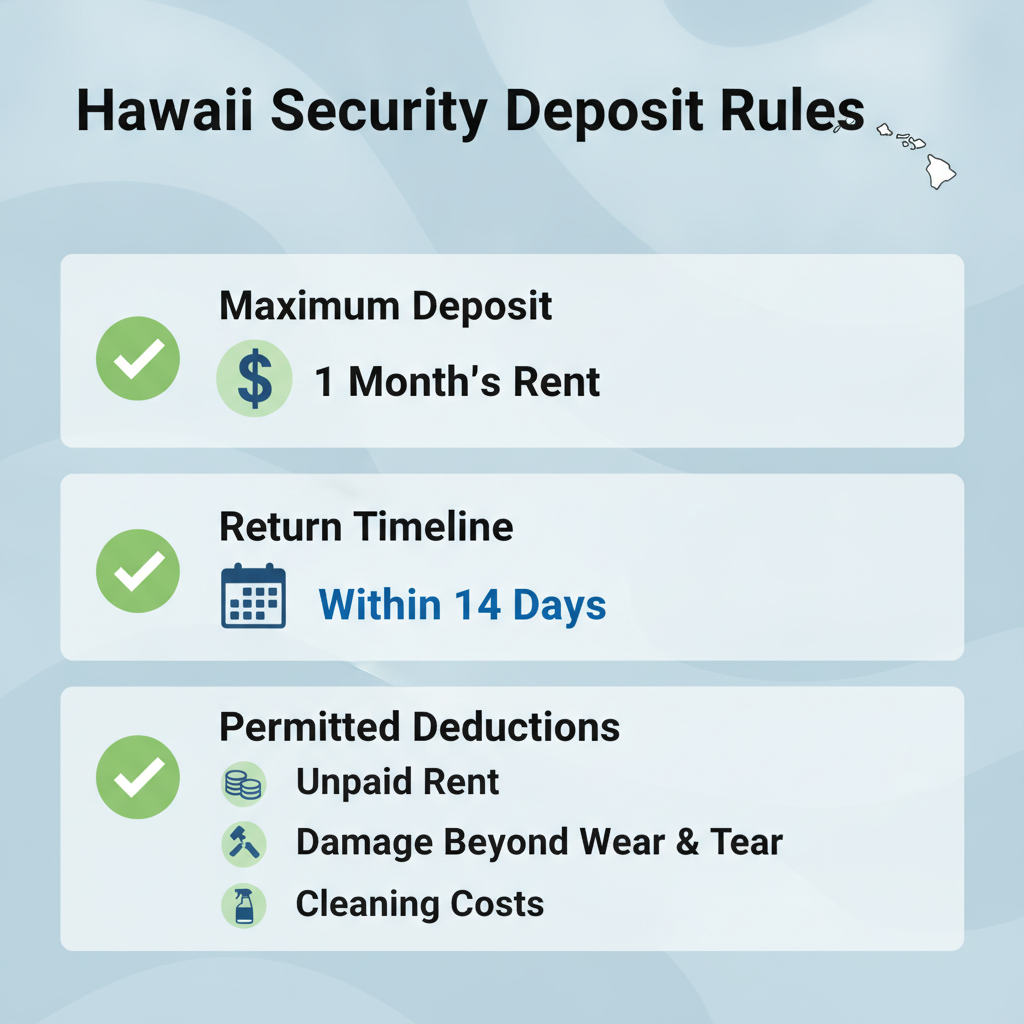
Hawaii law strictly regulates security deposits to safeguard tenant funds and define the conditions under which landlords may retain portions of the deposit. These regulations are designed to prevent abuses and ensure transparency in the handling of tenant funds.
Key regulations regarding security deposits include:
- Maximum Amount - A landlord may not demand or receive as security for the rental agreement an amount or value in excess of one month's rent (HRS § 521-44).
- Return Timeline - The landlord must return the security deposit, or any remaining portion, to the tenant within 14 days after the termination of the rental agreement (HRS § 521-44).
- Itemized Statement - If the landlord retains any portion of the security deposit, they must provide the tenant with a written notice containing an itemized statement of the deductions and the reasons for them (HRS § 521-44).
- Permitted Deductions - Deductions are generally limited to unpaid rent, damages caused by the tenant beyond normal wear and tear, and costs for cleaning (HRS § 521-44).
- Failure to Comply - If the landlord fails to return the deposit or provide an itemized statement within the 14-day period, the landlord may be liable for damages equal to three times the amount of the security deposit (HRS § 521-44).
Frequently Asked Questions
Sources
- HRS Chapter 521 – Residential Landlord-Tenant Code - Contains comprehensive laws governing residential landlord-tenant relationships in Hawaii, including lease agreements.
- Part III. Limitations on Rental Agreements and Practices - Details specific limitations and prohibited practices in rental agreements under Hawaii law.
- Part IV. Landlord Obligations - Outlines the obligations of landlords in Hawaii, including maintenance and disclosure requirements.
- Part V. Tenant Obligations - Specifies the responsibilities of tenants in Hawaii, including maintenance and proper use of the rental property.
- Residential Landlord-Tenant Information Center - Provides resources and information on Hawaii's Residential Landlord-Tenant Code, including a handbook and contact information for assistance.
Already have a Lease Agreement?
Get it reviewed free — checked against your state's laws in about a minute.
Not the form you're looking for?
Try our legal document generator to create a custom document
Disclaimer: The templates available on this website are provided for general informational purposes only and do not constitute legal advice. They are not intended to be, and should not be interpreted as, compliant with any specific legal, regulatory, or privacy requirements. These templates are not a replacement for professional legal guidance and should not be relied upon for any particular matter or circumstance. Users are strongly encouraged to seek advice from a qualified attorney licensed in their jurisdiction before using, modifying, or relying on any template.
All templates are provided on an "as is," "with all faults," and "as available" basis. The provider disclaims any and all warranties of any kind, whether express, implied, statutory, or otherwise, including without limitation warranties of merchantability, fitness for a particular purpose, title, or non-infringement.
LegalTemplates.com makes no guarantees or representations regarding the accuracy, completeness, expected outcomes, or reliability of the materials contained in these templates or any materials referenced or linked from them.