Arkansas Lease Agreement
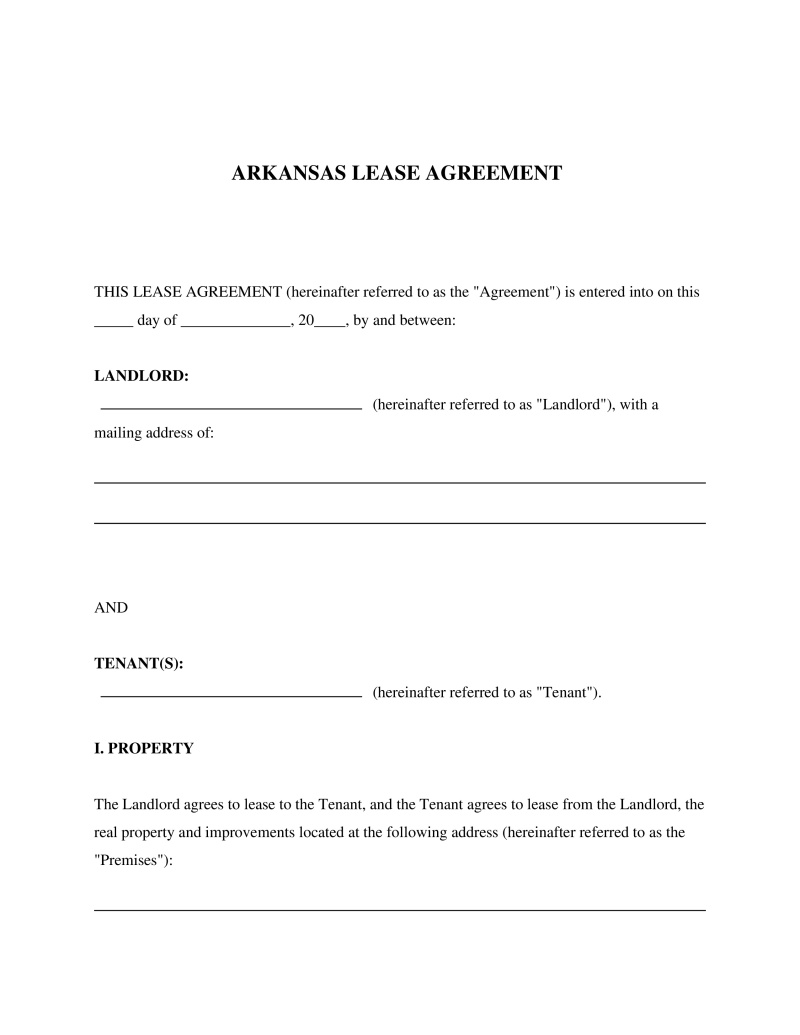
An Arkansas Lease Agreement is a legal document that outlines the terms and conditions between a landlord and tenant for the rental of property in Arkansas.
Residential Property Type
Select the residential property category that best describes the rental premises.
Use this if the rental property does not fit one of the listed categories.
Table of Contents
What is an Arkansas Lease Agreement?
An Arkansas lease agreement is a legally binding contract entered into by a landlord and a tenant to outline the terms and conditions for renting a property. This document serves as the foundation of the rental relationship, establishing critical details such as the monthly payment amount, the duration of the tenancy, and the specific responsibilities of each party regarding maintenance and utilities. By signing this agreement, both parties consent to be governed by the stipulations within the document as well as the broader regulatory framework provided by the Arkansas Residential Landlord-Tenant Act of 2007 and other relevant state statutes.
Legal Framework and Statutory Requirements
The landlord-tenant relationship in Arkansas is primarily governed by Title 18, Subtitle 2 of the Arkansas Code. Specifically, the Arkansas Residential Landlord-Tenant Act of 2007 (A.C.A. §§ 18-17-101 et seq.) provides the statutory basis for many rental contracts. Unlike many other jurisdictions, Arkansas law has historically favored a doctrine known as "caveat lessee" (let the tenant beware), meaning tenants accepted the property as-is. However, recent legislative changes, specifically Act 1052 of 2021, established minimum habitability standards, requiring landlords to provide and maintain basic essentials such as a functioning roof, walls, locks, and plumbing.
Federal laws also play a significant role in the validity of a lease. For properties built prior to 1978, landlords must comply with the Residential Lead-Based Paint Hazard Reduction Act of 1992 by providing a disclosure form and an information pamphlet to the tenant. Failure to adhere to these federal and state mandates can render certain provisions of the contract unenforceable or subject the landlord to legal penalties.
Security Deposit Regulations
Arkansas has specific statutes regarding the collection and return of security funds. According to A.C.A. § 18-16-304, a landlord may not demand a security deposit that exceeds the equivalent of two months' rent. This limitation applies to all residential leases unless the landlord owns fewer than five rental units and does not utilize a third-party management company.
Upon the termination of the lease, the landlord is required to return the security deposit, less any deductions for unpaid rent or damages beyond normal wear and tear, within 60 days. This 60-day window is notably longer than the 30-day requirement found in many other states. If deductions are made, the landlord must provide an itemized written list of the damages and the cost of repairs. Failure to return the deposit or provide the itemized list within the statutory timeframe can result in the landlord being liable for up to double the amount of the deposit.
Required Elements of a Valid Arkansas Lease Agreement
For a rental contract to be legally robust and effective in Arkansas, it should contain specific components that clearly define the arrangement. Omitting these details can lead to ambiguity and potential litigation.
- Identification of Parties: The full legal names of the landlord and all adult tenants who will occupy the premises.
- Property Description: The complete physical address of the rental unit, including unit numbers where applicable.
- Lease Term: The start and end dates of the agreement, or a statement indicating a month-to-month arrangement.
- Rent Specifics: The exact amount of rent, the due date, acceptable payment methods, and instructions for where payment should be sent.
- Security Deposit Terms: The amount collected and the conditions under which it may be withheld.
- Signatures: Dated signatures from the landlord and all tenants named in the agreement.
Mandatory Disclosures
Beyond the standard terms of rent and duration, specific disclosures must be included to ensure compliance with state and federal health safety regulations. These disclosures inform the tenant of potential risks associated with the property.
Lead-Based Paint Disclosure: As mandated by federal law (42 U.S. Code § 4852d), any housing constructed before 1978 must include a warning statement about the presence of lead-based paint. The landlord must also provide records of any known lead hazards.
Methamphetamine Contamination: Arkansas law generally requires landlords to disclose if a property has been contaminated by methamphetamine production if the issue has not been remediated according to state standards. While there is no specific statutory form for this, leasing a property known to be contaminated without disclosure can lead to liability.
Right of Entry and Access
One area where Arkansas law differs from many other states is the regulation of landlord entry. The state statutes do not explicitly mandate a specific notice period (such as 24 or 48 hours) before a landlord enters the premises for non-emergency reasons, such as inspections or repairs. Consequently, the lease agreement itself becomes the primary authority on this matter. It is standard practice and highly recommended for the document to specify that the landlord will provide reasonable notice—typically 24 hours—before entering the tenant's dwelling, except in cases of emergency.
Frequently Asked Questions
Arkansas Lease Agreement Sample
Lease Agreement in other states
Already have a Lease Agreement?
Get it reviewed free — checked against your state's laws in about a minute.
Not the form you're looking for?
Try our legal document generator to create a custom document
Disclaimer: The templates available on this website are provided for general informational purposes only and do not constitute legal advice. They are not intended to be, and should not be interpreted as, compliant with any specific legal, regulatory, or privacy requirements. These templates are not a replacement for professional legal guidance and should not be relied upon for any particular matter or circumstance. Users are strongly encouraged to seek advice from a qualified attorney licensed in their jurisdiction before using, modifying, or relying on any template.
All templates are provided on an "as is," "with all faults," and "as available" basis. The provider disclaims any and all warranties of any kind, whether express, implied, statutory, or otherwise, including without limitation warranties of merchantability, fitness for a particular purpose, title, or non-infringement.
LegalTemplates.com makes no guarantees or representations regarding the accuracy, completeness, expected outcomes, or reliability of the materials contained in these templates or any materials referenced or linked from them.