Affidavit of Heirship
An affidavit of heirship is a legal document declaring heirs of a deceased person, used to establish inheritance rights and property transfers.
Affiant 1 Full Name
The Affiant is the person making this sworn statement about the Decedent's heirs.
Provide the complete mailing address of the Affiant.
State how the Affiant knew the Decedent.
Estimate the total number of years.
You may add another person making this sworn statement.
Provide the full legal name of the second Affiant.
Complete mailing address of the second Affiant.
State how the second Affiant knew the Decedent.
Estimate the total number of years.
You may add a third person making this sworn statement.
Provide the full legal name of the third Affiant.
Complete mailing address of the third Affiant.
State how the third Affiant knew the Decedent.
Estimate the total number of years.
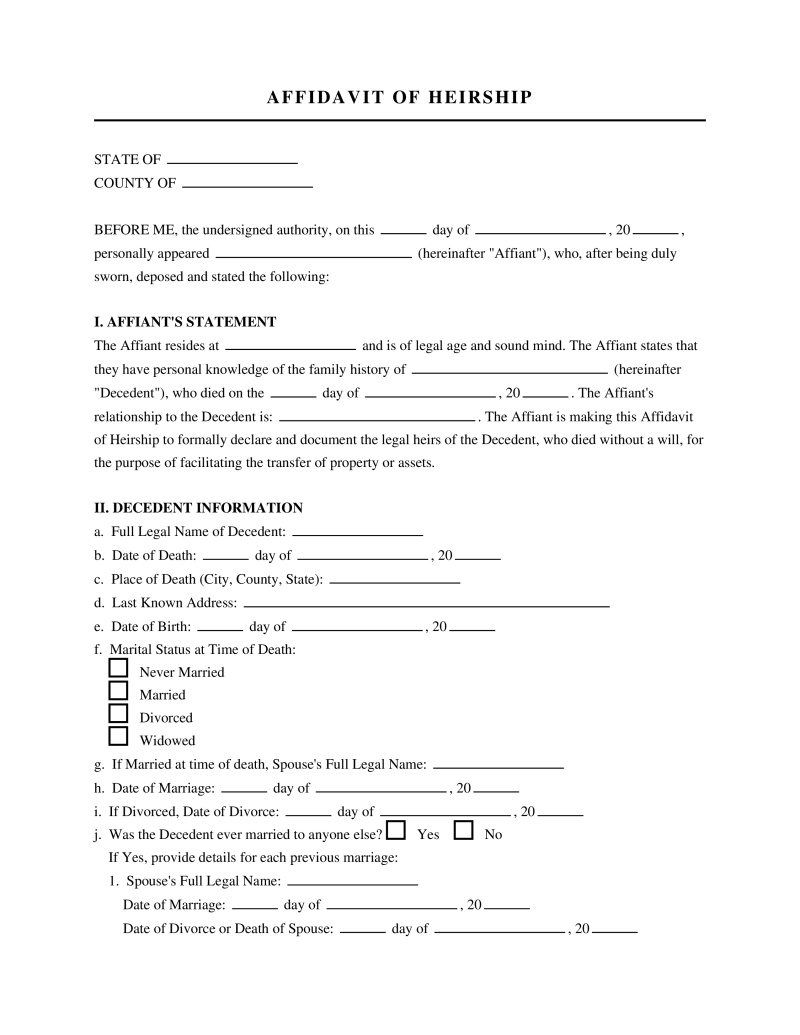
Table of Contents
What is a Affidavit of Heirship?
An Affidavit of Heirship is a sworn legal document used to identify the legal heirs of a deceased individual who died without a will (intestate). This document serves as evidence of heirship, particularly for transferring title to real property or other assets when formal probate proceedings are not required or desired due to the estate's size or nature. It is typically utilized in states where it is recognized as an alternative to formal probate for establishing ownership of property. The Affidavit of Heirship is executed by disinterested parties who are familiar with the deceased's family history and attest to the identity of the rightful heirs. Its primary purpose is to create a public record of who the heirs are, allowing for the transfer of property without the need for a court-supervised probate process.
Legal Requirements
The validity and legal effect of an Affidavit of Heirship are highly dependent on state law and specific statutory requirements. While it can be a cost-effective alternative to probate, its acceptance by third parties, such as title companies or financial institutions, is not universally guaranteed without adherence to strict guidelines. Key elements for an Affidavit of Heirship to be considered valid often include:
- Identification of the Deceased - Full legal name, date of death, and last known address of the decedent.
- Marital History - Complete details of the decedent's marital history, including names of all spouses, dates of marriage and divorce/death, and whether they had children with each spouse.
- Family Tree - A comprehensive list of all heirs, including children, parents, siblings, and any other potential heirs, along with their dates of birth and current addresses. It must explicitly state if there are no other heirs.
- Disinterested Witnesses - Typically, two or more individuals who are not beneficiaries of the estate but are familiar with the decedent's family history and can attest to the accuracy of the information provided. These witnesses must sign the affidavit under oath.
- Notarization - The affidavit must be signed by the affiant(s) and witnesses in the presence of a notary public, who then affixes their seal.
- Recording - In many jurisdictions, particularly when real property is involved, the Affidavit of Heirship must be filed in the public records of the county where the property is located to provide constructive notice of the transfer of title.
- Statement of No Probate - An affirmation that no probate proceeding has been initiated or is necessary for the decedent's estate.
How to Complete an Affidavit of Heirship
Preparing an Affidavit of Heirship requires careful attention to detail and accurate information about the deceased's family. The process typically involves several key steps to ensure its completeness and legal standing:
- Gather Essential Information - Begin by collecting all necessary personal details of the deceased, including their full legal name, date and place of birth, date and place of death, and last known address. Compile information about their marital history, including all spouses, dates of marriage and divorce, and whether they had children with each spouse. This step also involves identifying all potential heirs, such as children, parents, and siblings, along with their full names, dates of birth, and current addresses.
- Identify Disinterested Witnesses - Locate at least two individuals who are not heirs to the estate but were well-acquainted with the deceased and their family history. These witnesses should be able to truthfully swear under oath to the accuracy of the family information provided in the affidavit. They must be willing to sign the document and potentially provide their contact information.
- Draft the Affidavit Document - Either obtain a state-specific Affidavit of Heirship form or draft a document that includes all statutory requirements. The affidavit must clearly state that the affiant(s) are swearing under penalty of perjury, fully identify the deceased, detail their marital and family history, list all known heirs, and affirm that no probate administration is pending or needed. Ensure all property subject to the affidavit is clearly described, especially real estate.
- Execute and Notarize the Document - The affiant(s) and the disinterested witnesses must sign the Affidavit of Heirship in the presence of a notary public. The notary will verify their identities, administer the oath, and affix their official seal and signature. This notarization is crucial for the document's legal validity.
- Record the Affidavit - If the Affidavit of Heirship pertains to real property, it is generally required to be filed with the County Clerk or Recorder's Office in the county where the property is situated. This recording provides public notice of the heirship and establishes a clear chain of title for the property. A certified copy of the death certificate is often recorded alongside the affidavit.
Rights and Obligations of Parties Involved
Various parties have specific rights and obligations when an Affidavit of Heirship is utilized to transfer property or establish heirship. Understanding these roles is essential for the proper functioning and acceptance of the document.
- The Affiant(s) - The individual(s) who sign the Affidavit of Heirship. Their primary obligation is to truthfully and accurately attest to the deceased's family history and identity of heirs, under penalty of perjury. They must have sufficient personal knowledge to make these declarations. Their right is to initiate this process as a non-probate alternative.
- The Heirs - The individuals identified in the affidavit as the legal beneficiaries of the deceased's estate. Their right is to claim the property identified in the affidavit based on the established heirship. They have an obligation to ensure the information in the affidavit is correct, as any misrepresentation could affect their claim.
- Disinterested Witnesses - These individuals have the obligation to confirm, under oath, the accuracy of the family information presented in the affidavit. They must genuinely be familiar with the deceased's family and have no financial interest in the estate. Their testimony lends credibility to the document.
- Notary Public - The notary's obligation is to verify the identities of the affiant(s) and witnesses, administer the oath, and properly attest to the signatures. They ensure the document is formally executed according to legal requirements.
- Title Companies and Financial Institutions - While not parties to the creation of the affidavit, these entities often rely on it for property transfers or asset distribution. They have the right to scrutinize the document and may require additional assurances or a judicial determination if they deem the affidavit insufficient or unreliable for their purposes. Their obligation is to assess the risk associated with relying on the affidavit.
- County Clerk/Recorder's Office - This office has the obligation to properly record the Affidavit of Heirship in the public records, making it a matter of public record. They do not verify the truthfulness of the content, only the proper submission and format for recording.
Common Uses and Limitations
An Affidavit of Heirship serves as a practical tool for streamlining estate matters in specific circumstances, but it also carries inherent limitations that dictate its applicability and acceptance.
Common Uses
The Affidavit of Heirship is most commonly employed in situations where:
- Transfer of Real Property - It is frequently used to transfer title of real estate from a deceased owner to their heirs without formal probate, particularly when the property is the only significant asset.
- Small Estates - In many states, it is an option for estates that fall below a certain monetary threshold, allowing for a simplified transfer of assets.
- No Will Exists - The document is exclusively used for intestate estates, meaning the deceased did not leave a valid will.
- Avoid Probate Costs and Delays - It provides a faster and less expensive alternative to formal probate proceedings, which can be lengthy and costly.
- Clear Title Issues - It can help clarify the chain of title for real property when there are no disputes among heirs.
Limitations
Despite its utility, an Affidavit of Heirship has several significant limitations:
- Not Universally Accepted - Not all states recognize Affidavits of Heirship as a standalone method for transferring property, and some institutions (banks, transfer agents) may still require formal probate.
- Reliance Risk - Third parties, such as title companies, may not accept an Affidavit of Heirship without further indemnification or a judicial determination of heirship, due to the risk of unknown heirs or inaccurate information.
- No Debt Resolution - An Affidavit of Heirship does not typically provide a mechanism for settling the deceased's debts, which remains a liability for the estate or heirs.
- Disputed Heirship - If there is any dispute among potential heirs regarding who should inherit, an Affidavit of Heirship is ineffective and formal probate will almost certainly be required.
- Complex Estates - Estates with numerous assets, significant debts, or complex family structures are generally not suitable for resolution via an Affidavit of Heirship.
Applicable Laws and Penalties
The legal framework surrounding Affidavits of Heirship is primarily state-driven, with various statutes governing their creation, validity, and effect. Federal laws typically have less direct application but can influence broader estate administration.
Federal Statutes
While no specific federal statute directly governs the Affidavit of Heirship document itself, related federal laws may indirectly impact its context:
- Internal Revenue Code - Governs federal estate and gift taxes, which may be applicable depending on the size of the deceased's estate, regardless of the method of property transfer (26 U.S.C. § 2001 et seq.).
- Privacy of Protected Health Information (HIPAA) - Regulates the disclosure of protected health information, which might be relevant if medical records are needed to establish facts related to the deceased, though less directly for heirship itself (45 CFR Parts 160 and 164).
- Social Security Act - Provides for survivor benefits, and while an Affidavit of Heirship isn't a direct application, the identity of heirs is crucial for determining benefit eligibility (42 U.S.C. § 401 et seq.).
State Laws and Requirements
State laws are paramount in defining the requirements and legal efficacy of an Affidavit of Heirship. These laws vary significantly by jurisdiction:
- Probate Codes - Many states incorporate provisions for Affidavits of Heirship within their probate codes, outlining specific forms, content requirements, and conditions for their use as an alternative to formal probate (e.g., Texas Estates Code Chapter 203, California Probate Code § 13100 et seq. for small estate affidavits, though California's approach differs from a pure Affidavit of Heirship).
- Real Property Statutes - State real property laws often dictate how ownership is established and transferred, including the recording requirements for documents like Affidavits of Heirship to affect title to real estate.
- Small Estate Affidavits - While distinct, many states have statutes permitting small estate affidavits for transferring personal property, which share similarities with the Affidavit of Heirship's goal of avoiding full probate (e.g., Florida Statutes § 735.301 for Disposition of Personal Property Without Administration).
- Requirements for Disinterested Witnesses - State laws often specify the number and qualifications of disinterested witnesses required to sign the affidavit.
- Recording Requirements - Specific statutes detail where and how an Affidavit of Heirship must be recorded to be effective, especially for real property.
Penalties for Non-Compliance
Misrepresenting information or failing to adhere to legal requirements when executing an Affidavit of Heirship can lead to severe consequences:
- Perjury Charges - Since the affidavit is a sworn statement, providing false information can result in criminal charges for perjury, which can carry significant fines and imprisonment.
- Fraud - Intentionally making false statements to gain property or advantage can lead to civil or criminal charges of fraud.
- Voiding of the Affidavit - If the affidavit is found to contain material misrepresentations or fails to meet statutory requirements, it can be declared invalid, necessitating formal probate or other legal action to correct the property transfer.
- Liability to True Heirs - Individuals who improperly receive property based on a fraudulent or incorrect affidavit may be held liable to the true legal heirs for the value of the property, potentially including damages.
- Title Defects - An improperly prepared or fraudulent affidavit can create a cloud on the title of real property, making it difficult or impossible to sell or mortgage until the title defect is resolved, often through costly legal proceedings.
Frequently Asked Questions
Affidavit of Heiship Sample
Not the form you're looking for?
Try our legal document generator to create a custom document
Ask about an Affidavit of Heirship
Example questions:
Disclaimer: The templates available on this website are provided for general informational purposes only and do not constitute legal advice. They are not intended to be, and should not be interpreted as, compliant with any specific legal, regulatory, or privacy requirements. These templates are not a replacement for professional legal guidance and should not be relied upon for any particular matter or circumstance. Users are strongly encouraged to seek advice from a qualified attorney licensed in their jurisdiction before using, modifying, or relying on any template.
All templates are provided on an "as is," "with all faults," and "as available" basis. The provider disclaims any and all warranties of any kind, whether express, implied, statutory, or otherwise, including without limitation warranties of merchantability, fitness for a particular purpose, title, or non-infringement.
LegalTemplates.com makes no guarantees or representations regarding the accuracy, completeness, expected outcomes, or reliability of the materials contained in these templates or any materials referenced or linked from them.