Multi Member LLC Operating Agreement
A Multi Member LLC Operating Agreement is a legal document outlining the management structure and operational procedures of a multi-member LLC.
Llc Status
This helps tailor provisions for a newly formed LLC, an existing LLC adopting its first agreement, or an LLC replacing or amending a prior operating agreement.
Table of Contents
What is a Multi Member LLC Operating Agreement?
A Multi Member LLC Operating Agreement is a foundational legal document that outlines the ownership, management, and operational procedures for a Limited Liability Company (LLC) with two or more members. It functions as a binding contract between the members, establishing their rights, responsibilities, and how the business will be governed. This agreement is crucial for defining the internal structure of the LLC, preventing future disputes, and ensuring the business operates smoothly according to the members' shared understanding.
Legal Requirements and Validity
While many states do not legally mandate the filing of an operating agreement for an LLC, its absence can lead to significant complications. The operating agreement is primarily an internal document, not typically filed with the state's Secretary of State. Its legal validity stems from contract law principles, making it enforceable among the members who sign it.
Key aspects regarding its legal standing include:
- Contractual Basis - The operating agreement is a contract among the members, legally binding them to its terms and conditions.
- Internal Governance - It dictates how the LLC will be managed and operated, overriding default provisions of state LLC statutes where permitted.
- Enforceability - A well-drafted agreement provides a clear framework for resolving internal disputes, making it easier to enforce member rights and obligations in court.
- Oral Agreements - While some states may recognize oral operating agreements, they are notoriously difficult to prove and enforce, making a written agreement essential for legal certainty.
Rights and Obligations of Members
The Multi Member LLC Operating Agreement is instrumental in defining the specific rights and obligations of each member, which can vary significantly from default state rules. Clearly delineating these roles helps prevent misunderstandings and establishes a clear hierarchy and decision-making process within the LLC.
Common rights and obligations typically addressed include:
- Capital Contributions - Specifies the initial and potential future financial or in-kind contributions each member must make to the LLC.
- Profit and Loss Allocations - Details how the LLC's profits and losses will be distributed among members, which may not always be proportional to ownership percentages.
- Voting Rights - Establishes the voting power of each member, whether it's based on ownership percentage, a per capita basis, or another agreed-upon method, and outlines the types of decisions requiring member votes.
- Management Authority - Defines whether the LLC is member-managed (all members participate in daily operations) or manager-managed (a designated manager or group of managers handles daily operations).
- Fiduciary Duties - Outlines the duties of loyalty and care owed by members (especially managing members) to the LLC and to each other, often specifying the scope and limitations of these duties.
- Access to Records - Guarantees members' rights to inspect the LLC's books and records, ensuring transparency and accountability.
- Transfer of Membership Interests - Sets conditions and procedures for members to sell, transfer, or assign their ownership interests to third parties or other members, often including buy-sell provisions.
- Withdrawal or Expulsion - Describes the process and financial implications if a member wishes to withdraw or is expelled from the LLC.
How to Draft a Multi Member LLC Operating Agreement
Drafting a comprehensive Multi Member LLC Operating Agreement requires careful consideration of various operational and legal aspects to ensure it accurately reflects the members' intentions and complies with applicable laws. This process often benefits from legal counsel to address specific business needs and mitigate potential risks.
- Define Membership and Capital Contributions - Clearly identify all initial members, their respective ownership percentages, and the initial capital contribution (cash, property, services) each member is making. Detail any provisions for future capital calls or additional contributions and the consequences of failing to meet them.
- Establish Management Structure - Determine whether the LLC will be member-managed, where all members participate in day-to-day decisions, or manager-managed, where one or more designated managers (who may or may not be members) handle daily operations. Clearly outline the powers and responsibilities of the managing members or managers.
- Outline Voting Rights and Decision-Making - Specify how decisions will be made, including voting thresholds for different types of matters (e.g., simple majority for routine decisions, supermajority for major decisions like selling assets or admitting new members). Define whether votes are proportional to ownership interests or on a per-member basis.
- Detail Profit and Loss Distributions - Articulate the method for allocating profits and losses among members, which can differ from ownership percentages. Include provisions for distributions, such as when and how often they will occur, and whether they are mandatory or discretionary, often distinguishing between tax distributions and discretionary distributions.
- Plan for Member Withdrawal or Dissolution - Include clear provisions for what happens if a member withdraws, becomes disabled, dies, or is expelled. This should cover valuation of their interest, buy-out procedures, and payment terms. Additionally, outline the conditions under which the LLC may be dissolved and the process for winding up its affairs.
- Include Indemnification and Dispute Resolution - Incorporate clauses that protect members and managers from liability for actions taken on behalf of the LLC, provided they acted in good faith. Establish a clear process for resolving disputes among members, such as mediation or arbitration, before resorting to litigation.
Required Elements of a Valid Multi Member LLC Operating Agreement
While the specific content of a Multi Member LLC Operating Agreement can vary based on the business's unique needs, several key elements are generally considered essential for a comprehensive and effective document:
- Identification of Members - Full legal names and addresses of all initial members.
- Company Information - The legal name of the LLC, its principal place of business, and its registered agent.
- Capital Contributions - A detailed breakdown of each member's initial and potential future capital contributions.
- Allocation of Profits and Losses - The method for distributing profits, losses, and cash flow among members.
- Management Structure - Clear designation of whether the LLC is member-managed or manager-managed, including the roles and responsibilities.
- Voting Rights and Procedures - Rules for member meetings, voting thresholds, and decision-making processes.
- Transfer of Membership Interests - Provisions governing the sale, transfer, or assignment of membership interests, including any rights of first refusal.
- Buy-Sell Provisions - Agreements regarding the purchase of a member's interest upon specific events (e.g., death, disability, withdrawal).
- Dissolution Procedures - The conditions and process for dissolving the LLC and distributing its assets.
- Amendments - The procedure for amending the operating agreement itself.
- Indemnification Clauses - Provisions protecting members and managers from liability under certain circumstances.
- Dispute Resolution - Mechanisms for resolving conflicts among members, such as mediation or arbitration.
Applicable Laws and Penalties
The legal framework governing Multi Member LLC Operating Agreements primarily resides at the state level, though general contract law principles apply across jurisdictions. Understanding these laws is critical for ensuring the agreement's enforceability and avoiding potential legal issues.
State Laws and Requirements
Each state has its own specific statutes governing the formation and operation of Limited Liability Companies. These statutes, often known as the Revised Uniform Limited Liability Company Act (RULLCA) or similar state-specific LLC acts, provide default rules that apply in the absence of an operating agreement or where the agreement is silent on a particular matter.
- State LLC Statutes - These acts dictate fundamental aspects of LLC governance, such as member liability, management structures, and dissolution procedures (e.g., Delaware Limited Liability Company Act, Del. Code Ann. tit. 6, § 18-101 et seq.; California Revised Uniform Limited Liability Company Act, Cal. Corp. Code § 17701.01 et seq.).
- Contract Law Principles - Operating agreements are interpreted under general state contract law, meaning they must meet requirements for offer, acceptance, consideration, and mutual assent to be valid.
- Fiduciary Duties - State laws often impose default fiduciary duties on members or managers, which an operating agreement can modify or eliminate within certain limits (e.g., some states allow waiver of certain duties, while others maintain a non-waivable core of loyalty and care).
Penalties for Non-Compliance or Absence
While there are generally no direct state-imposed "penalties" for not having a Multi Member LLC Operating Agreement, its absence or non-compliance can lead to significant adverse consequences for the LLC and its members:
- Application of Default State Rules - Without a custom operating agreement, the LLC will be governed by the default provisions of the state's LLC statute, which may not align with the members' intentions or best interests.
- Internal Disputes - Lack of clear guidelines for decision-making, profit distribution, or member exit strategies can lead to severe internal conflicts and litigation among members.
- Loss of Limited Liability Protection - In some cases, a court might "pierce the corporate veil" and hold members personally liable for the LLC's debts if the LLC fails to observe corporate formalities, which an operating agreement helps establish.
- Difficulty Obtaining Financing - Banks and investors often require a well-drafted operating agreement to assess the stability and governance structure of an LLC before extending credit or making investments.
- Tax Implications - An unclear operating agreement can complicate tax elections and distributions, potentially leading to unfavorable tax treatment.
- Challenges with Member Exit - Without buy-sell provisions, valuing and transferring a departing member's interest can become a contentious and costly process, potentially forcing the liquidation of the business.
Frequently Asked Questions
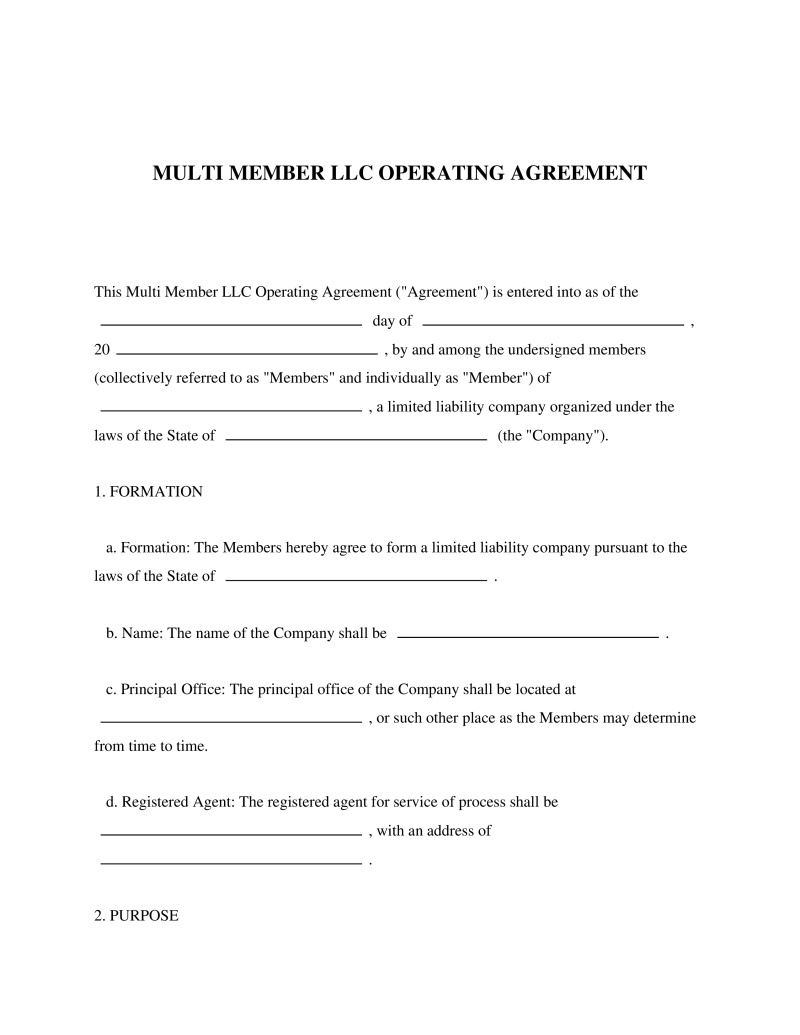
Multi Member LLC Operating Agreement Sample
Not the form you're looking for?
Try our legal document generator to create a custom document
Disclaimer: The templates available on this website are provided for general informational purposes only and do not constitute legal advice. They are not intended to be, and should not be interpreted as, compliant with any specific legal, regulatory, or privacy requirements. These templates are not a replacement for professional legal guidance and should not be relied upon for any particular matter or circumstance. Users are strongly encouraged to seek advice from a qualified attorney licensed in their jurisdiction before using, modifying, or relying on any template.
All templates are provided on an "as is," "with all faults," and "as available" basis. The provider disclaims any and all warranties of any kind, whether express, implied, statutory, or otherwise, including without limitation warranties of merchantability, fitness for a particular purpose, title, or non-infringement.
LegalTemplates.com makes no guarantees or representations regarding the accuracy, completeness, expected outcomes, or reliability of the materials contained in these templates or any materials referenced or linked from them.