Service Agreement
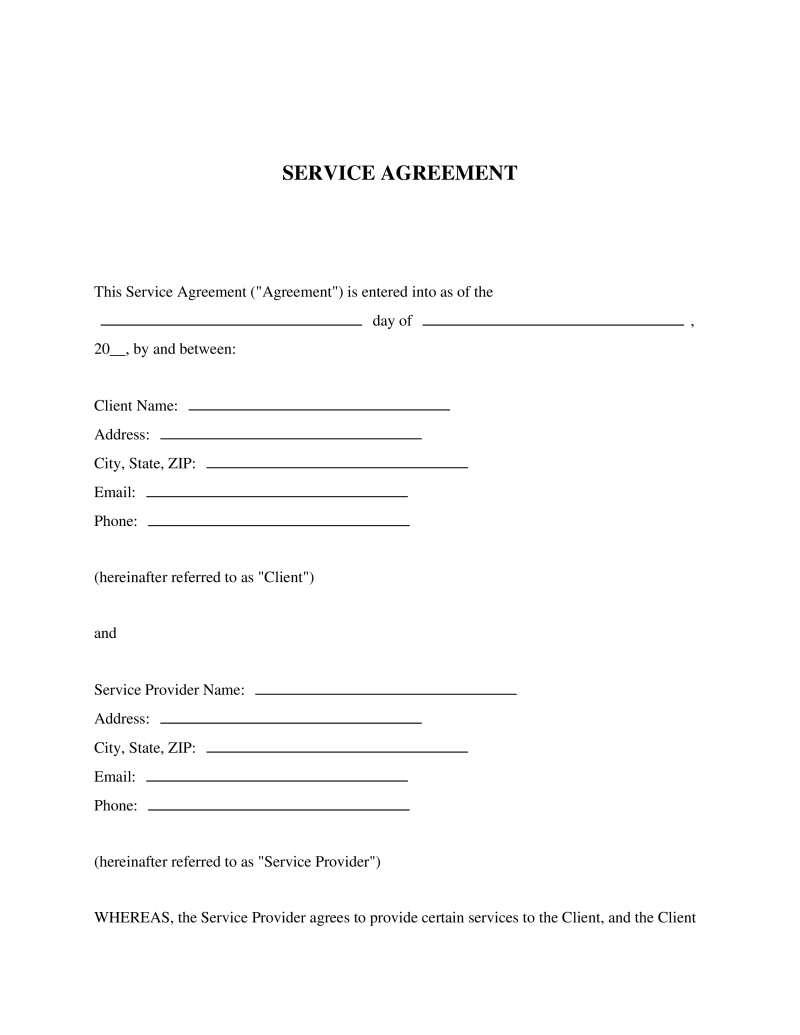
A Service Agreement is a legally binding contract that formalizes the terms, conditions, and compensation for services rendered between two or more parties.
Service Type
Select the primary category that best describes the services to be performed.
Provide a brief description of the service if you selected 'Other'.
Table of Contents
What is a Service Agreement?
A Service Agreement is a legally binding contract between two parties, typically a service provider and a client, that outlines the terms and conditions of a specific service to be performed. Its primary purpose is to clearly define the scope of work, responsibilities, deliverables, payment terms, and timelines, thereby minimizing misunderstandings and disputes. These agreements are widely utilized across various industries, from consulting and professional services to maintenance, construction, and technology, ensuring both parties have a clear understanding of their respective obligations and expectations.
Requirements
For a Service Agreement to be legally valid and enforceable, it must meet several fundamental contractual requirements. These elements ensure that the agreement reflects a true meeting of the minds and an intent to create legal relations. The absence of any of these elements may render the contract void or voidable.
- Offer and Acceptance - One party must make a clear offer to provide or receive services, and the other party must unequivocally accept that offer. The terms of the offer and acceptance must generally align.
- Consideration - Both parties must exchange something of value. For a service provider, this is typically the service itself, while for the client, it is usually monetary payment or another agreed-upon benefit.
- Capacity - All parties entering the agreement must have the legal capacity to do so. This means they must be of legal age, of sound mind, and not under duress or undue influence.
- Legality - The purpose and subject matter of the Service Agreement must be legal and not violate any public policy or statute. Contracts for illegal activities are unenforceable.
- Mutuality of Obligation - Both parties must be bound to perform their respective duties as outlined in the agreement. There must be a genuine commitment from each side.
- Definite Terms - The agreement must contain sufficiently clear and definite terms regarding the services, compensation, timeline, and other material aspects. Vague or ambiguous terms can lead to enforceability issues.
While many Service Agreements can be oral, a written agreement is highly recommended for clarity and enforceability, especially for complex or high-value services. Certain types of contracts, such as those that cannot be performed within one year, may be required by the Statute of Frauds to be in writing to be enforceable.
Rights and Obligations
A well-drafted Service Agreement explicitly details the rights and obligations of both the service provider and the client, fostering accountability and a clear operational framework. Understanding these roles is crucial for successful project execution and dispute avoidance.
The Service Provider's Rights and Obligations typically include:
- Right to Compensation - The provider has the right to receive payment for services rendered, as stipulated in the agreement, including any agreed-upon rates, payment schedules, and reimbursement for expenses.
- Right to Safe Working Conditions - Where applicable, the provider is entitled to a safe working environment free from unreasonable hazards, particularly when performing services on the client's premises.
- Obligation to Perform Services Competently - The provider must perform the services with reasonable care, skill, and diligence, meeting the standards typically expected in their industry or profession.
- Obligation to Deliver on Time - Adherence to agreed-upon deadlines and project timelines is a fundamental obligation, unless delays are caused by the client or unforeseen circumstances.
- Obligation to Maintain Confidentiality - Often, providers are obligated to keep confidential any proprietary or sensitive information disclosed by the client during the course of the service.
- Obligation to Provide Deliverables - If the agreement specifies certain reports, products, or outcomes, the provider is obligated to furnish these as agreed.
The Client's Rights and Obligations generally involve:
- Right to Receive Services - The client has the right to receive the services as described in the agreement, performed to the specified quality and within the agreed timeframe.
- Right to Intellectual Property - Depending on the agreement, the client may have the right to ownership of intellectual property created during the service, subject to specific clauses.
- Obligation to Pay - The client is obligated to pay the agreed-upon fees for the services received, adhering to the payment schedule and terms outlined in the contract.
- Obligation to Cooperate - Clients often have an obligation to provide necessary information, access, and resources in a timely manner to enable the service provider to perform their duties effectively.
- Obligation to Review and Approve - For projects with milestones or deliverables, the client is typically obligated to review and approve work in a timely fashion to avoid project delays.
- Obligation to Provide Accurate Information - The client must provide truthful and complete information relevant to the services being rendered, as inaccuracies can impede performance.
How to Complete a Service Agreement
Drafting a comprehensive Service Agreement requires careful attention to detail to ensure all critical aspects of the service relationship are clearly documented. The following steps outline a systematic approach to completing this essential document.
- Identify Parties and Service Scope - Begin by clearly identifying the full legal names and contact information of both the service provider and the client. Then, define the exact nature of the services to be performed. This involves describing what will be done, any specific methodologies, and the desired outcomes, ensuring there is no ambiguity about the work involved.
- Outline Payment Terms and Schedule - Detail how the service provider will be compensated. Specify the total fee, hourly rate, or project-based cost. Clearly state the payment schedule, such as upfront deposits, milestone payments, or final payment upon completion, including due dates and acceptable payment methods. Also, address any late payment penalties or interest charges.
- Define Deliverables and Milestones - List all specific deliverables, such as reports, software, designs, or completed tasks, that the service provider will provide. Establish any key project milestones and associated deadlines. This section helps track progress and ensures both parties are aligned on what constitutes successful completion at various stages.
- Establish Term, Termination, and Renewal - Specify the duration of the agreement, including a start and end date. Outline the conditions under which either party can terminate the agreement prematurely, such as for breach of contract, mutual agreement, or with a specific notice period. Include provisions for automatic renewal or conditions for extension if applicable.
- Address Confidentiality and Intellectual Property - If the service involves sharing sensitive information, include a confidentiality clause prohibiting its disclosure. For services that create original works, clarify ownership of intellectual property rights, specifying whether the client or provider retains rights, or if there's a license agreement.
- Include Indemnification and Limitation of Liability - Incorporate clauses that protect both parties from certain liabilities. An indemnification clause requires one party to compensate the other for specific losses or damages. A limitation of liability clause sets a cap on the amount of damages one party can claim from the other, often tied to the contract value or insurance coverage.
- Specify Dispute Resolution and Governing Law - Determine the process for resolving any disputes that may arise, such as negotiation, mediation, or arbitration, before resorting to litigation. Clearly state which state's laws will govern the interpretation and enforcement of the agreement, which is crucial for determining legal recourse.
Breach of Service Agreement and Remedies
A breach of a Service Agreement occurs when one party fails to fulfill their obligations as specified in the contract. Breaches can range from minor deviations to fundamental failures that undermine the entire purpose of the agreement. The legal system provides various remedies to the non-breaching party to mitigate their losses and enforce the terms of the contract.
Common types of breach include:
- Material Breach - A significant failure to perform a core obligation, which goes to the root of the contract and often excuses the non-breaching party from their own obligations.
- Minor Breach - A less severe failure that can be remedied without undermining the entire contract. The non-breaching party can sue for damages but must still perform their part of the agreement.
- Anticipatory Breach - Occurs when one party indicates, through words or actions, that they will not perform their contractual obligations before the performance is due. This allows the non-breaching party to sue immediately.
Remedies for breach of a Service Agreement are designed to compensate the injured party or compel performance:
- Damages - This is the most common remedy, involving monetary compensation to the non-breaching party for losses incurred as a direct result of the breach. This can include:
- Compensatory Damages - Aim to put the non-breaching party in the position they would have been in had the contract been performed.
- Consequential Damages - Indirect losses that result from the breach, such as lost profits, provided they were foreseeable at the time the contract was made.
- Liquidated Damages - A predetermined amount specified in the contract to be paid in the event of a breach, intended to be a reasonable estimate of actual damages.
- Specific Performance - A court order requiring the breaching party to fulfill their specific contractual obligations. This remedy is typically granted only when monetary damages are inadequate, such as in contracts involving unique goods or services.
- Rescission - This remedy cancels the contract and restores both parties to their pre-contractual positions, as if the agreement never existed. It often involves the return of any money or property exchanged.
- Reformation - A court may reform or rewrite a contract to correct errors or reflect the true intent of the parties, particularly in cases of mutual mistake.
It is common for Service Agreements to include clauses specifying how disputes will be resolved, such as through mediation or arbitration, before litigation is pursued. These clauses are intended to provide more efficient and less costly alternatives to court proceedings.
Federal Statutes
While no single federal law specifically governs all Service Agreements, several federal statutes can impact certain aspects, particularly concerning consumer protection, privacy, and specific industry regulations:
- Federal Trade Commission Act (FTC Act) - Prohibits unfair methods of competition and unfair or deceptive acts or practices in commerce (15 U.S.C. § 41 et seq.). The FTC has authority to regulate businesses engaging in services, ensuring truthfulness in advertising and preventing deceptive practices in service contracts.
- Health Insurance Portability and Accountability Act (HIPAA) - Establishes national standards to protect sensitive patient health information (PHI) from being disclosed without the patient's consent or knowledge (45 CFR Part 160 and Part 164). Service Agreements involving healthcare providers or their business associates must include specific provisions for safeguarding PHI.
- Americans with Disabilities Act (ADA) - Prohibits discrimination against individuals with disabilities in all areas of public life, including jobs, schools, transportation, and all public and private places that are open to the general public (42 U.S.C. § 12101 et seq.). Service providers must ensure their services and facilities are accessible to individuals with disabilities.
- CAN-SPAM Act - Establishes requirements for commercial messages, gives recipients the right to have emails stopped from being sent to them, and spells out tough penalties for violations (15 U.S.C. § 7701 et seq.). Digital marketing service agreements must comply with these regulations regarding email communications.
State Laws and Requirements
State laws play a significant role in governing Service Agreements, often providing the framework for contract formation, enforcement, and specific industry regulations. The Uniform Commercial Code (UCC), though primarily for goods, can influence service contracts by analogy in certain situations, particularly regarding good faith and commercial reasonableness.
- State Contract Law Statutes - Each state has its own body of statutes and common law governing contracts, including requirements for offer, acceptance, consideration, capacity, and legality. These laws dictate the validity and enforceability of Service Agreements within that state.
- Statute of Frauds - Many states have adopted a Statute of Frauds, which requires certain types of contracts, including those that cannot be performed within one year, to be in writing to be enforceable (e.g., California Civil Code § 1624).
- Consumer Protection Acts - Most states have comprehensive consumer protection acts that prohibit deceptive trade practices and ensure fair dealings between businesses and consumers (e.g., Texas Deceptive Trade Practices-Consumer Protection Act, Tex. Bus. & Com. Code § 17.41 et seq.). Service agreements with consumers must comply with these provisions.
- Licensing and Professional Regulations - Many states require service providers in specific professions (e.g., law, medicine, engineering, contracting) to hold valid licenses and adhere to professional standards. Service agreements in these fields must respect these regulatory frameworks.
- Specific Industry Regulations - States often have laws governing particular service industries, such as home improvement contracts, auto repair services, or financial advisory services, which may impose additional disclosure requirements or contractual terms.
Frequently Asked Questions
Not the form you're looking for?
Try our legal document generator to create a custom document
Disclaimer: The templates available on this website are provided for general informational purposes only and do not constitute legal advice. They are not intended to be, and should not be interpreted as, compliant with any specific legal, regulatory, or privacy requirements. These templates are not a replacement for professional legal guidance and should not be relied upon for any particular matter or circumstance. Users are strongly encouraged to seek advice from a qualified attorney licensed in their jurisdiction before using, modifying, or relying on any template.
All templates are provided on an "as is," "with all faults," and "as available" basis. The provider disclaims any and all warranties of any kind, whether express, implied, statutory, or otherwise, including without limitation warranties of merchantability, fitness for a particular purpose, title, or non-infringement.
LegalTemplates.com makes no guarantees or representations regarding the accuracy, completeness, expected outcomes, or reliability of the materials contained in these templates or any materials referenced or linked from them.