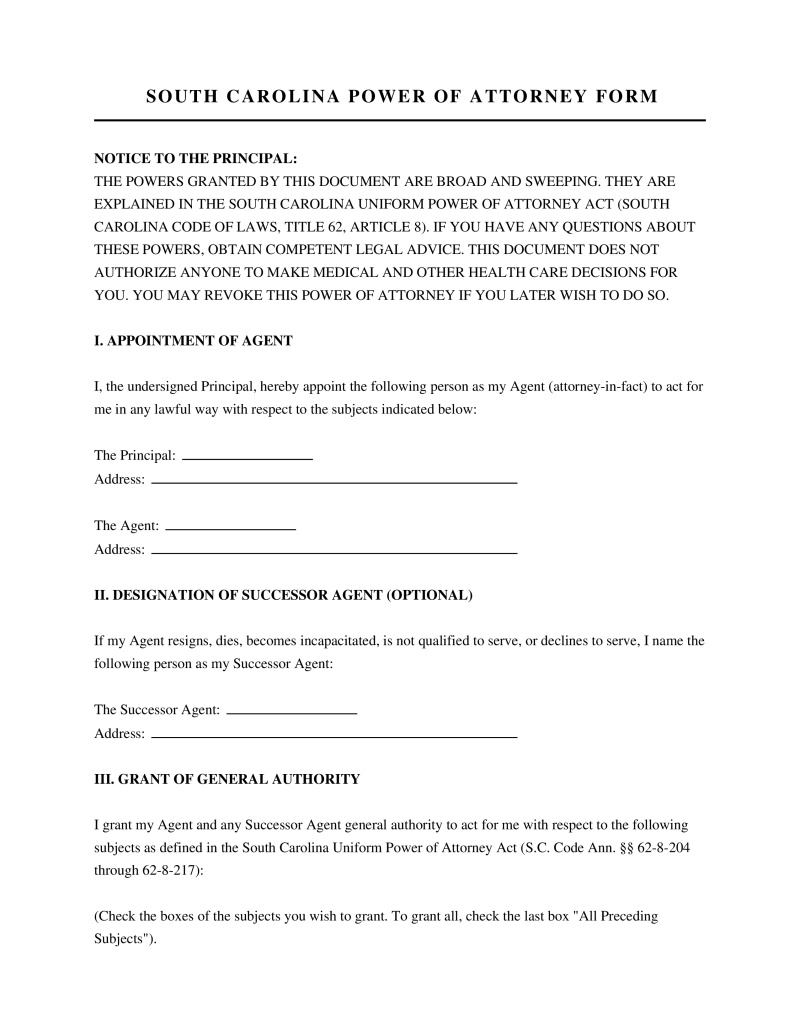
South Carolina Power of Attorney Form
A South Carolina Power of Attorney form allows an individual to formally appoint a representative to handle financial, healthcare, or other specified decisions on their behalf, with the scope of authority defined under South Carolina law.
Authority Effective Timing
Many powers of attorney are effective immediately. A springing power of attorney becomes effective only after a stated event, commonly the Principal's incapacity, but some jurisdictions impose special requirements for proving that event.
Use this only if the authority should not begin immediately and should start on a calendar date.
Describe the triggering event clearly, such as written certification of incapacity by one or two licensed physicians.
For springing authority, third parties often need clear proof before accepting the Agent's authority.
Use precise language so banks, healthcare providers, or other institutions can verify when the authority has begun.
Table of Contents
What is a South Carolina Power of Attorney Form?
A South Carolina Power of Attorney Form serves as a legal instrument allowing an individual to designate another person to act on their behalf regarding financial, legal, or medical matters. The individual granting authority is known as the principal, while the appointed representative acts as the agent or attorney-in-fact. This document functions as a critical component of estate planning by ensuring personal affairs remain managed during periods of absence or incapacitation. Residents of South Carolina utilize these forms to delegate specific tasks or broad management powers depending on their unique needs and circumstances.
Types of South Carolina Power of Attorney Forms
- Durable Power of Attorney - Grants the agent authority to manage financial and legal affairs that remains effective even if the principal becomes incapacitated or mentally incompetent.
- General Power of Attorney - Confers broad powers to the agent for handling financial transactions and business matters but terminates automatically upon the principal's incapacitation or death.
- Limited Power of Attorney - Restricts the agent's authority to specific actions or a defined time period, such as handling a real estate closing or accessing a single bank account.
- Health Care Power of Attorney - Designates an agent to make medical decisions for the principal specifically when they cannot communicate their own wishes regarding treatment and care.
- Springing Power of Attorney - Becomes effective only upon the occurrence of a specific future event, typically the medical incapacitation of the principal as certified by a physician.
- Tax Power of Attorney (Form SC-2848) - Authorizes a representative to handle tax matters and communicate directly with the South Carolina Department of Revenue on behalf of the taxpayer.
Legal Requirements for Validity in South Carolina
South Carolina statutes impose specific formalities that must be met for a power of attorney to be legally binding:
- Capacity of Principal - The individual creating the document must be at least 18 years old and of sound mind at the time of signing (S.C. Code Ann. § 62-8-102).
- Signature Requirements - The principal must sign the document or direct another to sign in their conscious presence (S.C. Code Ann. § 62-8-105).
- Notarization - A notary public must acknowledge the signature of the principal for the document to be presumed valid (S.C. Code Ann. § 62-8-105).
- Witness Requirements - While financial powers of attorney generally require notarization, instruments intended for recording in deed books require two witnesses (S.C. Code Ann. § 30-5-30).
- Health Care Specifics - A Health Care Power of Attorney requires the signatures of two witnesses who are not related to the principal or beneficiaries of the estate (S.C. Code Ann. § 62-5-504).
- Recording - The document must be recorded with the Register of Deeds in the appropriate county if the agent handles real estate transactions (S.C. Code Ann. § 62-8-109).
South Carolina Laws and Regulations
The creation and enforcement of these documents fall under specific state statutes:
- South Carolina Uniform Power of Attorney Act - Governs the creation, modification, and termination of financial powers of attorney in the state (S.C. Code Ann. § 62-8-101 et seq.).
- Adult Health Care Consent Act - Establishes the priority of individuals authorized to make health care decisions for a patient unable to consent (S.C. Code Ann. § 44-66-10 et seq.).
- Statutory Health Care Power of Attorney - Provides a model form and regulations for designating a health care agent (S.C. Code Ann. § 62-5-504).
- Recording of Instruments - Mandates that powers of attorney affecting real property must be recorded to be effective against third parties (S.C. Code Ann. § 30-7-10).
How to Execute a South Carolina Power of Attorney
Step 1: Select an Agent - Choose a trustworthy individual, such as a spouse, close relative, or professional, who understands the responsibilities involved.
Step 2: Determine Scope of Authority - Decide whether the agent requires broad general powers or authority limited to specific assets or medical decisions.
Step 3: Draft the Document - Utilize a template that complies with South Carolina Code Title 62, Article 8 for financial matters or Article 5 for health care.
Step 4: Sign Before Witnesses and Notary - Execute the document in the presence of a notary public and two witnesses to ensure full compliance with recording statutes and health care laws.
Step 5: Distribute Copies - Provide the original to the agent and copies to financial institutions, medical providers, and the county Register of Deeds if real estate is involved.
Revocation of Authority
A principal retains the right to revoke a power of attorney at any time, provided they maintain mental competency. South Carolina law outlines specific methods for termination:
- Written Revocation - The principal executes a formal document stating the termination of the agent's authority.
- Execution of New Power of Attorney - Creating a new document that explicitly revokes all prior inconsistent powers of attorney.
- Divorce or Annulment - The authority granted to a spouse terminates automatically upon the filing of an action for divorce or annulment, unless the document states otherwise (S.C. Code Ann. § 62-8-110).
- Recordation of Revocation - If the original power of attorney was recorded with the county, the revocation instrument must also be recorded to be effective against third parties.
Frequently Asked Questions
Power of Attorney in other states
Not the form you're looking for?
Try our legal document generator to create a custom document
Disclaimer: The templates available on this website are provided for general informational purposes only and do not constitute legal advice. They are not intended to be, and should not be interpreted as, compliant with any specific legal, regulatory, or privacy requirements. These templates are not a replacement for professional legal guidance and should not be relied upon for any particular matter or circumstance. Users are strongly encouraged to seek advice from a qualified attorney licensed in their jurisdiction before using, modifying, or relying on any template.
All templates are provided on an "as is," "with all faults," and "as available" basis. The provider disclaims any and all warranties of any kind, whether express, implied, statutory, or otherwise, including without limitation warranties of merchantability, fitness for a particular purpose, title, or non-infringement.
LegalTemplates.com makes no guarantees or representations regarding the accuracy, completeness, expected outcomes, or reliability of the materials contained in these templates or any materials referenced or linked from them.