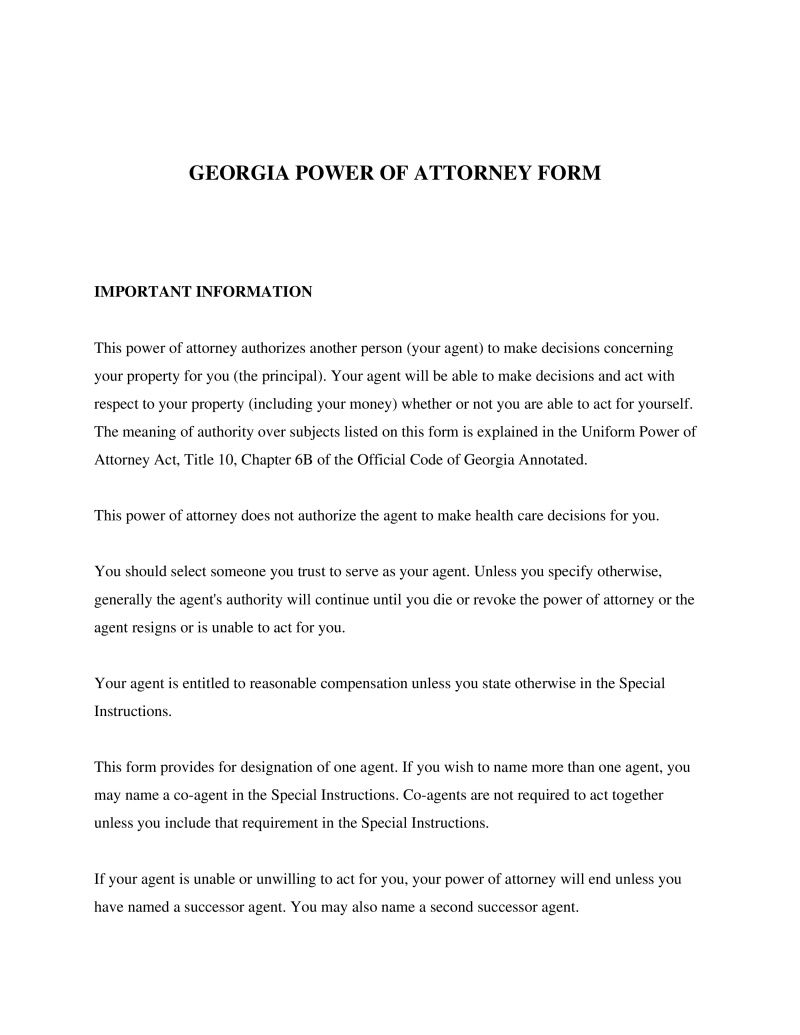
Georgia Power of Attorney Form
A Georgia Power of Attorney Form is a legal document that grants one individual the authority to act on behalf of another in Georgia.
Authority Effective Timing
Many powers of attorney are effective immediately. A springing power of attorney becomes effective only after a stated event, commonly the Principal's incapacity, but some jurisdictions impose special requirements for proving that event.
Use this only if the authority should not begin immediately and should start on a calendar date.
Describe the triggering event clearly, such as written certification of incapacity by one or two licensed physicians.
For springing authority, third parties often need clear proof before accepting the Agent's authority.
Use precise language so banks, healthcare providers, or other institutions can verify when the authority has begun.
Table of Contents
What is a Georgia Power of Attorney Form?
A Georgia Power of Attorney Form is a legal instrument that authorizes one individual, referred to as the agent or attorney-in-fact, to act on behalf of another person, known as the principal, regarding specific financial, property, or healthcare matters. This delegation of authority allows the appointed agent to execute decisions, manage assets, or consent to medical treatment when the principal is unavailable or incapacitated. The document is widely utilized in estate planning to ensure that personal affairs are managed according to state regulations without the need for court-appointed guardianship or conservatorship.
Legal Framework and the Uniform Power of Attorney Act
The governance of these documents in the state is primarily dictated by the Official Code of Georgia Annotated (O.C.G.A.). In 2017, the state legislature enacted the Uniform Power of Attorney Act (UPOAA), codified in Title 10, Chapter 6B of the O.C.G.A. This legislation was adopted to standardize the Georgia Power of Attorney Form, aligning it with national legal norms and providing clearer definitions regarding the duties and liabilities of agents. The UPOAA aims to prevent fraud and financial abuse by establishing strict fiduciary standards.
One of the significant provisions of the UPOAA is the protection it offers to the principal regarding the acceptance of the document. Under O.C.G.A. § 10-6B-20, third parties, such as banks and financial institutions, are generally mandated to accept a notarized power of attorney that substantially complies with the statutory form. If a third party refuses the document without a valid statutory reason, they may be subject to a court order mandating acceptance and could be liable for attorney fees and costs incurred by the agent to enforce the document.
Agent Responsibilities and Fiduciary Duties
Acceptance of the role of attorney-in-fact imposes strict fiduciary duties upon the agent. Under Georgia statutes, the agent must act in good faith, solely in the principal's best interest, and within the specific scope of authority granted by the document. They are legally required to attempt to preserve the principal's estate plan and must avoid conflicts of interest that could impair their ability to act impartially.
Agents are also required to keep accurate records of all transactions, receipts, and disbursements made on behalf of the principal. Commingling the principal's funds with the agent's personal assets is strictly prohibited unless specifically authorized. Violations of these duties can lead to civil liability for restoration of value or criminal charges for exploitation of a vulnerable adult.
Required Elements of a Valid Georgia Power of Attorney Form
For a power of attorney to be legally enforceable under the UPOAA, it must adhere to specific execution standards. Failure to meet these requirements may render the document void or result in rejection by financial institutions.
- Capacity: The principal must be of sound mind and at least 18 years of age at the time of signing.
- Signature: The principal must sign the document or direct another individual to sign in their conscious presence.
- Witnessing: The signature must be attested to by one or more competent witnesses who are not the named agent.
- Notarization: A notary public must acknowledge the principal's signature. Note that the notary may also serve as the witness, but having a separate witness is often recommended for clarity.
How to Execute a Statutory Power of Attorney
Completing the statutory form requires careful attention to detail to ensure the principal's wishes are accurately reflected and legally binding.
- Step 1: Designation of Agent – The principal must clearly print their name and the name of the chosen agent. It is advisable to appoint a successor agent in case the primary agent is unable or unwilling to serve.
- Step 2: Granting of General Authority – The form lists various subjects such as "Real Property," "Banks and Other Financial Institutions," and "Taxes." The principal must initial the line next to each specific power they wish to grant.
- Step 3: Limitations and Special Instructions – If the principal wishes to restrict the agent's powers or provide specific directions, these must be written in the "Special Instructions" section.
- Step 4: Formal Execution – The principal signs the document in the presence of the witness and notary public, who then affix their signatures and seals respectively.
Revocation and Termination of Authority
A principal retains the right to revoke a Georgia Power of Attorney Form at any time, provided they maintain the mental capacity to do so. Revocation is typically executed through a written statement delivered to the agent and any third parties who have relied on the original document. By operation of law, the authority granted also terminates upon the death of the principal, at which point the executor of the estate assumes control. Furthermore, if the spouse is the named agent, a filing for divorce or legal separation generally triggers the automatic suspension of their authority unless the document expressly states otherwise.
Frequently Asked Questions
Already have a Power of Attorney?
Get it reviewed free — checked against your state's laws in about a minute.
Not the form you're looking for?
Try our legal document generator to create a custom document
Disclaimer: The templates available on this website are provided for general informational purposes only and do not constitute legal advice. They are not intended to be, and should not be interpreted as, compliant with any specific legal, regulatory, or privacy requirements. These templates are not a replacement for professional legal guidance and should not be relied upon for any particular matter or circumstance. Users are strongly encouraged to seek advice from a qualified attorney licensed in their jurisdiction before using, modifying, or relying on any template.
All templates are provided on an "as is," "with all faults," and "as available" basis. The provider disclaims any and all warranties of any kind, whether express, implied, statutory, or otherwise, including without limitation warranties of merchantability, fitness for a particular purpose, title, or non-infringement.
LegalTemplates.com makes no guarantees or representations regarding the accuracy, completeness, expected outcomes, or reliability of the materials contained in these templates or any materials referenced or linked from them.