Virginia Lease Agreement
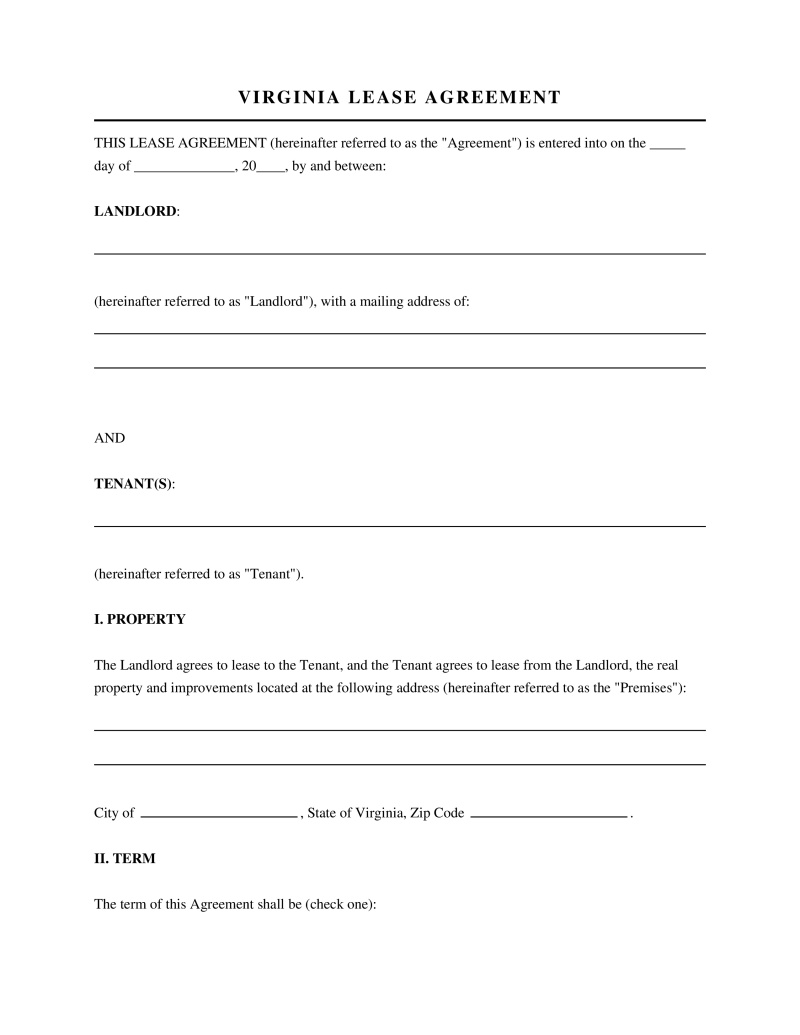
A Virginia Lease Agreement is a legally binding contract between a landlord and a tenant outlining the terms for renting property within the state of Virginia.
Residential Property Type
Select the residential property category that best describes the rental premises.
Use this if the rental property does not fit one of the listed categories.
Table of Contents
What is a Virginia Lease Agreement?
A Virginia Lease Agreement is a legally binding contract executed between a landlord (lessor) and a tenant (lessee) regarding the rental of residential or commercial property within the Commonwealth of Virginia. This document establishes the terms and conditions of the tenancy, including the duration of the lease, the monthly rent amount, security deposit requirements, and the specific obligations of both parties regarding maintenance and utilities. It serves as the primary legal record governing the landlord-tenant relationship and provides a framework for dispute resolution should conflicts arise during the occupancy period.
Legal Framework and the VRLTA
The primary body of law governing residential leases in the state is the Virginia Residential Landlord and Tenant Act (VRLTA), found in the Code of Virginia under Title 55.1, Chapter 12. Historically, the VRLTA applied only to specific types of tenancies or larger landlords, but legislative updates have expanded its scope to cover nearly all residential rental agreements in the state. These statutes supersede many common law principles and impose specific statutory duties on landlords to maintain fit and habitable premises and on tenants to maintain the dwelling unit in a clean and safe condition.
In addition to state statutes, federal laws such as the Fair Housing Act prohibit discrimination in housing based on race, color, national origin, religion, sex, familial status, or disability. While the state allows for freedom of contract regarding many terms, any provision in a lease that waives or modifies the tenant's statutory rights or remedies as defined by the VRLTA is generally unenforceable.
Security Deposits and Rent Regulations
Virginia law places specific limitations on the financial aspects of a tenancy. Under the Code of Virginia § 55.1-1226, a landlord may not demand or receive a security deposit that exceeds the equivalent of two months' rent. This deposit is held to secure the tenant's performance under the lease, including the payment of rent and the repair of damages beyond normal wear and tear.
Upon the termination of the tenancy, the landlord is required to return the security deposit, minus any lawful deductions, within 45 days. Along with the refund, the landlord must provide a written itemization of any deductions made. Furthermore, state law mandates that if a landlord charges a late fee for overdue rent, the fee cannot exceed 10 percent of the periodic rent or 10 percent of the remaining balance due, whichever is less.
Mandatory State Disclosures
For a lease to be fully compliant, Virginia statutes require landlords to disclose specific information to tenants prior to the execution of the agreement. Failure to provide these disclosures can lead to legal penalties or provide the tenant with grounds to terminate the lease. Unlike general contract terms, these disclosures address specific health, safety, and zoning issues relevant to the property.
Required Elements and Disclosures for Compliance
- Lead-Based Paint Disclosure: Required by federal law for any housing built prior to 1978, warning of the dangers of lead exposure.
- Defective Drywall: Landlords must disclose if they have actual knowledge of defective drywall in the unit (Code of Virginia § 55.1-1218).
- Military Air Installation: Properties located in a noise zone or accident potential zone of a military air installation must be identified (Code of Virginia § 55.1-1217).
- Methamphetamine Manufacturing: If the landlord has knowledge that the unit was previously used to manufacture methamphetamine and has not been cleaned according to state guidelines, this must be disclosed (Code of Virginia § 55.1-1219).
- Demolition or Displacement: If a multi-family unit is scheduled for demolition or substantial rehabilitation that will displace the tenant within six months, the landlord must provide notice.
- Management Information: The lease must disclose the names and addresses of the owner and the person authorized to manage the premises and receive legal notices.
Landlord Right of Entry
The balance between a tenant's right to quiet enjoyment and a landlord's need to maintain the property is strictly regulated. According to Code of Virginia § 55.1-1229, a landlord must provide reasonable notice to the tenant before entering the dwelling unit. The statute defines reasonable notice as at least 72 hours for routine maintenance that has not been requested by the tenant. For other non-emergency entries, such as inspections, reasonable notice is generally interpreted as 24 to 48 hours, though the 72-hour rule is specific to unrequested maintenance.
In cases of emergency, such as a fire or a burst pipe, the landlord may enter the premises without the tenant's consent. Conversely, tenants may not unreasonably withhold consent for the landlord to enter to inspect the premises, make necessary repairs, or show the unit to prospective buyers or tenants.
Termination and Eviction Procedures
To terminate a standard lease agreement, specific notice periods must be observed. For a month-to-month tenancy, either party must provide at least 30 days' written notice prior to the next rent due date. In the event of a lease violation by the tenant, such as non-payment of rent, the landlord must follow strict due process. This typically begins with a 5-Day Notice to Pay or Quit for unpaid rent. If the tenant fails to pay or vacate, the landlord must file an unlawful detainer action in court; self-help evictions, such as changing locks or shutting off utilities, are illegal in Virginia.
Frequently Asked Questions
Lease Agreement in other states
Already have a Lease Agreement?
Get it reviewed free — checked against your state's laws in about a minute.
Not the form you're looking for?
Try our legal document generator to create a custom document
Disclaimer: The templates available on this website are provided for general informational purposes only and do not constitute legal advice. They are not intended to be, and should not be interpreted as, compliant with any specific legal, regulatory, or privacy requirements. These templates are not a replacement for professional legal guidance and should not be relied upon for any particular matter or circumstance. Users are strongly encouraged to seek advice from a qualified attorney licensed in their jurisdiction before using, modifying, or relying on any template.
All templates are provided on an "as is," "with all faults," and "as available" basis. The provider disclaims any and all warranties of any kind, whether express, implied, statutory, or otherwise, including without limitation warranties of merchantability, fitness for a particular purpose, title, or non-infringement.
LegalTemplates.com makes no guarantees or representations regarding the accuracy, completeness, expected outcomes, or reliability of the materials contained in these templates or any materials referenced or linked from them.