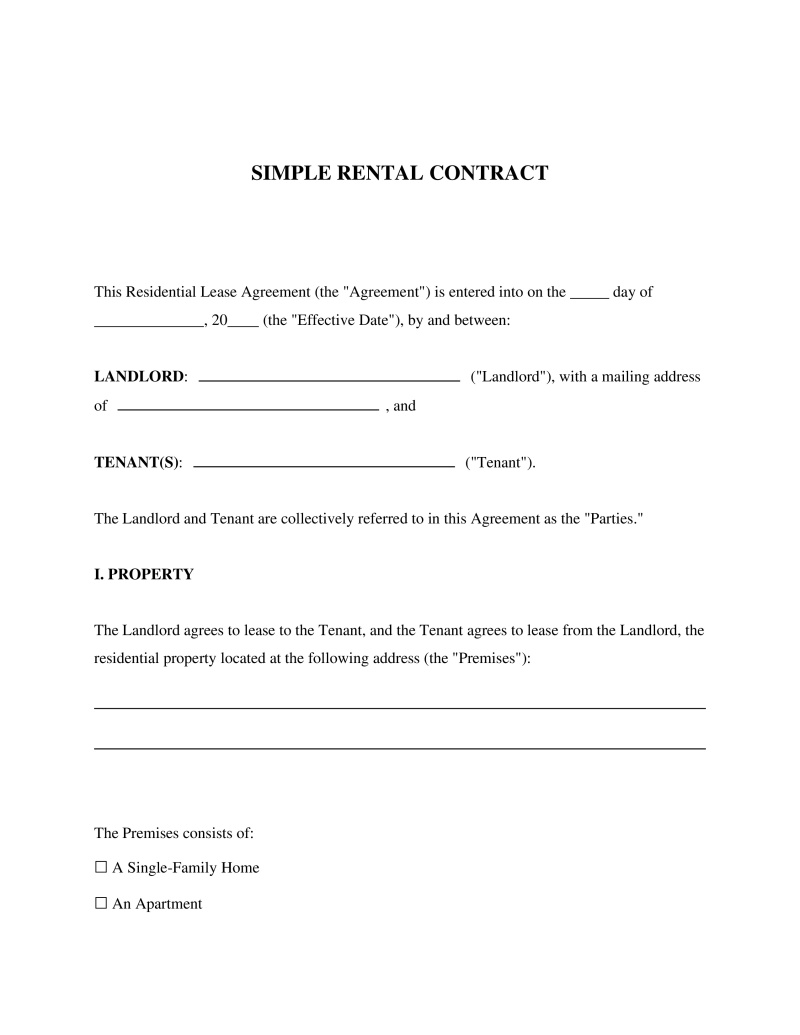
Simple Rental Contract
A Simple Rental Contract is a legally binding agreement establishing the fundamental terms and conditions between a landlord and a tenant for the occupancy of a specified property.
Property Category
Select whether the property is residential or commercial. This will tailor the contract terms to your situation.
Table of Contents
What is a Simple Rental Contract?
A simple rental contract, often referred to as a simple rental agreement, is a legally binding document that establishes the terms and conditions under which a landlord agrees to rent a property to a tenant. This foundational agreement outlines the rights and responsibilities of both parties, ensuring clarity and mutual understanding regarding the tenancy. Its primary purpose is to define the scope of the rental arrangement, including rent payments, lease duration, property usage, and maintenance expectations. Such agreements are widely used by individual property owners, small landlords, and tenants seeking straightforward and uncomplicated leasing terms for residential properties.
Legal Requirements and Validity
For a simple rental contract to be legally valid and enforceable, it must adhere to fundamental contract law principles and specific landlord-tenant statutes. While the exact requirements can vary significantly by jurisdiction, several common elements are universally recognized as essential for establishing a binding agreement. Failure to meet these requirements can render the contract voidable or unenforceable, leading to potential disputes and legal challenges.
- Mutual Assent (Offer and Acceptance) - Both the landlord and tenant must agree to the same terms, signifying a "meeting of the minds." The landlord offers the property for rent under specific conditions, and the tenant accepts these conditions.
- Consideration - There must be an exchange of value between the parties. Typically, this involves the tenant's payment of rent in exchange for the landlord's grant of possession and use of the property.
- Legal Capacity - All parties entering the contract must be of legal age (usually 18) and possess the mental competence to understand the terms and obligations of the agreement. Contracts signed by minors or individuals lacking capacity may be voidable.
- Legal Purpose - The purpose of the contract must be lawful. A rental agreement for an illegal activity would be unenforceable.
- Written Form - While some short-term verbal rental agreements may be enforceable in certain jurisdictions, most states require rental contracts exceeding a year to be in writing to satisfy the Statute of Frauds. A written agreement is always recommended for clarity and enforceability.
- Clear Identification of Parties and Property - The contract must clearly state the full legal names of all landlords and tenants, along with the precise address and description of the rental property.
Key Elements of a Simple Rental Contract
A simple rental contract, while concise, must include several fundamental provisions to adequately protect the interests of both the landlord and the tenant. These elements ensure that all critical aspects of the tenancy are addressed, preventing ambiguity and potential disagreements down the line.
- Identification of Parties - The full legal names of the landlord(s) and all adult tenants who will reside in the property must be clearly stated.
- Property Description - A precise street address, including unit number if applicable, of the rental property.
- Term of Tenancy - The start and end dates of the rental period. This can be a fixed term (e.g., one year) or a month-to-month agreement.
- Rent Amount and Payment Terms - The exact amount of rent, due date, acceptable payment methods, and any grace periods or late fees for overdue payments.
- Security Deposit Details - The amount of the security deposit, conditions for its return, and any permitted deductions, in compliance with state laws.
- Utilities Responsibility - A clear statement outlining which utilities (e.g., water, electricity, gas, internet) are the responsibility of the tenant and which are covered by the landlord.
- Maintenance and Repairs - Defines the responsibilities of both parties for property maintenance, minor repairs, and reporting major issues.
- Occupancy Limits - Specifies the maximum number of occupants permitted to reside in the rental unit.
- Pet Policy - Details whether pets are allowed, any restrictions on pet type or size, and potential pet fees or deposits.
- Entry by Landlord - Outlines the conditions and notice requirements for the landlord to enter the premises, adhering to state-specific regulations.
- Signatures and Dates - The dated signatures of all landlords and tenants involved in the agreement, signifying their consent to the terms.
Rights and Obligations of Parties
A simple rental contract establishes a reciprocal relationship, granting specific rights to and imposing distinct obligations on both the landlord and the tenant. Understanding these roles is crucial for a harmonious tenancy and for ensuring legal compliance. The specifics can be influenced by local statutes, but general principles apply broadly.
Landlord's Rights and Obligations
Landlords hold certain rights to protect their property and investment, alongside obligations to provide a safe and habitable living environment.
- Right to Collect Rent - The landlord has the right to receive rent payments on time, as specified in the rental agreement.
- Right to Property Access - With proper notice and for legitimate reasons (e.g., repairs, inspections, showing to prospective tenants), the landlord generally has the right to enter the rental unit.
- Obligation to Maintain Habitable Premises - Landlords are typically required to ensure the property is safe, structurally sound, and provides essential services like heat, water, and electricity, fulfilling the implied warranty of habitability.
- Obligation to Respect Tenant Privacy - Landlords must provide reasonable notice before entering the premises and cannot harass tenants or interfere with their quiet enjoyment of the property.
- Obligation to Return Security Deposit - Upon termination of the tenancy, landlords must return the security deposit within a state-mandated timeframe, providing an itemized list of any deductions.
Tenant's Rights and Obligations
Tenants also possess rights protecting their living conditions and personal space, along with obligations to care for the property and adhere to the contract.
- Right to Peaceful Enjoyment - Tenants have the right to use and enjoy the rental property without unreasonable interference from the landlord.
- Right to a Habitable Home - Tenants are entitled to a safe, clean, and structurally sound living environment that meets basic health and safety standards.
- Obligation to Pay Rent - The tenant's primary obligation is to pay rent in full and on time, as outlined in the rental agreement.
- Obligation to Maintain Premises - Tenants are generally responsible for keeping the property clean, performing minor maintenance, and avoiding intentional damage or negligence.
- Obligation to Adhere to Lease Terms - Tenants must comply with all terms and conditions specified in the rental contract, including rules regarding pets, noise, and occupancy.
How to Complete a Simple Rental Contract
Completing a simple rental contract involves a structured process to ensure all necessary information is accurately recorded and both parties understand their commitments. Careful attention to each step helps prevent future misunderstandings and legal complications.
- Gather Essential Information - Begin by collecting all pertinent details for both the landlord and the tenant, including full legal names, current contact information, and identification. For the property, have the complete street address, including any unit numbers, and specific details about included appliances or furnishings. This foundational information ensures proper identification of all parties and the subject property.
- Define the Tenancy Term and Rent - Clearly establish the duration of the rental agreement, specifying the exact start and end dates for a fixed-term lease, or indicating a month-to-month arrangement. Simultaneously, determine the monthly rent amount, the due date for payments, acceptable payment methods (e.g., check, electronic transfer), and any grace period before a late fee is applied. It is crucial to also specify the amount of any late fees.
- Outline Security Deposit and Other Fees - State the exact security deposit amount, ensuring it complies with state and local limits. Detail the conditions under which the deposit will be returned, including any permissible deductions for damages beyond normal wear and tear or unpaid rent. If applicable, include provisions for pet fees, pet deposits, or other one-time charges, specifying if they are refundable or non-refundable.
- Specify Utility and Maintenance Responsibilities - Clearly delineate which utilities (e.g., electricity, water, gas, internet, trash) are the responsibility of the tenant and which remain with the landlord. Additionally, define the division of maintenance responsibilities, such as who is responsible for lawn care, minor repairs (like changing light bulbs), and who should be contacted for major repairs to the property's structure or essential systems.
- Include Specific Clauses and Disclosures - Incorporate any additional clauses pertinent to the tenancy, such as a pet policy, rules regarding subletting, or restrictions on alterations to the property. Crucially, include all legally mandated disclosures, such as lead-based paint warnings for properties built before 1978, or information about shared utility billing. Ensure these clauses align with local landlord-tenant laws.
- Review, Sign, and Distribute Copies - Before signing, thoroughly review the entire document with all parties to ensure accuracy and mutual understanding of all terms. Once confirmed, all landlords and tenants should sign and date the agreement. Each party should receive a signed original or a clear copy of the completed rental contract for their records.
Applicable Federal and State Laws
Rental contracts are subject to a complex web of federal, state, and sometimes local laws designed to protect both landlords and tenants. Compliance with these statutes is not optional; violations can lead to significant penalties, legal disputes, and financial liabilities.
Federal Statutes
Several federal laws impose broad requirements on rental agreements across all states, primarily focusing on fair housing and environmental disclosures.
- Fair Housing Act - Prohibits discrimination in housing based on race, color, national origin, religion, sex, familial status, or disability (42 U.S.C. § 3601 et seq.). Landlords must ensure their rental practices, including advertising, tenant screening, and lease terms, do not violate these protections.
- Residential Lead-Based Paint Hazard Reduction Act - Mandates that landlords of properties built before 1978 disclose any known lead-based paint hazards to prospective tenants and provide an EPA-approved pamphlet on lead poisoning prevention (42 U.S.C. § 4852d). Failure to comply can result in substantial fines and liability.
State Laws and Requirements
State laws provide the primary framework for landlord-tenant relationships, often codifying common law principles and establishing specific rules for various aspects of a rental agreement. These laws vary significantly from state to state.
- Uniform Residential Landlord and Tenant Act (URLTA) - This model act, adopted in various forms by many states (e.g., Arizona Revised Statutes Title 33, Chapter 10; Florida Statutes Chapter 83), standardizes the rights and duties of landlords and tenants, covering topics like lease agreements, security deposits, and eviction procedures.
- Security Deposit Limits and Returns - Most states impose limits on the maximum amount a landlord can charge for a security deposit (e.g., California Civil Code § 1950.5 limits residential security deposits to two months' rent for unfurnished properties). States also dictate the timeframe within which landlords must return deposits and provide itemized deductions (e.g., New York General Obligations Law § 7-103 requires return within 14 days).
- Implied Warranty of Habitability - This doctrine, codified in most states (e.g., Massachusetts General Laws Chapter 186, Section 14), requires landlords to maintain rental properties in a safe and livable condition, ensuring access to essential services like heat, hot water, and a structurally sound dwelling.
- Notice Requirements for Entry - States specify the amount of notice a landlord must provide before entering a tenant's unit (e.g., California Civil Code § 1954 generally requires 24 hours' written notice).
- Eviction Procedures - State statutes outline the legal process landlords must follow to evict a tenant, including specific notice periods and court actions (e.g., Texas Property Code Chapter 24 details forcible entry and detainer suits).
Penalties for Non-Compliance
Non-compliance with federal, state, or local landlord-tenant laws can lead to a range of legal and financial consequences for the offending party. For landlords, this might include fines for violating fair housing laws or lead-based paint disclosures, statutory damages for improper handling of security deposits, or being compelled by a court to make necessary repairs. Tenants who violate the terms of their rental agreement may face eviction, forfeiture of their security deposit, or liability for unpaid rent and damages. In severe cases, particularly with discriminatory practices or unsafe living conditions, government agencies may also levy civil penalties or pursue legal action.
Frequently Asked Questions
Already have a Contract?
Get it reviewed free — checked against your state's laws in about a minute.
Not the form you're looking for?
Try our legal document generator to create a custom document
Disclaimer: The templates available on this website are provided for general informational purposes only and do not constitute legal advice. They are not intended to be, and should not be interpreted as, compliant with any specific legal, regulatory, or privacy requirements. These templates are not a replacement for professional legal guidance and should not be relied upon for any particular matter or circumstance. Users are strongly encouraged to seek advice from a qualified attorney licensed in their jurisdiction before using, modifying, or relying on any template.
All templates are provided on an "as is," "with all faults," and "as available" basis. The provider disclaims any and all warranties of any kind, whether express, implied, statutory, or otherwise, including without limitation warranties of merchantability, fitness for a particular purpose, title, or non-infringement.
LegalTemplates.com makes no guarantees or representations regarding the accuracy, completeness, expected outcomes, or reliability of the materials contained in these templates or any materials referenced or linked from them.