Simple Lease Agreement Create a Simple Lease Agreement

Simple Lease Agreement

Updated Jan 07, 2026
0 Comments
5 (1)
1 Downloads

A Simple Lease Agreement is a binding legal contract between a landlord and tenant establishing the terms for renting residential property for a set period.

Is Fixed Term

A fixed term lease has a set end date. Month-to-month continues until terminated by either party.

Table of Contents

0% Complete 0/0 Fields

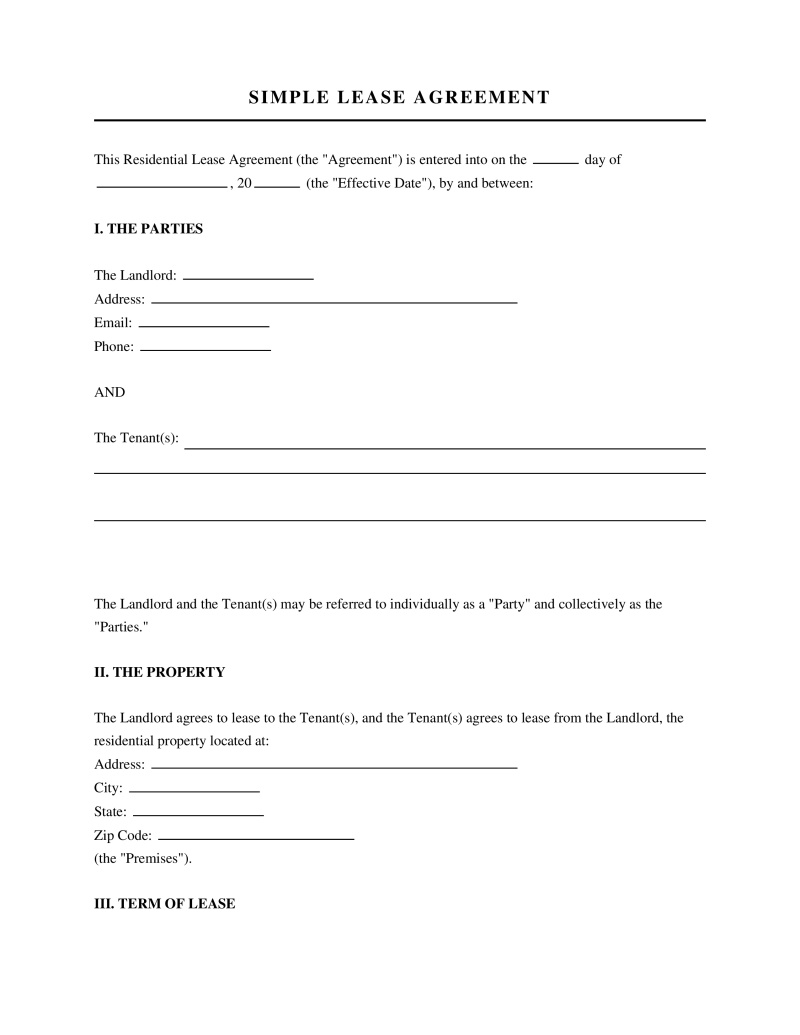
SIMPLE LEASE AGREEMENT

This Residential Lease Agreement (the "Agreement") is entered into on (the "Effective Date"), by and between:

I. THE PARTIES

The Landlord:
Name:
Address:
Email:
Phone:

AND

The Tenant(s):
Name:

The Landlord and the Tenant(s) may be referred to individually as a "Party" and collectively as the "Parties."

II. THE PROPERTY

The Landlord agrees to lease to the Tenant(s), and the Tenant(s) agrees to lease from the Landlord, the residential property located at:

Address:
City:
State:
Zip Code:
(the "Premises").

III. TERM OF LEASE

This Agreement shall be for a fixed term (the "Lease Term") beginning on and ending on .

Upon the expiration of the Lease Term, the Tenant(s) shall vacate the Premises unless a new agreement is signed or the Landlord accepts rent for a subsequent period, creating a month-to-month tenancy under the same terms and conditions.

IV. RENT

The Tenant(s) shall pay the Landlord the sum of $ per month as rent (the "Rent").

The Rent is due on the day of each month (the "Due Date"). The first month's rent is due upon the execution of this Agreement.

Rent shall be paid by the following method(s):

Payment instructions:

V. LATE CHARGES AND RETURNED CHECKS

If Rent is not received by the Landlord within days of the Due Date, the Tenant(s) agrees to pay a late fee of $.

If any check offered by the Tenant(s) to the Landlord in payment of rent or any other amount due under this Agreement is returned for lack of sufficient funds, a "Stop Payment," or any other reason, the Tenant(s) shall pay the Landlord a returned check fee of $.

VI. SECURITY DEPOSIT

Upon the execution of this Agreement, the Tenant(s) shall deposit with the Landlord the sum of $ (the "Security Deposit") as security for the faithful performance by the Tenant(s) of the terms of this Agreement.

The Security Deposit shall be returned to the Tenant(s) within days after the termination of this tenancy, less any deductions for damages to the Premises (reasonable wear and tear excepted), unpaid rent, or other charges owed by the Tenant(s). The Landlord shall provide a written itemized statement of any deductions.

VII. UTILITIES AND SERVICES

The Parties agree that utilities and services for the Premises shall be paid as follows:

Electricity:

Water/Sewer:

Gas/Oil:

Trash Removal:

Internet/Cable:

Landscaping/Lawn Care:

Snow Removal:

VIII. USE OF PREMISES

The Premises shall be used and occupied by the Tenant(s) exclusively as a private single-family residence. No part of the Premises shall be used at any time during the term of this Agreement by the Tenant(s) for the purpose of carrying on any business, profession, or trade of any kind, or for any purpose other than as a private single-family residence.

The Tenant(s) shall not allow any other person, other than the Tenant's immediate family or authorized occupants, to use or occupy the Premises without first obtaining the Landlord's written consent.

The authorized occupants of the Premises are:

IX. PETS

The Tenant(s) shall be allowed to keep pets on the Premises:

X. SMOKING POLICY

Smoking of any substance, including vaping, on the Premises is:

XI. MAINTENANCE AND REPAIRS

A. Landlord's Responsibilities: The Landlord shall maintain the structure, roof, and foundation of the Premises, and keep all heating, plumbing, and electrical systems in good working order, provided that the Tenant(s) shall be liable for repairs caused by the Tenant's negligence or misuse.

B. Tenant's Responsibilities: The Tenant(s) shall keep the Premises in a clean and sanitary condition and shall immediately notify the Landlord of any damage or needed repairs. The Tenant(s) shall be responsible for minor maintenance, including replacing light bulbs and HVAC filters.

XII. RIGHT OF ENTRY

The Landlord and the Landlord's agents shall have the right at all reasonable times, and by providing hours written notice, to enter the Premises for the purpose of inspecting the Premises and all buildings and improvements thereon, or for the purposes of making any repairs, additions, or alterations as may be deemed appropriate by the Landlord for the preservation of the Premises or the building.

In the event of an emergency, the Landlord may enter the Premises at any time without notice.

XIII. LEAD-BASED PAINT DISCLOSURE

Housing built before 1978 may contain lead-based paint. Lead from paint, paint chips, and dust can pose health hazards if not managed properly.

The Premises was constructed:

XIV. DEFAULT

If the Tenant(s) fails to comply with any of the material provisions of this Agreement, other than the covenant to pay rent, or of any present rules and regulations, or materially fails to comply with any duties imposed on the Tenant(s) by statute, within days after delivery of written notice by the Landlord specifying the non-compliance and indicating the intention of the Landlord to terminate the Lease by reason thereof, the Landlord may terminate this Agreement.

If the Tenant(s) fails to pay rent when due and the default continues for days thereafter, the Landlord may, at the Landlord's option, declare the entire balance of rent payable hereunder to be immediately due and payable and may exercise any and all rights and remedies available to the Landlord at law or in equity.

XV. GOVERNING LAW

This Agreement shall be governed, construed, and enforced in accordance with the laws of the State of .

XVI. SEVERABILITY

If any provision of this Agreement or the application thereof shall, for any reason and to any extent, be invalid or unenforceable, neither the remainder of this Agreement nor the application of the provision to other persons, entities, or circumstances shall be affected thereby, but instead shall be enforced to the maximum extent permitted by law.

XVII. ENTIRE AGREEMENT

This Agreement constitutes the sole and entire agreement of the Parties regarding the subject matter contained herein and supersedes all prior and contemporaneous understandings, agreements, representations, and warranties, both written and oral, regarding such subject matter. This Agreement may not be amended, modified, or altered except in writing signed by both Parties.

XVIII. ADDITIONAL TERMS AND CONDITIONS

Additional terms:

IN WITNESS WHEREOF, the Parties have executed this Agreement as of the day and year first above written.

LANDLORD

Signature: _________________________
Print Name: _______________
Date:
Address: _______________

TENANT(S)

Signature: _________________________
Print Name: _______________
Date:
Address:

What is a Simple Lease Agreement?

A Simple Lease Agreement constitutes a legally binding contract between a landlord and a tenant that outlines the terms of a residential rental arrangement. This document establishes the fundamental rights and responsibilities of both parties, serving as the governing instrument for the occupancy of a property for a specific duration. Landlords utilize this agreement to secure financial compensation and protect real estate assets, while tenants rely on it to establish right of possession and define housing costs. The agreement typically includes essential details such as rent amount, payment schedules, and property rules without the complex clauses found in commercial or long-form real estate contracts.

Essential Elements of a Valid Lease

To ensure enforceability in a court of law, a lease must contain specific components that clearly define the relationship and obligations. A comprehensive agreement includes the following data points:

  • Parties Identification - Full legal names of the landlord (lessor) and the tenant (lessee).
  • Property Description - The complete physical address and specific unit number of the rental premises.
  • Lease Term - The specific start date and end date of the tenancy or the conditions for automatic renewal.
  • Consideration - The specific amount of rent, the due date, and acceptable methods of payment.
  • Signatures - Written acknowledgement from all competent parties involved in the transaction.

Federal Statutes and Regulations

While property laws are primarily state-specific, federal regulations impose strict requirements on residential leases across the United States:

  • Fair Housing Act - Prohibits discrimination in the rental of housing based on race, color, national origin, religion, sex, familial status, or disability (42 U.S.C. § 3601 et seq.).
  • Lead-Based Paint Disclosure - Mandates that landlords of properties built before 1978 provide tenants with an information pamphlet and disclose known lead hazards (42 U.S.C. § 4852d).
  • Servicemembers Civil Relief Act - Grants military personnel the right to terminate a lease early upon receipt of deployment or permanent change of station orders (50 U.S.C. § 3955).
  • Fair Credit Reporting Act - Requires landlords to provide an adverse action notice if a tenant application is denied based on information in a consumer report (15 U.S.C. § 1681 et seq.).

State Laws and Tenant Protections

State statutes heavily influence the content and enforcement of a Simple Lease Agreement. These laws typically address:

  • Uniform Residential Landlord and Tenant Act - Standardizes the rights and duties of landlords and tenants regarding maintenance, access, and evictions (adopted in various forms by many states).
  • Security Deposit Limits - Restricts the maximum amount a landlord may charge for a deposit, often capped at one or two months' rent (varies by state statute).
  • Implied Warranty of Habitability - Requires landlords to maintain the premises in a safe and livable condition, regardless of lease terms (Common Law/State Statutes).
  • Right to Entry - Mandates that landlords provide advance notice, usually 24 to 48 hours, before entering the rental unit for non-emergency reasons.

Rights and Obligations of Parties

The execution of a lease creates reciprocal duties for both the property owner and the occupant. These obligations ensure the smooth operation of the tenancy.

Landlord Responsibilities

  • Property Maintenance - Keeping structural elements, plumbing, and electrical systems in safe working order.
  • Quiet Enjoyment - Ensuring the tenant can occupy the premises without unreasonable disturbance or harassment.
  • Deposit Return - Refunding the security deposit within the state-mandated timeframe after lease termination, minus valid deductions.

Tenant Responsibilities

  • Timely Payment - Remitting rent in full on or before the due date specified in the agreement.
  • Preservation of Premises - Maintaining the unit in a clean condition and preventing negligent damage beyond normal wear and tear.
  • Rule Compliance - Adhering to building policies regarding noise, guests, pets, and illegal activities.

How to Execute a Simple Lease Agreement

Finalizing a rental arrangement involves a systematic process to ensure legal compliance and mutual understanding.

Step 1: Drafting the Agreement - The landlord prepares the document including all specific terms, rent amounts, and necessary disclosures.

Step 2: Tenant Review - The prospective tenant reads the contract to understand their obligations and negotiates terms if necessary.

Step 3: Signing and Dating - Both parties sign the document; some states may require witnesses or notarization for leases exceeding one year.

Step 4: Payment Collection - The tenant pays the first month's rent and security deposit as stipulated in the contract.

Step 5: Move-In Inspection - Parties conduct a walkthrough to document the condition of the property before the tenant takes possession.

Frequently Asked Questions

Notarization is generally not required for standard residential leases of one year or less. Some states, such as Washington and Ohio, mandate notarization for leases with terms exceeding three years to be valid against third parties.
Verbal leases for less than one year are legally binding in many jurisdictions but are difficult to enforce due to a lack of proof regarding terms. The Statute of Frauds in most states requires real estate contracts lasting longer than one year to be in writing.
A lease typically refers to a fixed-term contract (e.g., 12 months) where terms cannot change during the period. A rental agreement often implies a short-term or month-to-month arrangement where terms can change with proper notice.
Landlords generally cannot enter without permission unless there is an emergency, such as a fire or water leak. For routine inspections or repairs, state laws usually require the landlord to provide 24 to 48 hours of written notice.
Breaking a lease early is a breach of contract that may make the tenant liable for the remaining rent due under the term. Landlords in many states have a duty to mitigate damages by making reasonable efforts to re-rent the unit to a new tenant.

Not the form you're looking for?

Try our legal document generator to create a custom document

Community Discussion

Share your experience and help others

0

Comments (0)

Leave a Comment

Your email will not be displayed publicly. It is used for validation purposes only and will never be used to send unwanted emails or sold to third parties.

No comments yet. Be the first to comment!

Legal Notice: Comments are personal opinions and do not constitute legal advice. Always consult a qualified attorney for matters specific to your situation.