North Carolina Lease Agreement Create a North Carolina Lease Agreement

North Carolina Lease Agreement

Published Dec 07, 2025
0 Comments
5 (1)
1 Downloads

A North Carolina Power of Attorney Form is a legal document that permits someone to appoint an agent to handle specified financial or legal matters on their behalf.
Lease Type

Select the type of property that this lease applies to from the options provided. This helps clarify the nature of the rental arrangement and can affect lease terms and tenant rights. If your property type is not listed, choose "Other" and specify what it is.

Table of Contents

0% Complete 0/0 Fields

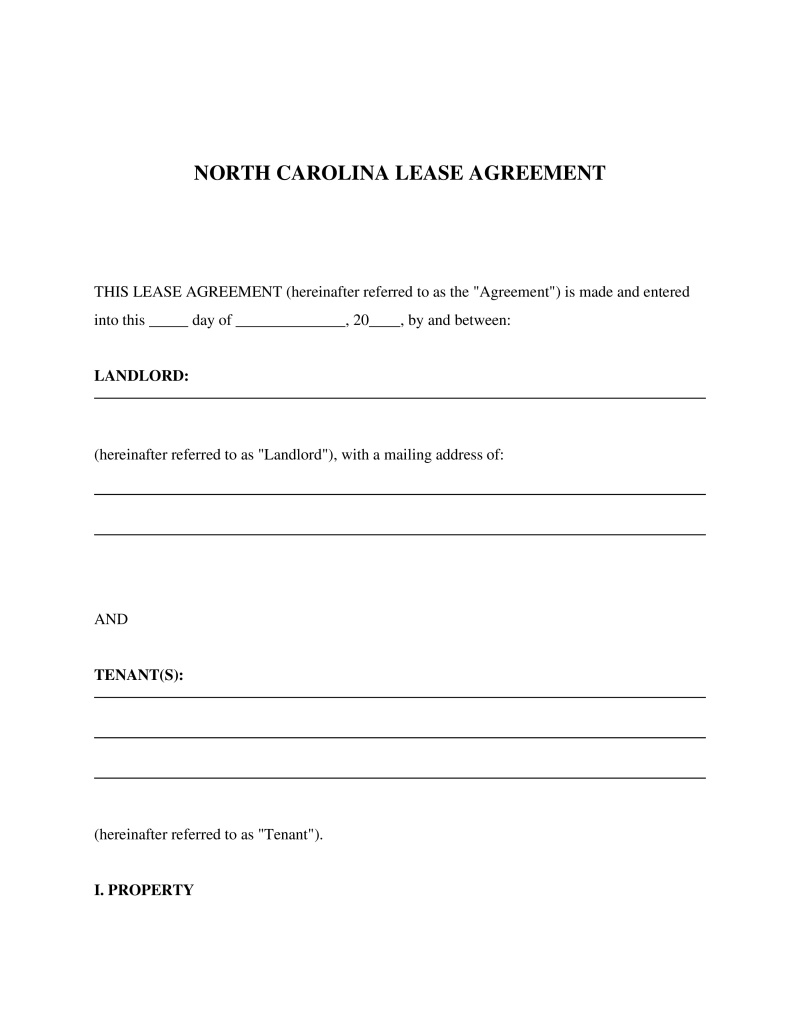
NORTH CAROLINA LEASE AGREEMENT

THIS LEASE AGREEMENT (hereinafter referred to as the "Agreement") is made and entered into this , by and between:

LANDLORD:
(hereinafter referred to as "Landlord"), with a mailing address of:

AND TENANT(S):
(hereinafter referred to as "Tenant").

I. PROPERTY

The Landlord agrees to lease to the Tenant, and the Tenant agrees to lease from the Landlord, the following residential property (hereinafter referred to as the "Premises"):

Street Address:
City:
State: North Carolina
Zip Code:

The Premises includes the following fixtures and appliances:

II. TERM

The term of this Agreement shall be (check one):

III. RENT

The Tenant agrees to pay the Landlord a monthly rent of $.

Rent is due on the day of each month.

Rent shall be paid by the following method(s):

Payment instructions:

IV. LATE FEES AND RETURNED CHECKS

Late Fees: Pursuant to N.C. Gen. Stat. § 42-46, if rent is not paid within five (5) days of the due date, the Landlord may charge a late fee. The late fee shall not exceed fifteen dollars ($15.00) or five percent (5%) of the monthly rent, whichever is greater.

Returned Checks: If a check is returned for insufficient funds, the Tenant shall pay a processing fee of $ (maximum $35.00 pursuant to N.C. Gen. Stat. § 25-3-506).

V. SECURITY DEPOSIT

Upon execution of this Agreement, the Tenant shall deposit with the Landlord the sum of $ as a Security Deposit.

Location of Deposit (REQUIRED BY N.C. Gen. Stat. § 42-50):
The Landlord shall hold the Security Deposit in a trust account with the following licensed and insured bank or savings institution located in the State of North Carolina:

Name of Bank/Institution:
Address of Bank/Institution:

Return of Deposit: Pursuant to N.C. Gen. Stat. § 42-52, the Landlord shall return the Security Deposit to the Tenant within thirty (30) days after the termination of the tenancy and delivery of possession. If the Landlord retains any portion of the deposit, the Landlord must provide the Tenant with an itemized accounting of any damages or unpaid rent.

VI. USE OF PREMISES

The Premises shall be used exclusively as a private residence for the Tenant(s) listed in this Agreement and the following minor children/occupants:

Guests staying more than days without prior written consent of the Landlord is prohibited.

VII. UTILITIES

The parties agree that utilities and services shall be the responsibility of the following:

Electricity:

Gas/Heating Fuel:

Water/Sewer:

Trash Collection:

Cable/Internet:

Lawn Care:

Snow Removal:

VIII. PETS

IX. MAINTENANCE AND REPAIRS

Landlord's Obligations (N.C. Gen. Stat. § 42-42):
The Landlord shall:
1. Comply with the current applicable building and housing codes.
2. Make all repairs and do whatever is necessary to put and keep the Premises in a fit and habitable condition.
3. Keep all common areas of the Premises in a safe condition.
4. Maintain in good and safe working order and promptly repair all electrical, plumbing, sanitary, heating, ventilating, air conditioning, and other facilities and appliances supplied or required to be supplied by the Landlord.
5. Provide operable smoke detectors and carbon monoxide detectors as required by law.

Tenant's Obligations (N.C. Gen. Stat. § 42-43):
The Tenant shall:
1. Keep that part of the Premises that the Tenant occupies and uses as clean and safe as the condition of the Premises permits.
2. Dispose of all ashes, rubbish, garbage, and other waste in a clean and safe manner.
3. Keep all plumbing fixtures in the Premises or used by the Tenant as clean as their condition permits.
4. Not deliberately or negligently destroy, deface, damage, impair, or remove any part of the Premises or knowingly permit any person to do so.
5. Notify the Landlord immediately of any need for repairs.
6. Replace batteries in smoke detectors and carbon monoxide detectors as needed during the tenancy.

X. RIGHT OF ENTRY

The Landlord shall have the right to enter the Premises at reasonable times for the purpose of inspection, making necessary repairs, or showing the Premises to prospective buyers or tenants. Except in cases of emergency, the Landlord agrees to provide the Tenant with at least hours notice prior to entry.

XI. MILITARY SERVICE TERMINATION

Pursuant to N.C. Gen. Stat. § 42-45, if the Tenant is a member of the United States Armed Forces and receives permanent change of station orders to depart fifty (50) miles or more from the Premises, or is prematurely or involuntarily discharged or released from active duty, the Tenant may terminate this Agreement by providing the Landlord with a written notice of termination and a copy of the official military orders or a verification signed by the Tenant's commanding officer.

XII. VICTIMS OF DOMESTIC VIOLENCE

Pursuant to N.C. Gen. Stat. § 42-45.1, a Tenant who is a victim of domestic violence, sexual assault, or stalking may terminate this Agreement by providing the Landlord with written notice and the required documentation (such as a protective order or safety plan). The Tenant shall be liable for rent prorated to the effective date of the termination notice.

XIII. LEAD-BASED PAINT DISCLOSURE

Check one:

XIV. DEFAULT

If the Tenant fails to pay rent when due or violates any other term of this Agreement, the Landlord may terminate this Agreement in accordance with North Carolina law.
1. Failure to Pay Rent: If rent is not paid within ten (10) days after a demand for payment is made, the Landlord may file for Summary Ejectment pursuant to N.C. Gen. Stat. § 42-3.
2. Breach of Lease: If the Tenant breaches any other provision of this Agreement, the Landlord may terminate the tenancy upon providing proper notice as required by law.

XV. GOVERNING LAW

This Agreement shall be governed by and construed in accordance with the laws of the State of North Carolina.

XVI. ENTIRE AGREEMENT

This Agreement constitutes the entire agreement between the parties and supersedes all prior understandings, agreements, or representations. This Agreement may only be modified in writing and signed by both parties.

XVII. ADDITIONAL TERMS AND CONDITIONS

The following additional terms apply to this Agreement:

SIGNATURES

LANDLORD:
Signature: _________________________
Date:
Print Name: _______________

TENANT:
Signature: _________________________
Date:
Print Name: _______________

What is a North Carolina Lease Agreement?

A North Carolina Lease Agreement is a legally binding contract executed between a landlord (lessor) and a tenant (lessee) regarding the rental of residential or commercial property within the state. This document serves to outline the specific terms and conditions of the tenancy, including the monthly rental amount, payment due dates, the duration of the lease, and the responsibilities regarding maintenance and utilities. By signing this agreement, both parties consent to be governed by the stipulations contained therein as well as the broader regulatory framework provided by North Carolina state law.

Legal Framework and Statutory Regulations

The landlord-tenant relationship in this jurisdiction is primarily governed by Chapter 42 of the North Carolina General Statutes. These laws establish the baseline rights for both property owners and renters, superseding conflicting terms that might appear in a private contract. The Residential Rental Agreements Act (N.C. Gen. Stat. §§ 42-38 to 42-46) specifically mandates that landlords maintain premises in a fit and habitable condition, while tenants are obligated to keep their dwelling unit clean and safe. Additionally, the North Carolina Tenant Security Deposit Act regulates how security deposits must be collected, held in trust accounts, and returned, providing strict penalties for non-compliance.

Mandatory Disclosures in North Carolina

While landlords and tenants have significant freedom to negotiate terms, state and federal laws dictate that certain information must be explicitly disclosed within or alongside the North Carolina Lease Agreement to ensure validity and compliance.

  • Lead-Based Paint Disclosure: In accordance with federal law (42 U.S. Code § 4852d), landlords leasing properties constructed prior to 1978 must provide a warning statement and information regarding lead-based paint hazards.
  • Security Deposit Location: Under N.C. Gen. Stat. § 42-50, the landlord is required to notify the tenant within 30 days of the lease start date regarding the name and address of the bank or institution where the security deposit is being held in trust.
  • Late Fees: If the landlord intends to charge a fee for late rent payments, this must be explicitly stated in the lease. State law limits this fee to $15 or 5% of the monthly rent, whichever is greater.
  • Utility Billing: If the landlord charges for water, sewer, or electricity based on a master meter, the specific method of allocation and billing must be disclosed in the agreement.

Security Deposits and Rent Rules

Financial regulations regarding tenancy in North Carolina are distinct compared to other states. The amount a landlord may charge for a security deposit is capped based on the length of the tenancy: two weeks' rent for week-to-week leases, one and a half months' rent for month-to-month leases, and two months' rent for terms longer than one month. Landlords must return the deposit, or an itemized list of deductions for damages exceeding normal wear and tear, within 30 days of the lease termination. Regarding rent, North Carolina does not statutorily mandate a grace period; however, late fees can only be assessed if the rent remains unpaid five days or more after the due date.

Termination and Eviction Procedures

The process for ending a tenancy varies depending on the type of lease and the reason for termination. For fixed-term leases, the agreement naturally concludes on the specified end date. For periodic tenancies, statutory notice periods apply under N.C. Gen. Stat. § 42-14: a two-day notice is required for week-to-week tenancies, seven days for month-to-month tenancies, and one month for year-to-year tenancies. If a tenant breaches the North Carolina Lease Agreement through non-payment or other violations, the landlord must pursue a judicial process known as summary ejectment. Self-help evictions, such as changing locks or cutting off utilities without a court order, are illegal in the state.

Rights of Entry and Privacy

Unlike many other jurisdictions, North Carolina statutes do not explicitly specify a required notice period for landlord entry into a rental unit for non-emergency purposes, such as inspections or repairs. Consequently, the rights of entry are typically defined strictly by the terms within the lease document. It is standard practice for a North Carolina Lease Agreement to include a clause granting the landlord the right to enter with reasonable notice, usually 24 to 48 hours, except in cases of emergency where immediate access is necessary to protect the property or safety of occupants.

Domestic Violence and Military Exceptions

State law provides specific protections for certain classes of tenants allowing for early lease termination. Under N.C. Gen. Stat. § 42-45.1, victims of domestic violence, sexual assault, or stalking may terminate their lease early by providing the landlord with written notice and a copy of a protective order or safety plan. Similarly, military personnel who receive station change orders or are deployed for more than 90 days are protected under the Servicemembers Civil Relief Act and state statutes, allowing them to terminate their rental obligations without penalty provided they follow proper notification procedures.

Frequently Asked Questions

Yes, verbal lease agreements are generally valid in North Carolina for tenancies lasting less than three years. However, written agreements are strongly recommended to clearly define terms and serve as evidence in legal disputes.
North Carolina law caps late fees at $15 or 5% of the monthly rent payment, whichever is greater. This fee can only be applied if the rent is five days or more late.
No, tenants generally cannot unilaterally withhold rent because a landlord fails to make repairs. Instead, tenants should seek a court order or mutual agreement to reduce rent, as withholding rent may lead to eviction proceedings.
Under North Carolina state law, a landlord or tenant must provide at least seven days' notice before the end of the term to terminate a month-to-month tenancy.
Landlords may charge a reasonable, non-refundable pet fee in North Carolina. This is distinct from a security deposit, which must be refundable minus deductions for damage.
While not strictly mandated by state statute for all tenancies, using a move-in checklist is a standard best practice. It documents the condition of the property at the start of the lease, which is crucial for resolving security deposit disputes later.

Not the form you're looking for?

Try our legal document generator to create a custom document

Community Discussion

Share your experience and help others

0

Comments (0)

Leave a Comment

Your email will not be displayed publicly. It is used for validation purposes only and will never be used to send unwanted emails or sold to third parties.

No comments yet. Be the first to comment!

Legal Notice: Comments are personal opinions and do not constitute legal advice. Always consult a qualified attorney for matters specific to your situation.