New York Lease Agreement
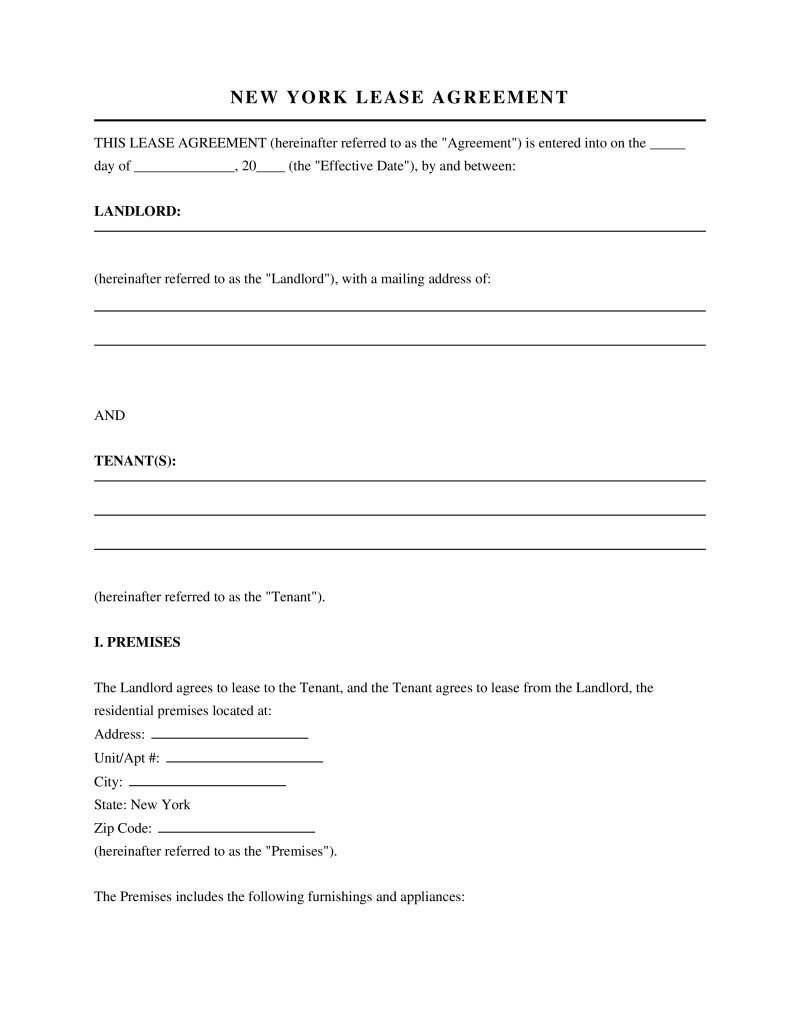
A New York Lease Agreement is a binding contract between a landlord and tenant that establishes the terms for renting residential property in the state.
Residential Property Type
Select the residential property category that best describes the rental premises.
Use this if the rental property does not fit one of the listed categories.
Table of Contents
What is a New York Lease Agreement?
A New York Lease Agreement is a legally binding contract executed between a landlord and a tenant to outline the terms and conditions regarding the rental of a property within the state. This document establishes the specific rights and responsibilities of both parties, including the duration of the tenancy, rent payment schedules, security deposit requirements, and rules regarding property maintenance. Landlords utilize this agreement to protect their property interests and ensure consistent income, while tenants rely on it to secure their right to occupy the premises and understand their financial obligations. The agreement must comply with New York State laws, including specific regulations found in the Real Property Law and General Obligations Law.
Types of New York Lease Agreements
Rental contracts in New York vary depending on the property type and the duration of the tenancy. Common variations include:
- Standard Residential Lease Agreement - Establishes a fixed-term tenancy, typically for one year, detailing rent, security deposits, and rules for residential occupancy.
- Commercial Lease Agreement - Governs the rental of property for business purposes, often including complex terms regarding operating expenses, zoning, and build-outs.
- Month-to-Month Rental Agreement - Creates a tenancy that renews automatically each month until terminated by either party with proper notice (NY Real Property Law § 232-b).
- Sublease Agreement - Allows an existing tenant to rent all or part of their leased space to a third party, subject to the landlord's approval.
- Roommate Agreement - Outlines the responsibilities and house rules between individuals sharing a single rental unit, distinct from the lease with the landlord.
State Statutes and Legal Requirements
New York maintains strict regulations protecting tenants and defining the landlord-tenant relationship. Key statutes include:
- Security Deposit Limits - Restricts landlords from demanding security deposits exceeding the equivalent of one month's rent (NY Gen. Oblig. Law § 7-108).
- Security Deposit Return Timeline - Mandates that landlords return the security deposit, less any itemized deductions, within 14 days of the tenant vacating the premises (NY Gen. Oblig. Law § 7-108(1-a)(e)).
- Warranty of Habitability - Requires landlords to maintain the premises in a condition fit for human habitation and free from conditions dangerous to life, health, or safety (NY Real Prop. Law § 235-b).
- Late Fee Restrictions - Caps late fees at the lesser of $50 or 5% of the monthly rent (NY Real Prop. Law § 238-a).
- Notice of Rent Increase - Requires landlords to provide advanced written notice for rent increases greater than 5% or if they intend not to renew the lease (NY Real Prop. Law § 226-c).
Required Disclosures in New York
Landlords must provide specific information to tenants before or at the time of signing the lease. Failure to provide these disclosures may result in legal penalties or potential lease invalidation:
- Lead-Based Paint Disclosure - Requires landlords of properties built before 1978 to inform tenants of any known lead paint hazards (42 U.S.C. § 4852d).
- Bed Bug Disclosure - Mandates that landlords in New York City provide a notice indicating the bed bug infestation history of the premises for the past year (NYC Admin. Code § 27-2018.1).
- Sprinkler System Disclosure - Obligates landlords to state whether the rental unit contains a maintained and operative sprinkler system (NY Real Prop. Law § 231-a).
- Indoor Allergen Hazards - Requires NYC landlords to inspect for and disclose hazards such as mold and pests (NYC Admin. Code § 27-2017).
- Security Deposit Receipt - Compels landlords to provide the name and address of the bank where the security deposit is held (NY Gen. Oblig. Law § 7-103).
Rent Stabilization and Control
New York, particularly New York City, operates under unique systems of rent regulation known as rent control and rent stabilization. These laws limit the amount a landlord can increase rent and provide tenants with the right to lease renewals. Rent stabilization generally applies to buildings built before 1974 with six or more units, although tax abatements can subject newer buildings to these rules. The Division of Housing and Community Renewal (DHCR) oversees these regulations. Leases for stabilized units must include a specific rider detailing the tenant's rights and the calculated legal rent.
Landlord Access and Entry Rights
New York laws balance a tenant's right to privacy with a landlord's need to maintain the property. While state statutes do not explicitly define notice periods for non-emergency entry, courts generally uphold the following standards:
- Reasonable Notice - Courts typically interpret reasonable notice as 24 hours before entering for non-emergency repairs or inspections.
- Emergency Access - Landlords may enter the property without prior notice in true emergencies, such as a fire or severe water leak.
- Business Hours - Entry for standard maintenance or showing the unit to prospective tenants should generally occur during normal business hours.
How to Execute a New York Lease Agreement
- Step 1: Application and Screening - The landlord collects a rental application to verify the tenant's income, credit history, and background, ensuring compliance with Fair Housing laws.
- Step 2: Drafting the Agreement - The parties draft the lease, incorporating all required state disclosures, rent amounts, and specific property rules.
- Step 3: Walkthrough Inspection - Both parties inspect the property to document existing damages, often utilizing a move-in checklist to prevent security deposit disputes later.
- Step 4: Signing and Payment - The landlord and tenant sign the document, and the tenant pays the first month's rent and security deposit.
- Step 5: Lease Registration - For rent-stabilized units, the landlord must register the lease and rent amount with the NY State Division of Housing and Community Renewal.
Lease Agreement in other states
Not the form you're looking for?
Try our legal document generator to create a custom document
Disclaimer: The templates available on this website are provided for general informational purposes only and do not constitute legal advice. They are not intended to be, and should not be interpreted as, compliant with any specific legal, regulatory, or privacy requirements. These templates are not a replacement for professional legal guidance and should not be relied upon for any particular matter or circumstance. Users are strongly encouraged to seek advice from a qualified attorney licensed in their jurisdiction before using, modifying, or relying on any template.
All templates are provided on an "as is," "with all faults," and "as available" basis. The provider disclaims any and all warranties of any kind, whether express, implied, statutory, or otherwise, including without limitation warranties of merchantability, fitness for a particular purpose, title, or non-infringement.
LegalTemplates.com makes no guarantees or representations regarding the accuracy, completeness, expected outcomes, or reliability of the materials contained in these templates or any materials referenced or linked from them.