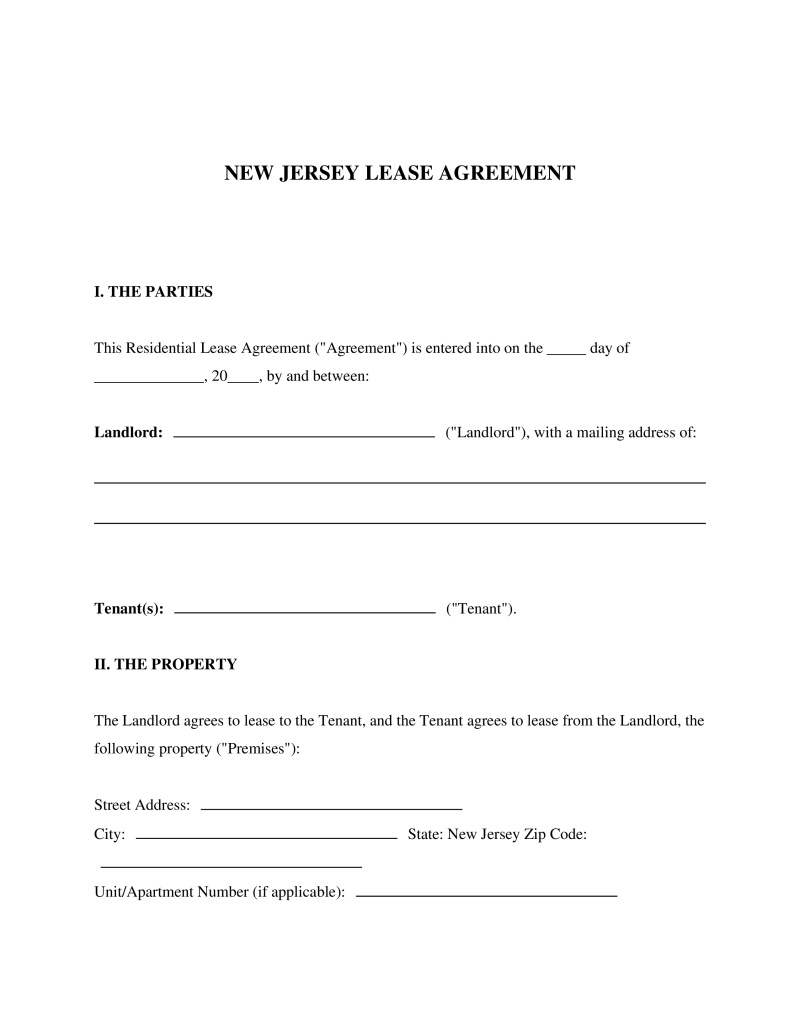
New Jersey Lease Agreement
A New Jersey Lease Agreement is a legal form that outlines the rental arrangement between a landlord and tenant, detailing the terms, responsibilities, and conditions for leasing property in New Jersey.
Residential Property Type
Select the residential property category that best describes the rental premises.
Use this if the rental property does not fit one of the listed categories.
Table of Contents
What is a New Jersey Lease Agreement?
A New Jersey lease agreement is a legally binding contract executed between a landlord and a tenant that outlines the terms and conditions for the rental of a residential or commercial property within the state. This document serves as the primary governing instrument for the tenancy, detailing critical obligations such as the monthly rent amount, payment schedules, property maintenance responsibilities, and the duration of the occupancy. Property owners and management companies utilize this agreement to secure their assets and ensure regulatory compliance, while tenants rely on it to understand their rights and housing security under state law.
Statutory Framework and Legal Compliance
The landlord-tenant relationship in New Jersey is governed by a complex set of statutes that are generally considered highly protective of tenant rights. The primary legislative framework includes the Anti-Eviction Act (N.J.S.A. 2A:18-61.1) and the Truth-in-Renting Act (N.J.S.A. 46:8-43). Unlike many other states, New Jersey law prohibits landlords from evicting residential tenants without "good cause," even after a lease term expires, provided the tenant continues to pay rent and abide by reasonable lease changes. Furthermore, federal laws such as the Fair Housing Act prevent discrimination based on race, religion, national origin, familial status, or disability.
Security Deposit Regulations
Financial interactions regarding security deposits are strictly regulated under the Rent Security Deposit Act (N.J.S.A. 46:8-19). In a New Jersey lease agreement, a landlord may not charge a security deposit exceeding one and a half times the monthly rent. If the landlord raises the rent annually, they may require additional security deposit funds, but this increase is capped at 10% of the current security deposit amount per year. Landlords are legally mandated to hold these funds in an interest-bearing account or a money market fund within the state and must notify the tenant of the bank's name and address within 30 days of receipt. Upon the termination of the lease, the landlord has 30 days to return the deposit along with any accrued interest, less any deductions for damages beyond normal wear and tear.
Mandatory Disclosures in New Jersey
For a lease to be fully compliant, specific disclosures must be provided to the tenant prior to or at the time of signing. These requirements ensure transparency regarding the condition of the property and the legal rights of the occupants.
- Truth in Renting Act: Landlords in buildings with more than two rental units (unless owner-occupied) must distribute the Department of Community Affairs' "Truth in Renting" guide.
- Flood Zone: The landlord must disclose if the property is located in a FEMA-designated flood zone.
- Window Guards: Leases must include a notice informing tenants of their right to request window guards if a child 10 years of age or younger resides in the unit.
- Lead-Based Paint: Pursuant to federal law, any property built before 1978 must include a lead paint disclosure and an EPA information pamphlet.
Required Elements of a Valid New Jersey Lease Agreement
While the specific clauses may vary depending on the property type, a standardized New Jersey lease agreement generally must contain specific elements to be enforceable in court. Missing these components can lead to ambiguities that are often interpreted against the drafting party, usually the landlord.
- Party Identification: Full legal names of the landlord and all adult tenants.
- Property Description: The specific address and unit number of the premises.
- Term of Tenancy: The start and end dates of the lease, or specification of a month-to-month arrangement.
- Rent Specifics: The total amount due, due date, acceptable payment methods, and any grace periods.
- Rights of Entry: Clauses specifying the notice period required before a landlord enters the unit (typically reasonable notice, often interpreted as 24 hours).
- Signatures: Dated signatures from all parties involved.
Eviction and Lease Termination
New Jersey is distinct in its approach to lease termination. Under the Anti-Eviction Act, landlords cannot simply choose not to renew a lease for a compliant tenant. Eviction proceedings can only be initiated for specific statutory causes, such as nonpayment of rent, disorderly conduct, destruction of property, or violation of reasonable lease rules and regulations. If a landlord wishes to terminate a tenancy for reasons such as taking the property off the rental market or personal occupancy, they must provide strictly timed notices to quit, the duration of which varies based on the specific ground for eviction cited in the statute.
Frequently Asked Questions
Already have a Lease Agreement?
Get it reviewed free — checked against your state's laws in about a minute.
Not the form you're looking for?
Try our legal document generator to create a custom document
Disclaimer: The templates available on this website are provided for general informational purposes only and do not constitute legal advice. They are not intended to be, and should not be interpreted as, compliant with any specific legal, regulatory, or privacy requirements. These templates are not a replacement for professional legal guidance and should not be relied upon for any particular matter or circumstance. Users are strongly encouraged to seek advice from a qualified attorney licensed in their jurisdiction before using, modifying, or relying on any template.
All templates are provided on an "as is," "with all faults," and "as available" basis. The provider disclaims any and all warranties of any kind, whether express, implied, statutory, or otherwise, including without limitation warranties of merchantability, fitness for a particular purpose, title, or non-infringement.
LegalTemplates.com makes no guarantees or representations regarding the accuracy, completeness, expected outcomes, or reliability of the materials contained in these templates or any materials referenced or linked from them.