Nevada Lease Agreement
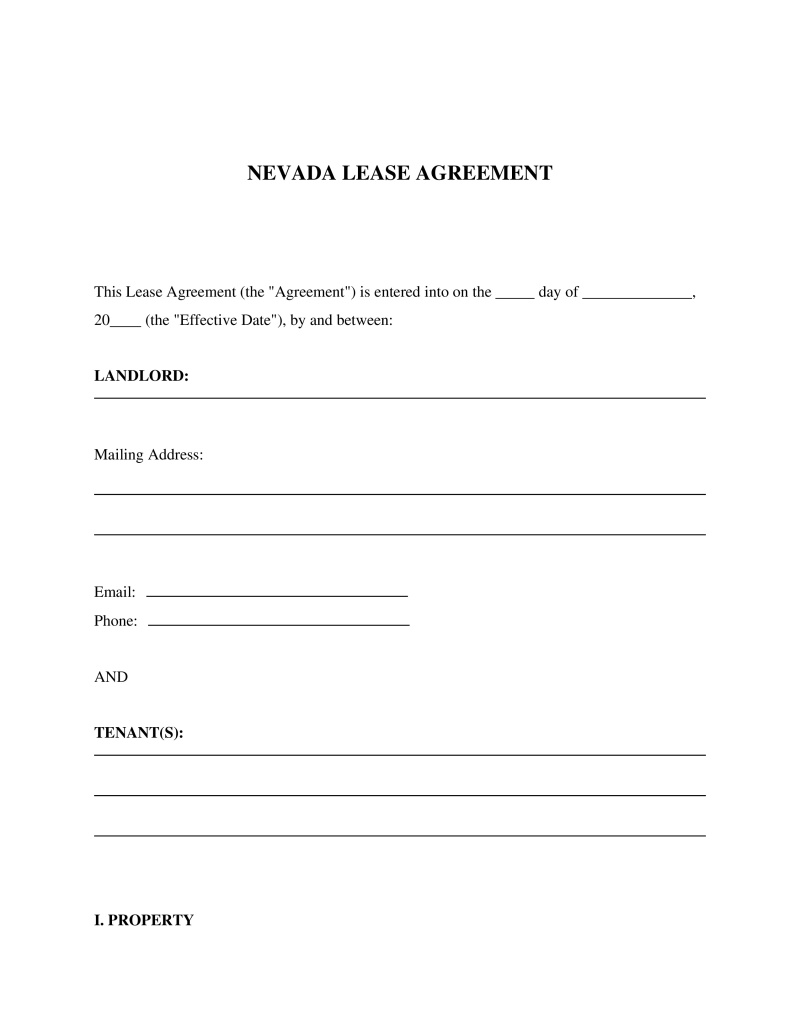
A Nevada Lease Agreement is a legal contract that defines the rental arrangement between a landlord and tenant, including the rules, payment terms, and responsibilities for leasing property in Nevada.
Residential Property Type
Select the residential property category that best describes the rental premises.
Use this if the rental property does not fit one of the listed categories.
Table of Contents
What is a Nevada Lease Agreement?
A Nevada Lease Agreement is a legally binding contract executed between a landlord (lessor) and a tenant (lessee) regarding the rental of a residential or commercial property within the state. This document establishes the formal terms of the tenancy, outlining the rights, responsibilities, and financial obligations of all parties involved. It serves as the primary governing document for the rental arrangement, detailing critical elements such as the duration of the lease, rent payment schedules, security deposit requirements, and rules regarding property use. By signing this agreement, both the landlord and tenant agree to comply with the stipulations set forth, which must align with the Nevada Revised Statutes (NRS) to be enforceable in a court of law.
Legal Framework and Statutory Requirements
The landlord-tenant relationship in Nevada is primarily governed by Title 10 of the Nevada Revised Statutes. Specifically, NRS Chapter 118A addresses the Landlord and Tenant: Dwellings, covering residential agreements, while commercial leases are generally subject to contract law and specific sections of NRS Chapter 118C. These statutes provide a comprehensive framework that overrides any lease terms attempting to waive statutory rights. For instance, Nevada law prohibits lease clauses that attempt to waive a tenant's right to a habitable dwelling or the right to sue for damages. Furthermore, while oral agreements for tenancies of less than one year are technically valid, the Statute of Frauds requires that any lease with a term exceeding one year must be in writing to be legally enforceable.
Mandatory Disclosures in Nevada
To ensure transparency and legal compliance, state law mandates that landlords disclose specific information to tenants prior to the commencement of the tenancy. These disclosures are typically integrated directly into the Nevada Lease Agreement or attached as addendums.
- Non-Refundable Fees: The agreement must explicitly state the purpose of any non-refundable fees. If a fee is not designated as non-refundable in writing, the law treats it as refundable.
- Foreclosure Proceedings: Under NRS 118A.275, landlords must disclose if the property is currently subject to foreclosure proceedings.
- Nuisance Laws: Landlords are required to inform tenants regarding the state's definition of nuisance and the penalties associated with reporting nuisances.
- USA Flag Rights: Nevada law (NRS 118A.325) grants tenants the right to display the flag of the United States, and the lease usually outlines the permissible placement of such flags.
- Inventory Checklist: While not strictly a disclosure, the landlord must provide a signed inventory and condition form upon move-in to document existing damages.
Security Deposits and Rent Regulations
Financial interactions between landlords and tenants are strictly regulated to prevent exploitation. According to NRS 118A.242, a landlord cannot demand a security deposit (including the last month's rent) that exceeds the equivalent of three months' periodic rent. This cap applies regardless of whether the unit is furnished or unfurnished. Additionally, surety bonds may be used as a substitute for a security deposit if agreed upon by both parties.
Upon the termination of the tenancy, the landlord is obligated to return the security deposit within 30 days. If deductions are made for damages exceeding normal wear and tear or for unpaid rent, the landlord must provide an itemized written accounting of these deductions. Regarding rent, Nevada does not impose statewide rent control; however, landlords must provide 60 days' written notice to increase rent for periodic tenancies (e.g., month-to-month). Late fees must be reasonable and are legally capped at 5% of the periodic rent payment.
Landlord Access and Tenant Privacy
The Nevada Lease Agreement must respect the tenant's right to quiet enjoyment of the premises. State statutes dictate that a landlord must provide at least 24 hours of notice before entering the rental unit for non-emergency reasons, such as conducting inspections, making necessary repairs, or showing the unit to prospective buyers or tenants. Entry is generally permitted only during reasonable business hours. In cases of emergency, such as a fire or a burst pipe, the notice requirement is waived, and the landlord may enter immediately to protect the property and safety of the occupants.
How to Execute a Nevada Lease Agreement
Finalizing a rental contract involves several procedural steps to ensure the document is valid and that both parties are protected under state law.
- Step 1: Drafting the Agreement – The landlord prepares the document, ensuring all terms comply with NRS Chapter 118A and that all mandatory disclosures are included.
- Step 2: Tenant Screening and Review – After passing background or credit checks, the tenant reviews the lease terms. This is the stage to negotiate specific clauses, such as pet policies or lease duration.
- Step 3: Move-In Inspection – Both parties should conduct a walkthrough of the property. They must sign a move-in checklist documenting the current condition of the premises to avoid disputes over security deposits later.
- Step 4: Signing and Payment – Both the landlord and tenant sign and date the agreement. At this time, the tenant typically pays the first month's rent and the security deposit.
- Step 5: Copy Distribution – The landlord must provide the tenant with a free copy of the signed agreement immediately or within a reasonable timeframe after execution.
Termination and Eviction Procedures
The lease outlines the procedures for ending the tenancy, which must adhere to the specific notice periods defined by law. For a standard month-to-month tenancy, a landlord must typically provide 30 days' notice to terminate without cause, although this requirement extends to 60 days if the tenant has resided in the unit for at least one year. If a tenant fails to pay rent, the landlord must serve a specific notice (often a 7-Day Notice to Pay or Quit) before filing for summary eviction. It is illegal for landlords to engage in "self-help" eviction tactics, such as changing locks or shutting off utilities, without a court order.
Frequently Asked Questions
Lease Agreement in other states
Already have a Lease Agreement?
Get it reviewed free — checked against your state's laws in about a minute.
Not the form you're looking for?
Try our legal document generator to create a custom document
Disclaimer: The templates available on this website are provided for general informational purposes only and do not constitute legal advice. They are not intended to be, and should not be interpreted as, compliant with any specific legal, regulatory, or privacy requirements. These templates are not a replacement for professional legal guidance and should not be relied upon for any particular matter or circumstance. Users are strongly encouraged to seek advice from a qualified attorney licensed in their jurisdiction before using, modifying, or relying on any template.
All templates are provided on an "as is," "with all faults," and "as available" basis. The provider disclaims any and all warranties of any kind, whether express, implied, statutory, or otherwise, including without limitation warranties of merchantability, fitness for a particular purpose, title, or non-infringement.
LegalTemplates.com makes no guarantees or representations regarding the accuracy, completeness, expected outcomes, or reliability of the materials contained in these templates or any materials referenced or linked from them.