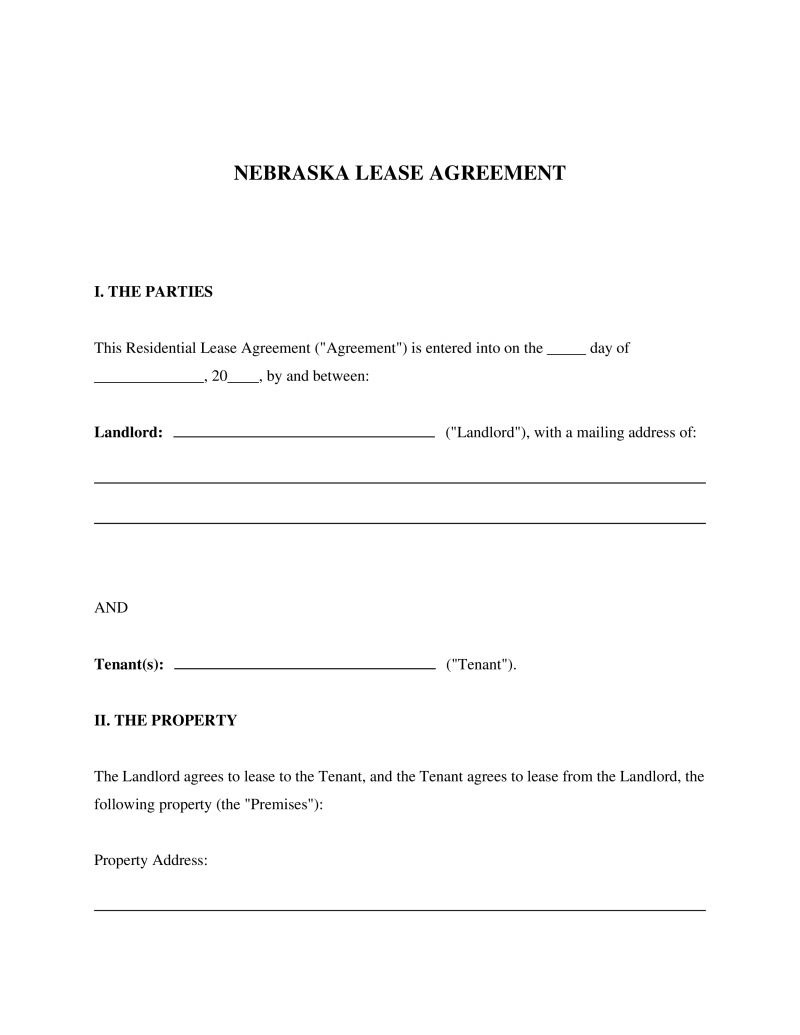
Nebraska Lease Agreement
A Nebraska Lease Agreement is a legal document that records the rental arrangement between a landlord and tenant, specifying the terms, responsibilities, and conditions for leasing property in the state.
Residential Property Type
Select the residential property category that best describes the rental premises.
Use this if the rental property does not fit one of the listed categories.
Table of Contents
What is a Nebraska Lease Agreement?
A Nebraska Lease Agreement is a legally binding contract entered into by a landlord and a tenant to outline the terms and conditions for renting a residential or commercial property within the state. This document establishes the rights and obligations of both parties, covering essential details such as the monthly rental amount, payment due dates, security deposit requirements, and the duration of the tenancy. It serves as the primary legal record of the arrangement, providing a framework for dispute resolution and ensuring that the rental relationship complies with the Nebraska Uniform Residential Landlord and Tenant Act.
Legal Framework and Statutory Requirements
The governance of residential rental contracts in the state falls primarily under the Uniform Residential Landlord and Tenant Act adopted by Nebraska. Found within the Nebraska Revised Statutes, specifically Chapter 76, Article 14, these laws dictate the permissible provisions that can be included in a lease. While federal laws such as the Fair Housing Act prohibit discrimination based on race, religion, national origin, gender, disability, or family status, state statutes address specific operational aspects like security deposits and entry rights. A lease that contains provisions contrary to these statutes, such as waiving a tenant's right to sue for damages, may find those specific clauses unenforceable in a court of law.
Security Deposit Regulations
State law imposes specific limitations on the amount a landlord may charge for a security deposit to protect tenants from excessive upfront costs. Under Nebraska Rev. Stat. § 76-1416, a landlord generally cannot demand or receive security, however denominated, in an amount or value in excess of one month's periodic rent. However, a specific exception exists for pet owners; if the tenant has a pet, the landlord may demand an additional amount not to exceed one-quarter of one month's periodic rent. Upon termination of the tenancy, property owners are required to return the remaining balance of the deposit to the tenant within 14 days of a demand for payment, typically accompanied by an itemized list of any deductions made for damages or unpaid rent.
Mandatory Disclosures in Nebraska
To ensure a Nebraska Lease Agreement is valid and transparent, specific disclosures must be provided to the tenant before or at the time of signing. Failure to include these elements can lead to legal complications.
- Lead-Based Paint Disclosure: For any property constructed prior to 1978, federal law requires landlords to provide information regarding the known presence of lead-based paint and lead-based paint hazards.
- Identification of Landlord and Agents: The agreement must disclose the name and address of the property owner and any person authorized to manage the premises or receive notices and demands on behalf of the owner.
- Security Deposit Location: While not strictly required to be in a separate interest-bearing account for all private landlords, the terms regarding the holding and return of the deposit must be clear and compliant with state caps.
- Shared Utilities: If the unit shares a master meter for utilities with other units or common areas, the landlord should disclose how charges are calculated and allocated.
Landlord Access and Tenant Privacy
Privacy rights for tenants are protected under state statutes, which regulate when and how a landlord may enter the rented premises. Generally, a landlord must provide at least one day's notice (24 hours) before entering the unit for non-emergency reasons, such as inspections, repairs, alterations, or showing the property to prospective tenants or buyers. Entry must occur at reasonable times. In the event of an emergency, such as a fire or significant water leak, the requirement for advance notice is waived, allowing the landlord immediate access to address the situation and prevent further property damage. Tenants cannot unreasonably withhold consent for the landlord to enter the unit for legitimate purposes.
Fixed-Term vs. Month-to-Month Tenancies
A fixed-term lease creates a tenancy for a specific duration, most commonly one year. During this period, the terms of the agreement cannot be changed by the landlord without the tenant's consent, and the tenant is liable for rent for the entire term unless the lease is terminated early for valid legal cause or mutual agreement. In contrast, a month-to-month rental agreement renews automatically at the end of every monthly payment cycle. This arrangement offers greater flexibility, allowing either party to terminate the tenancy with proper written notice, usually 30 days prior to the periodic rental date. While fixed-term leases provide stability regarding rent prices and housing security, month-to-month agreements are often preferred for short-term housing needs or transitional periods.
Termination and Eviction Procedures
The process for terminating a rental contract varies depending on the reason for termination. For non-payment of rent, a landlord must issue a written notice giving the tenant three days to pay the outstanding amount or vacate the premises. If the tenant violates other terms of the lease, such as keeping unauthorized pets or causing excessive noise, the landlord typically provides a 14/30-day notice. This notice states that the lease will terminate in 30 days if the breach is not remedied within 14 days. If the breach is not fixable or happens again within six months, the landlord may terminate the agreement with a 14-day written notice. Strict adherence to these notice periods is required for an eviction to be upheld in court.
FAQs
Already have a Lease Agreement?
Get it reviewed free — checked against your state's laws in about a minute.
Not the form you're looking for?
Try our legal document generator to create a custom document
Disclaimer: The templates available on this website are provided for general informational purposes only and do not constitute legal advice. They are not intended to be, and should not be interpreted as, compliant with any specific legal, regulatory, or privacy requirements. These templates are not a replacement for professional legal guidance and should not be relied upon for any particular matter or circumstance. Users are strongly encouraged to seek advice from a qualified attorney licensed in their jurisdiction before using, modifying, or relying on any template.
All templates are provided on an "as is," "with all faults," and "as available" basis. The provider disclaims any and all warranties of any kind, whether express, implied, statutory, or otherwise, including without limitation warranties of merchantability, fitness for a particular purpose, title, or non-infringement.
LegalTemplates.com makes no guarantees or representations regarding the accuracy, completeness, expected outcomes, or reliability of the materials contained in these templates or any materials referenced or linked from them.