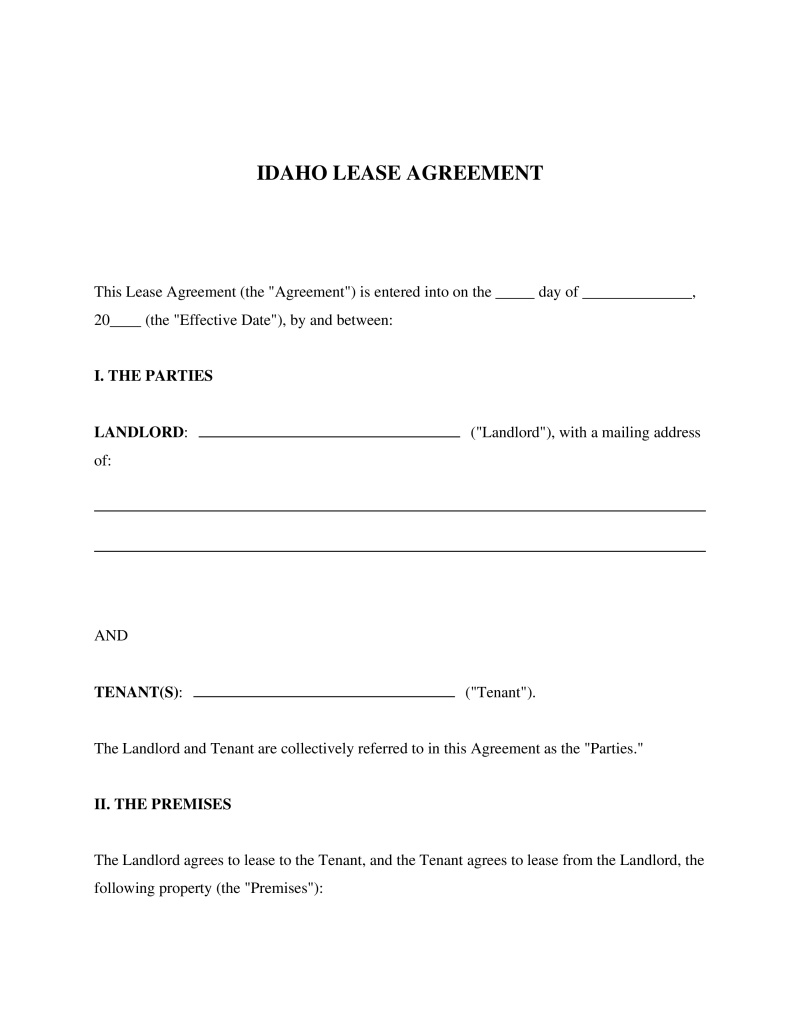
Idaho Lease Agreement
An Idaho Lease Agreement is a legal document that outlines the terms under which one party agrees to rent property from another party in Idaho.
Residential Property Type
Select the residential property category that best describes the rental premises.
Use this if the rental property does not fit one of the listed categories.
Table of Contents
What is an Idaho Lease Agreement?
An Idaho Lease Agreement is a legally binding contract that outlines the terms and conditions under which a landlord permits a tenant to occupy a property or use an asset within the state of Idaho. This agreement establishes the rights and responsibilities of both parties, covering aspects such as rent, duration, property use, and maintenance. It is a fundamental document for establishing a tenancy or other leasing arrangement, ensuring clarity and enforceability in the relationship between lessor and lessee. These agreements can pertain to real estate, such as residential homes or commercial spaces, various types of land, or even tangible personal property.
Types of Idaho Lease Agreements
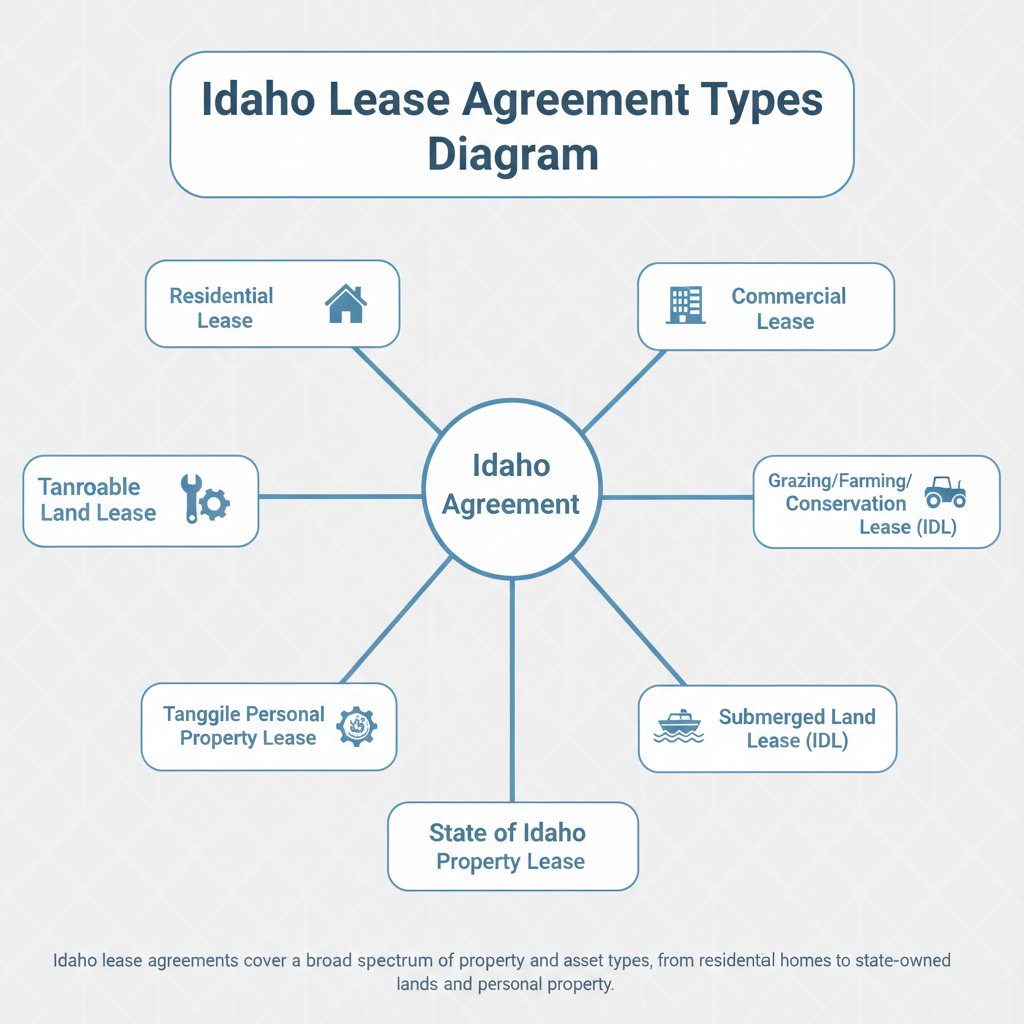
Lease agreements in Idaho encompass a wide range of property and asset types, reflecting the state's diverse economic and geographic landscape. These agreements are tailored to the specific nature of the leased item and the intended use.
- Residential Lease Agreement - Governs the rental of homes, apartments, or other dwellings for residential purposes. These agreements detail terms like rent, security deposits, and tenant responsibilities, forming the basis of the landlord-tenant relationship (Idaho Landlord-Tenant Law).
- Commercial Lease Agreement - Pertains to the rental of office spaces, retail storefronts, warehouses, or other properties used for business operations. These leases often include complex clauses regarding build-outs, common area maintenance (CAM) charges, and specific business uses.
- Grazing, Farming, and Conservation Lease - Involves the leasing of approximately 2.5 million acres of Idaho's endowment land by the Idaho Department of Lands. Revenue generated from these leases is dedicated to funding Idaho's public schools, supporting agricultural activities and natural resource management (Idaho Department of Lands).
- Submerged Land Lease - Required for specific uses of submerged lands within Idaho's navigable waterways. This includes commercial ventures like marinas, stores, and restaurants, as well as private uses such as community docks and float homes (Idaho Department of Lands).
- State of Idaho Property Lease - Property owners can lease various types of real estate, including office space, warehouses, land, and specialty properties, to the State of Idaho for its operational needs. Leases extending beyond five years require special approval from the State Board of Examiners (leasing.idaho.gov).
- Tangible Personal Property Lease - Covers the rental of items like equipment, vehicles, or machinery. In Idaho, leases of tangible personal property are generally considered taxable sales, requiring lessors to collect sales tax unless the lessee presents a valid exemption certificate (Form ST-101) (Idaho State Tax Commission).
Key Elements of a Written Idaho Lease
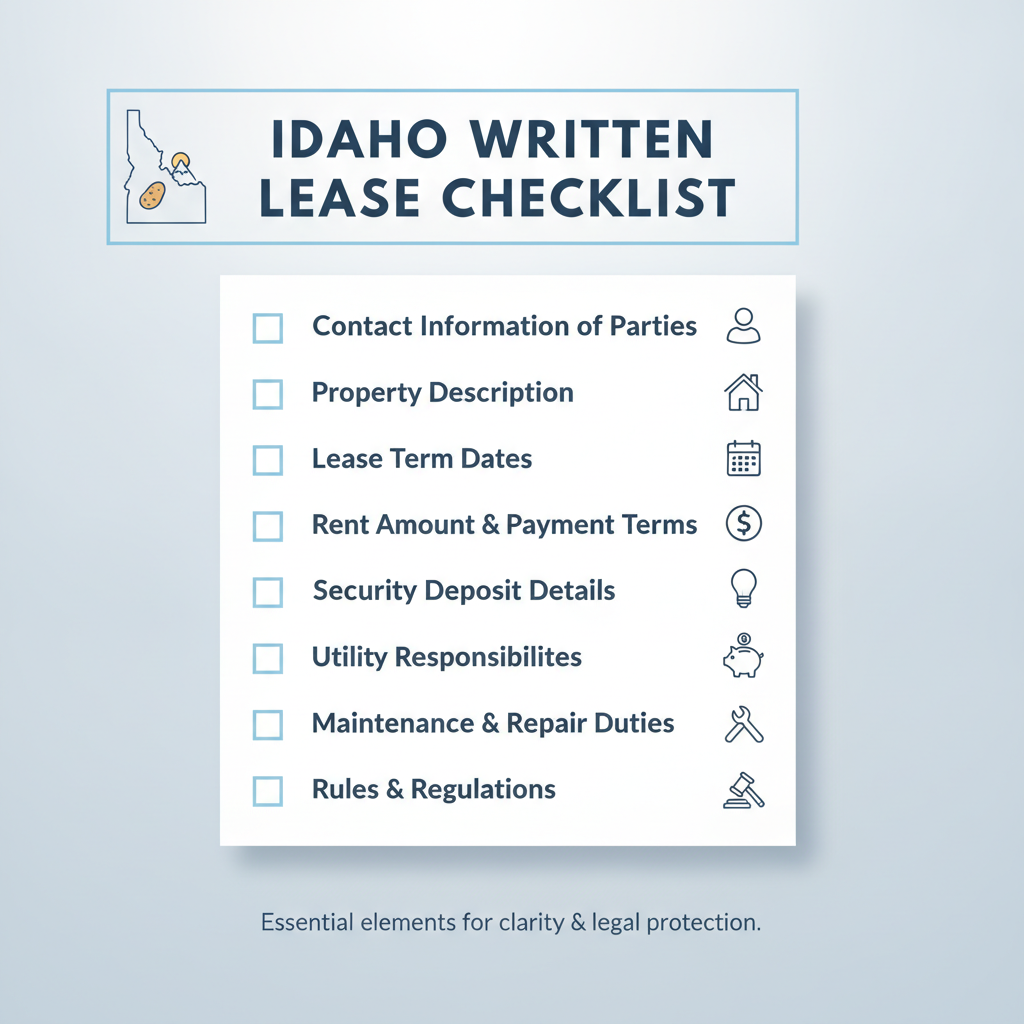
While Idaho recognizes certain oral agreements, a written Idaho Lease Agreement provides clarity and legal protection for both parties by documenting all agreed-upon terms. A comprehensive written lease ensures that critical details are not overlooked and can be referenced in case of disputes.
A well-drafted written lease agreement should generally include:
- Contact Information - Full legal names and addresses of all parties involved, including the landlord(s) and tenant(s).
- Property Details - A clear and precise description of the leased property, including its physical address and any specific unit numbers or identifying features.
- Agreement Dates - The start and end dates of the lease term, specifying whether it is a fixed-term lease or a month-to-month arrangement.
- Rent Amount and Payment Terms - The exact amount of rent due, the due date, acceptable payment methods, and any grace periods or late fees.
- Security Deposit Information - The amount of the security deposit, conditions for its return, and any allowable deductions.
- Utilities - Specification of which party is responsible for various utility payments (e.g., electricity, water, gas, internet).
- Maintenance and Repairs - Delineation of responsibilities for property maintenance and repairs, including procedures for reporting issues.
- Rules and Regulations - Any specific rules regarding property use, such as pet policies, smoking restrictions, or guest policies.
- Signatures - The signatures of all parties to indicate their agreement to the terms (Idaho Landlord-Tenant Law).
Oral vs. Written Leases in Idaho
Idaho law makes a distinction between oral and written lease agreements, primarily based on the duration of the tenancy. Understanding this difference is crucial for both landlords and tenants.
Idaho recognizes oral leases for tenancies that are less than one year in duration, provided that all terms of the agreement are clearly established and understood by both parties. While legally valid, oral agreements can be challenging to enforce due to the lack of documented proof of specific terms. For tenancies lasting one year or longer, a written lease agreement is generally required to be legally enforceable, adhering to the Statute of Frauds principles common in many jurisdictions. A written lease helps prevent misunderstandings and provides a clear record of the agreed-upon conditions (Idaho Landlord-Tenant Law).
Leasing State and Endowment Lands
The State of Idaho, through its Department of Lands (IDL), actively manages and leases significant portions of its public lands. These leasing programs serve specific purposes, often generating revenue that benefits public services.
The IDL leases approximately 2.5 million acres of endowment land. The primary purpose of these leases is to generate revenue that directly funds Idaho's public schools, fulfilling the constitutional mandate for managing these lands. These programs include:
- Grazing Leases - Permits for livestock grazing on state lands.
- Farming Leases - Agreements for agricultural cultivation on state-owned acreage.
- Conservation Leases - Leases designed to support conservation efforts and natural resource management (Idaho Department of Lands).
Additionally, the IDL is responsible for managing Idaho's navigable waterways, which includes leasing submerged lands. These leases are required for a variety of uses:
- Commercial Uses - Such as the establishment of marinas, stores, and restaurants that utilize submerged land.
- Private Uses - Including community docks and float homes that extend over or are situated on submerged lands (Idaho Department of Lands).
Leasing to the State of Idaho
Property owners in Idaho have the opportunity to lease their properties to the State of Idaho, providing space for various government operations. This process involves specific requirements and approvals.
The State of Idaho leases a range of property types to meet its operational needs. These include office spaces for state agencies, warehouses for storage, general land for various purposes, and specialty properties that may have unique requirements. For leases that extend beyond a five-year term, special approval from the State Board of Examiners is required, ensuring fiscal responsibility and long-term planning for state expenditures (leasing.idaho.gov).
Taxation of Leases in Idaho
Lease agreements in Idaho are subject to specific tax regulations, particularly concerning tangible personal property. Lessors must be aware of their obligations to ensure compliance with state tax law.
In Idaho, leases involving tangible personal property are generally classified as taxable sales. This means that lessors are required to collect sales tax on the lease payments. However, exemptions may apply if the customer qualifies and provides the lessor with a completed Form ST-101, which is the Idaho Sales Tax Exemption Certificate. It is the lessor's responsibility to understand and apply these tax requirements to their leasing activities (Idaho State Tax Commission).
Frequently Asked Questions
Sources
- Leasing Out Tangible Personal Property - Provides information on the taxation of leasing tangible personal property in Idaho.
- Grazing, Farming and Conservation Leasing - Details the leasing process for grazing, farming, and conservation on endowment lands in Idaho.
- Submerged Land Lease - Outlines the process for leasing submerged lands in Idaho's navigable waterways.
- How to Lease to the State - Provides guidance for property owners on leasing to the State of Idaho.
- Idaho Landlord-Tenant Law - Offers guidance on landlord-tenant relationships and lease agreements in Idaho.
Already have a Lease Agreement?
Get it reviewed free — checked against your state's laws in about a minute.
Not the form you're looking for?
Try our legal document generator to create a custom document
Disclaimer: The templates available on this website are provided for general informational purposes only and do not constitute legal advice. They are not intended to be, and should not be interpreted as, compliant with any specific legal, regulatory, or privacy requirements. These templates are not a replacement for professional legal guidance and should not be relied upon for any particular matter or circumstance. Users are strongly encouraged to seek advice from a qualified attorney licensed in their jurisdiction before using, modifying, or relying on any template.
All templates are provided on an "as is," "with all faults," and "as available" basis. The provider disclaims any and all warranties of any kind, whether express, implied, statutory, or otherwise, including without limitation warranties of merchantability, fitness for a particular purpose, title, or non-infringement.
LegalTemplates.com makes no guarantees or representations regarding the accuracy, completeness, expected outcomes, or reliability of the materials contained in these templates or any materials referenced or linked from them.