Georgia Lease Agreement
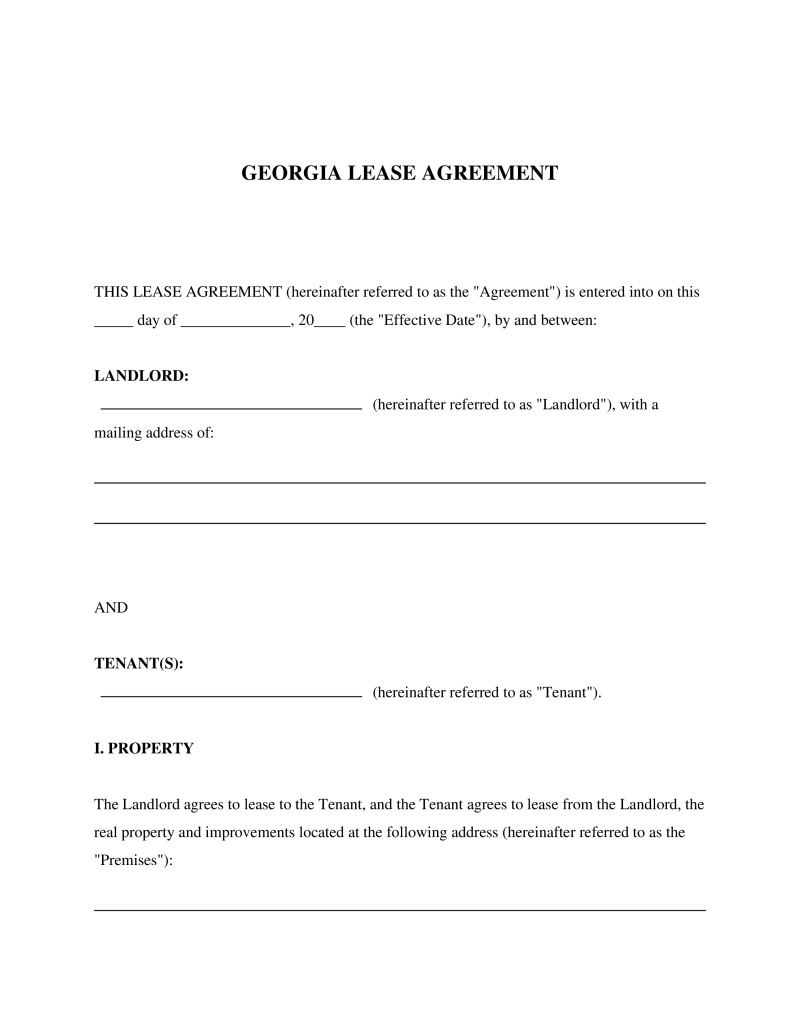
A Georgia Lease Agreement is a legally binding contract between a landlord and a tenant that specifies the terms and conditions for renting residential property within the state of Georgia.
Residential Property Type
Select the residential property category that best describes the rental premises.
Use this if the rental property does not fit one of the listed categories.
Table of Contents
What is a Georgia Lease Agreement?
A Georgia Lease Agreement is a legally binding contract between a landlord and a tenant that outlines the terms and conditions for renting residential property within the state of Georgia. This document establishes the rights and responsibilities of both parties, covering aspects such as rent payments, lease duration, property maintenance, and dispute resolution. It serves to protect the interests of both the property owner and the occupant, providing a clear framework for the tenancy.
Legal Framework Governing Georgia Leases
Lease agreements in Georgia are primarily governed by state law, specifically Title 44, Chapter 7 of the Official Code of Georgia Annotated (OCGA). This chapter provides the statutory framework for landlord and tenant relationships concerning residential properties. Complementing these statutes, the Georgia Department of Community Affairs (DCA) publishes a Landlord-Tenant Handbook, which offers practical guidance and clarifies many aspects of these legal provisions.
Key legal considerations under Georgia law include:
- Georgia Landlord and Tenant Act - Establishes the general rights, obligations, and remedies for both landlords and tenants in residential rental agreements (OCGA Title 44, Chapter 7).
- Georgia Department of Community Affairs Handbook - Provides comprehensive guidance on landlord-tenant laws, including a sample lease agreement template and information on dispute resolution processes.
Key Provisions in a Georgia Lease Agreement
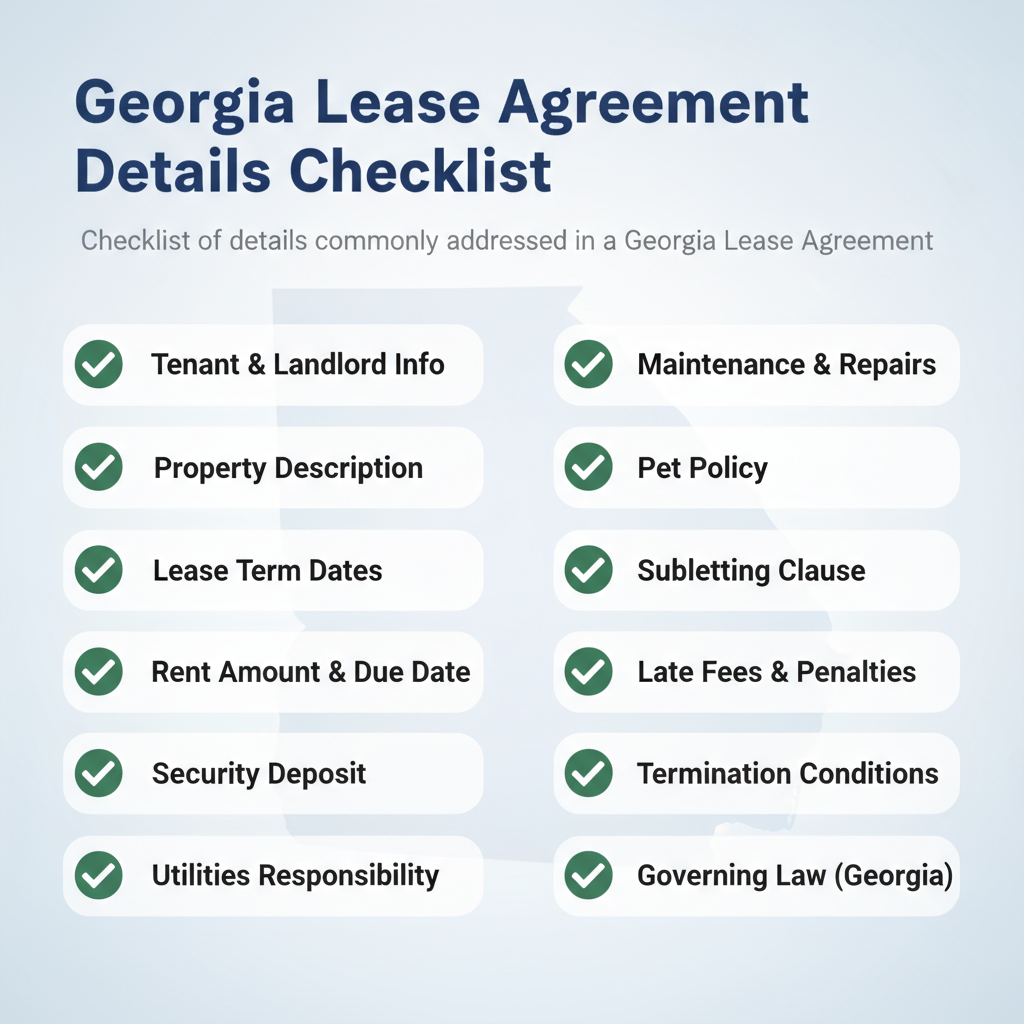
A comprehensive Georgia Lease Agreement typically includes several essential provisions to ensure clarity and avoid future misunderstandings. These elements define the core aspects of the rental arrangement and are crucial for both parties to understand before signing.
- Identification of Parties - Full legal names and contact information for both the landlord(s) and tenant(s).
- Property Description - A detailed description of the rental property, including the full address and any specific unit numbers.
- Lease Term - The start and end dates of the tenancy, specifying whether it is a fixed-term lease (e.g., 12 months) or a month-to-month arrangement.
- Rent Amount and Payment Terms - The exact amount of rent, due date, acceptable payment methods, and any grace period or late fees.
- Security Deposit Details - The amount of the security deposit, conditions for its return, and any allowable deductions, in accordance with state law.
- Utilities and Services - Clarification of which party is responsible for specific utilities (e.g., electricity, water, gas, internet) and other services.
- Maintenance and Repairs - Delineation of responsibilities for property maintenance, routine repairs, and emergency procedures.
- Pet Policy - Any restrictions on pets, pet fees, or pet deposits.
- Occupancy Limits - The maximum number of individuals permitted to reside in the property.
- Termination Clause - Conditions under which the lease can be terminated by either party, including required notice periods.
- Signatures - Dated signatures of all adult tenants and the landlord or their authorized agent.
Types of Residential Lease Agreements in Georgia
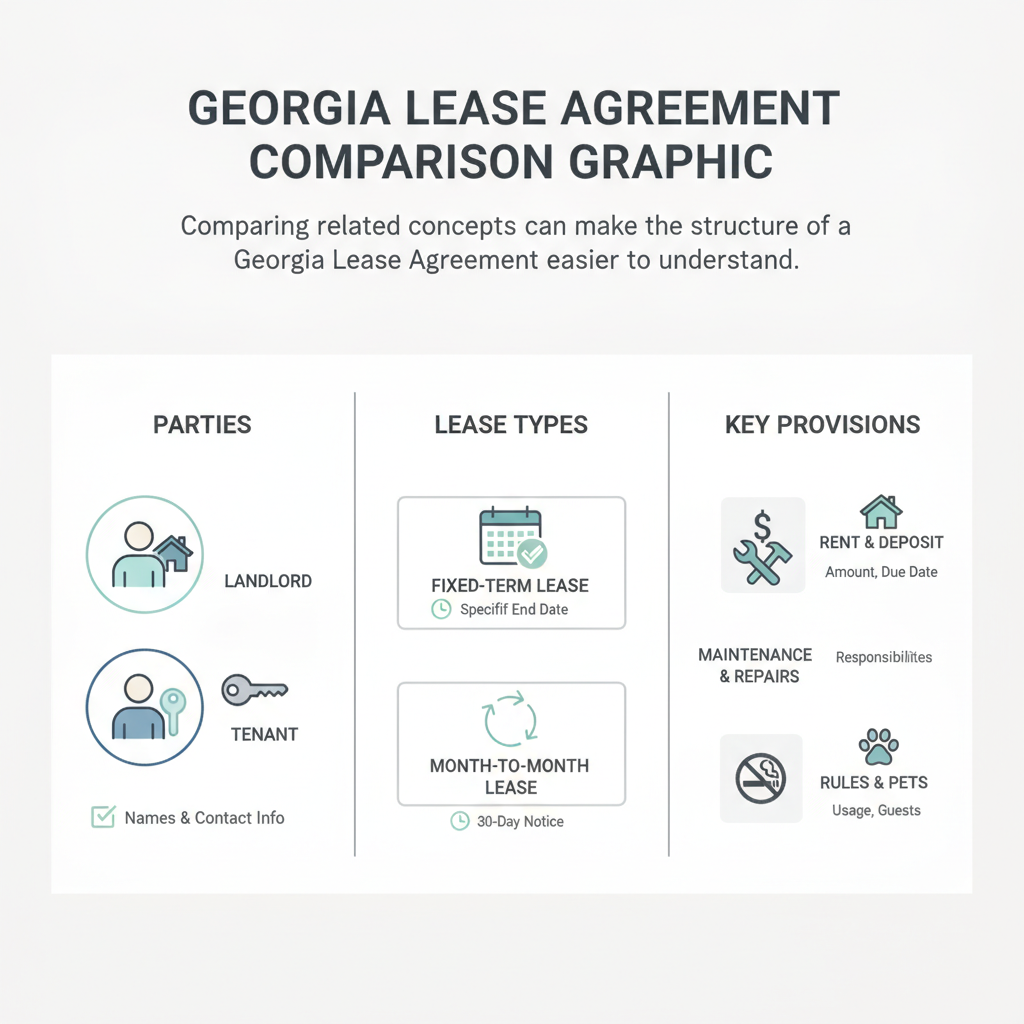
Residential lease agreements in Georgia can take various forms, each suited to different tenancy durations and preferences. The choice of lease type impacts the flexibility and stability for both the landlord and the tenant.
- Fixed-Term Lease Agreement - This agreement specifies a definite period for the tenancy, typically 6 or 12 months. During this period, neither the landlord nor the tenant can terminate the lease without cause, unless explicitly allowed by a specific clause within the agreement. Rent cannot be increased during a fixed term, providing stability for the tenant.
- Month-to-Month Lease Agreement - This arrangement allows the tenancy to continue on a monthly basis, automatically renewing at the end of each month until either the landlord or the tenant provides proper notice to terminate. It offers greater flexibility for both parties but also less stability regarding rent amounts and tenancy duration.
- Sublease Agreement - A sublease occurs when a tenant (the sublessor) rents out all or part of their rented property to another individual (the sublessee). The original tenant remains responsible for the lease obligations to the landlord, and the sublease agreement must typically be approved by the landlord.
Georgia Security Deposit Regulations
Georgia law imposes specific requirements and limitations regarding security deposits to protect both landlords and tenants. These regulations cover the collection, holding, and return of security deposits.
- Holding Deposits - Landlords must place security deposits in an escrow account, either in a regulated financial institution in Georgia or post a surety bond. Tenants must be informed of the location of the escrow account (OCGA § 44-7-31).
- Inspection and Damages List - Before accepting a security deposit, the landlord must provide the tenant with a comprehensive list of existing damages to the property. The tenant has the right to inspect the premises and agree or disagree with the list (OCGA § 44-7-33).
- Return Timeline - Landlords must return the security deposit, or the remainder of it after lawful deductions, to the tenant within 30 days after the termination of the lease or the surrender of the premises, whichever occurs later (OCGA § 44-7-34).
- Itemized Deductions - If any portion of the security deposit is withheld, the landlord must provide the tenant with an itemized statement detailing the reasons for the deductions. Deductions are typically allowed for unpaid rent, damages beyond normal wear and tear, and other agreed-upon costs outlined in the lease (OCGA § 44-7-34).
Tenant and Landlord Rights and Responsibilities
Both tenants and landlords in Georgia possess specific rights and responsibilities that are integral to a fair and lawful tenancy. These are generally outlined in the lease agreement and reinforced by state law.
For tenants, key rights and responsibilities include:
- Right to Habitability - The right to a safe, sanitary, and habitable living environment.
- Right to Privacy - Protection from unreasonable entry by the landlord, requiring proper notice for non-emergency access.
- Responsibility for Rent - The obligation to pay rent on time as specified in the lease agreement.
- Responsibility for Property Care - The duty to maintain the rental unit in a clean and safe condition and to avoid causing damage beyond normal wear and tear.
For landlords, key rights and responsibilities include:
- Right to Collect Rent - The right to receive timely rent payments as agreed upon.
- Right to Property Access - The right to enter the property for maintenance, inspections, or showings, typically with reasonable notice.
- Responsibility for Maintenance - The duty to keep the property in good repair and ensure all essential services are functional.
- Responsibility for Disclosures - The obligation to disclose certain information, such as lead-based paint hazards for properties built before 1978.
Dispute Resolution for Lease Agreements
When disagreements arise between landlords and tenants in Georgia, several avenues exist for resolving disputes, ranging from informal communication to formal legal proceedings. The Georgia Department of Community Affairs Landlord-Tenant Handbook encourages communication and provides guidance on these processes.
- Direct Communication - Often, the first step involves direct communication between the landlord and tenant to clarify issues and find a mutually agreeable solution.
- Mediation - For disputes that cannot be resolved directly, mediation offers a voluntary process where a neutral third party helps facilitate discussion and negotiation between the parties to reach a settlement.
- Legal Action (Dispossessory Proceedings) - If a tenant fails to pay rent or violates other lease terms, a landlord may initiate a dispossessory action in court to evict the tenant. Conversely, tenants may sue landlords for failure to uphold their responsibilities.
Frequently Asked Questions
Sources
- Georgia Department of Community Affairs: Landlord-Tenant Handbook - Offers guidance on landlord and tenant rights and responsibilities under Georgia law.
Already have a Lease Agreement?
Get it reviewed free — checked against your state's laws in about a minute.
Not the form you're looking for?
Try our legal document generator to create a custom document
Disclaimer: The templates available on this website are provided for general informational purposes only and do not constitute legal advice. They are not intended to be, and should not be interpreted as, compliant with any specific legal, regulatory, or privacy requirements. These templates are not a replacement for professional legal guidance and should not be relied upon for any particular matter or circumstance. Users are strongly encouraged to seek advice from a qualified attorney licensed in their jurisdiction before using, modifying, or relying on any template.
All templates are provided on an "as is," "with all faults," and "as available" basis. The provider disclaims any and all warranties of any kind, whether express, implied, statutory, or otherwise, including without limitation warranties of merchantability, fitness for a particular purpose, title, or non-infringement.
LegalTemplates.com makes no guarantees or representations regarding the accuracy, completeness, expected outcomes, or reliability of the materials contained in these templates or any materials referenced or linked from them.