Delaware Lease Agreement
A Delaware Lease Agreement is a legal document that outlines the terms and conditions between a landlord and tenant for the rental of property in Delaware.
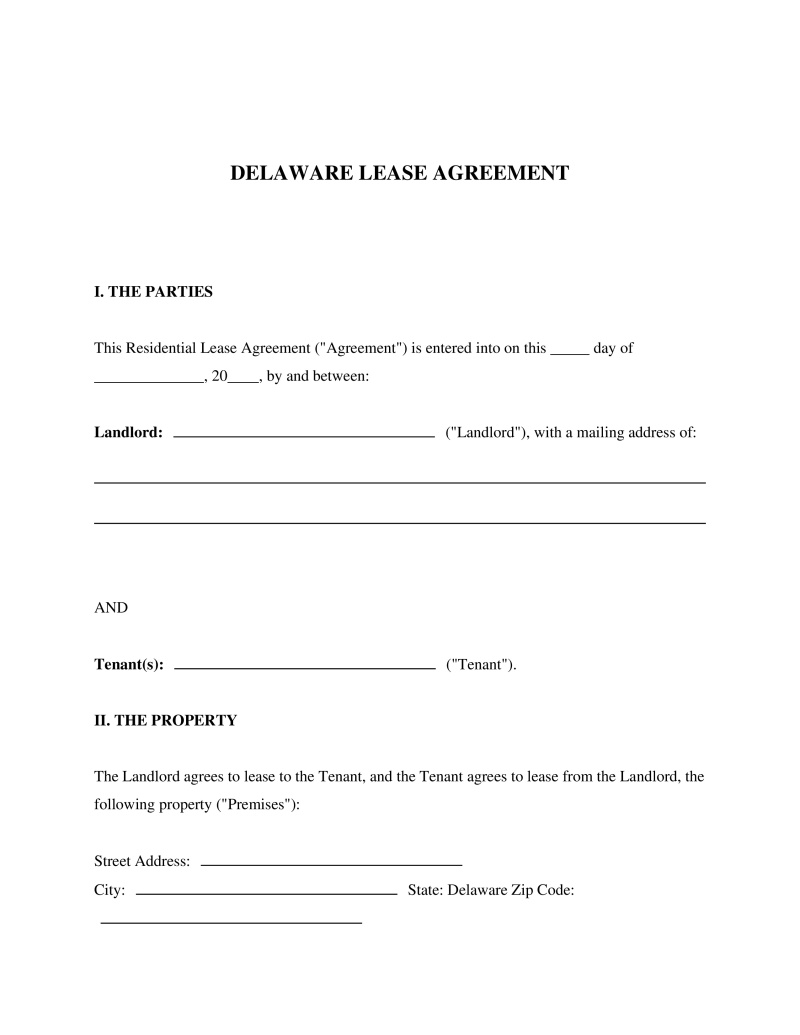
Residential Property Type
Select the residential property category that best describes the rental premises.
Use this if the rental property does not fit one of the listed categories.
Table of Contents
What is a Delaware Lease Agreement?
A Delaware lease agreement is a legally binding contract that outlines the terms and conditions between a landlord and a tenant for the rental of property within the state of Delaware. This document establishes the rights and responsibilities of both parties, ensuring clarity regarding rent payments, property maintenance, and the duration of the tenancy. It serves as a foundational agreement for residential and commercial rentals, providing a framework for dispute resolution and legal recourse.
Legal Framework for Delaware Lease Agreements
Lease agreements in Delaware are governed by a robust legal framework established within the Delaware Code, which provides specific regulations for their formation, enforcement, and termination. These laws define the rights and obligations of both landlords and tenants, aiming to ensure fair and equitable rental practices across the state.
- Uniform Commercial Code (UCC) Article 2A - This section governs lease agreements for goods, detailing definitions, enforceability, and performance requirements for commercial leases, though residential leases primarily fall under Title 25 (Del. Code Ann. tit. 6, sub. I, art. 2A).
- Landlord Obligations and Tenant Remedies - This chapter specifies the duties of landlords and the available remedies for tenants, including provisions that are explicitly prohibited in rental agreements and tenant rights to recover damages for unenforceable clauses (Del. Code Ann. tit. 25, ch. 53).
- Summary Possession - This chapter outlines the legal procedures for summary possession actions, commonly known as eviction proceedings, covering aspects such as jurisdiction, venue, and the rights afforded to tenants during such processes (Del. Code Ann. tit. 25, ch. 57).
Key Elements of a Delaware Lease Agreement
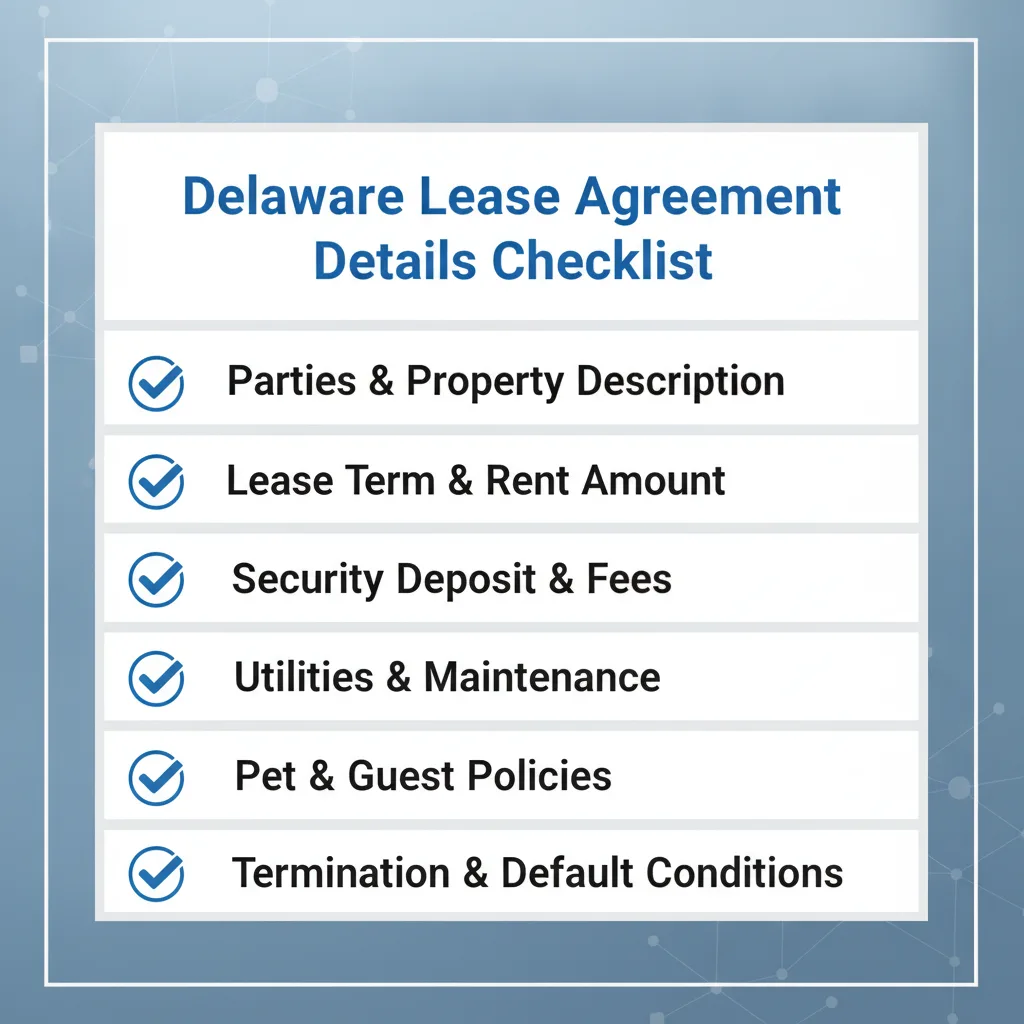
A comprehensive Delaware lease agreement typically includes several essential components to clearly define the terms of the tenancy and protect the interests of both the landlord and the tenant. While specific provisions may vary, certain elements are fundamental to nearly all rental contracts.
- Identification of Parties - The full legal names and contact information of all landlords and tenants involved in the agreement.
- Property Description - A precise address and description of the rental property, including any specific units or areas being leased.
- Lease Term - The start and end dates of the tenancy, specifying whether it is a fixed-term lease or a month-to-month arrangement.
- Rent Amount and Payment Terms - The exact amount of rent, due date, acceptable payment methods, and any grace periods or late fees.
- Security Deposit Details - The amount of the security deposit, conditions for its return, and any permissible deductions, in accordance with state law.
- Utilities and Services - A clear outline of which party is responsible for specific utilities (e.g., electricity, water, gas, internet) and other services.
- Maintenance Responsibilities - Details regarding who is responsible for routine maintenance, repairs, and property upkeep.
- Occupancy Limits - The maximum number of individuals permitted to reside in the rental unit.
- Rules and Regulations - Any specific rules pertaining to pets, smoking, common areas, or other aspects of property use.
Landlord Obligations and Prohibited Provisions
Delaware law imposes specific obligations on landlords and prohibits certain clauses within rental agreements to protect tenants' rights and ensure habitable living conditions. These regulations are primarily detailed within Title 25, Chapter 53 of the Delaware Code.
Landlords in Delaware have several key obligations:
- Maintain Habitable Premises - Landlords must keep the rental unit and all common areas in a clean and safe condition, ensuring compliance with all applicable housing, building, and health codes (Del. Code Ann. tit. 25, § 5305).
- Provide Essential Services - Landlords must provide and maintain essential services such as heat, running water, and hot water (Del. Code Ann. tit. 25, § 5305).
- Respect Tenant Privacy - Landlords must provide reasonable notice, typically 48 hours, before entering a tenant's unit, except in emergencies (Del. Code Ann. tit. 25, § 5509).
- Return Security Deposit - Landlords must return the security deposit, less any lawful deductions, within 20 days after the termination of the rental agreement and delivery of possession (Del. Code Ann. tit. 25, § 5510).
Delaware law also prohibits certain provisions in rental agreements, making them unenforceable:
- Waiver of Legal Rights - Any provision that attempts to waive or forego rights or remedies provided by Delaware's Landlord-Tenant Code (Del. Code Ann. tit. 25, § 5301).
- Confession of Judgment - A provision authorizing a person to confess judgment on a claim arising out of the rental agreement (Del. Code Ann. tit. 25, § 5301).
- Exculpatory Clauses - Clauses limiting the landlord's liability for negligence or willful acts (Del. Code Ann. tit. 25, § 5301).
- Attorney's Fees for Landlord - Provisions requiring a tenant to pay the landlord's attorney's fees unless specifically authorized by statute (Del. Code Ann. tit. 25, § 5301).
Types of Delaware Lease Agreements
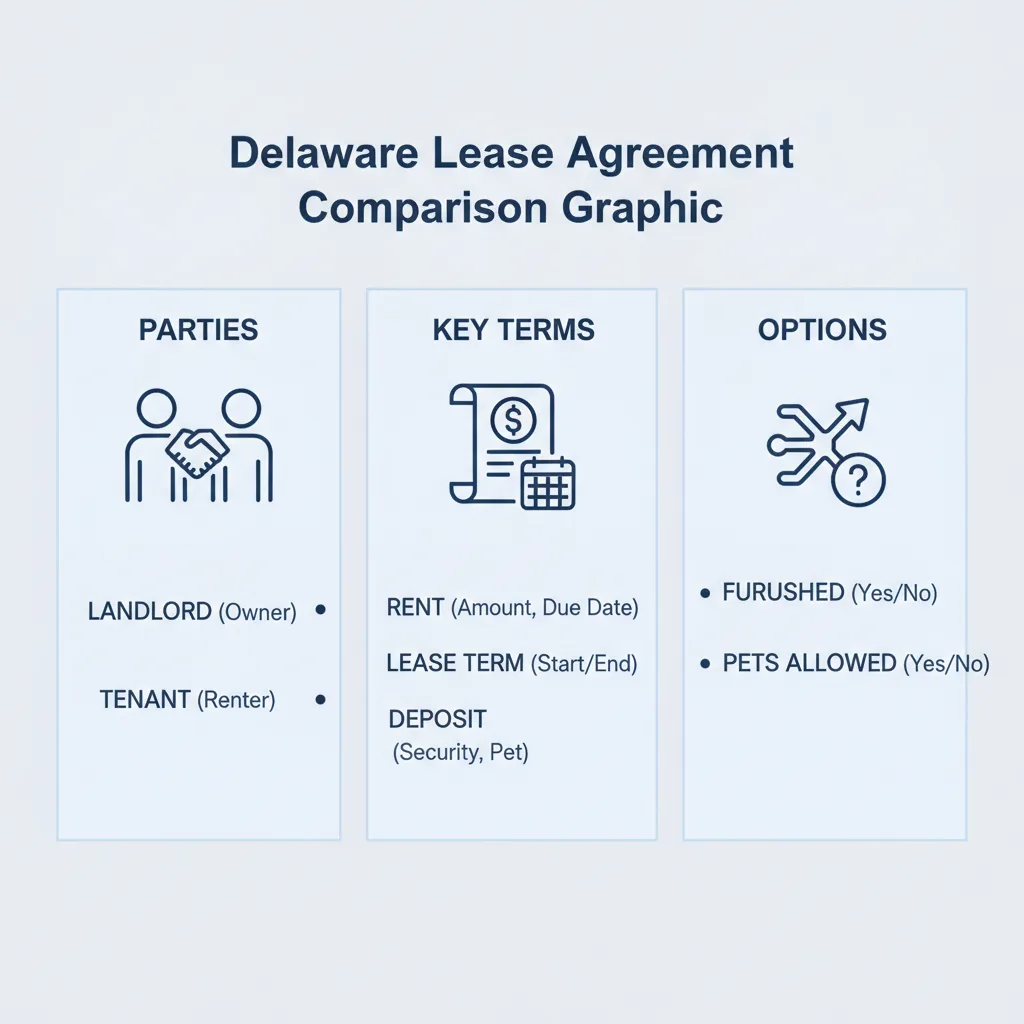
Delaware recognizes various types of lease agreements, each structured to accommodate different rental needs and durations. The choice of lease type often depends on the stability of the tenancy desired by both parties.
- Fixed-Term Lease Agreement - This is a contract for a specific, predetermined period, typically six months or one year. Both landlord and tenant are bound by the terms for the entire duration, and the lease automatically terminates at the end of the term unless renewed.
- Month-to-Month Lease Agreement - This agreement has no fixed end date and automatically renews each month. Either the landlord or the tenant can terminate the agreement with proper notice, usually 60 days in Delaware for the landlord and 30 days for the tenant (Del. Code Ann. tit. 25, § 5106).
- Commercial Lease Agreement - Used for leasing properties for business purposes, such as office spaces, retail stores, or industrial warehouses. These leases are generally more complex and often governed by Title 6 of the Delaware Code, Article 2A, which pertains to leases of goods.
- Sublease Agreement - An agreement where an existing tenant leases a portion or all of their rental property to a new tenant. The original tenant remains responsible to the landlord for the rent and conditions of the initial lease.
Summary Possession Proceedings
Summary possession actions, commonly known as eviction proceedings, are the legal process by which a landlord regains possession of a rental property from a tenant in Delaware. These procedures are strictly outlined in Title 25, Chapter 57 of the Delaware Code, ensuring due process for both parties.
Key aspects of summary possession in Delaware include:
- Jurisdiction and Venue - Summary possession actions are typically filed in the Justice of the Peace Court of the county where the rental property is located (Del. Code Ann. tit. 25, § 5701).
- Grounds for Eviction - A landlord may initiate summary possession for reasons such as non-payment of rent, breach of a material term of the lease agreement, or holding over after the expiration of a lease term (Del. Code Ann. tit. 25, § 5702).
- Notice Requirements - Before filing for summary possession, landlords must provide the tenant with appropriate notice, such as a 5-day notice for non-payment of rent, allowing the tenant an opportunity to cure the breach or vacate (Del. Code Ann. tit. 25, § 5702).
- Tenant Defenses - Tenants have the right to present defenses in court, which may include claims of landlord retaliation, discriminatory practices, or the landlord's failure to maintain the premises in a habitable condition (Del. Code Ann. tit. 25, § 5703).
- Appeal Rights - Both landlords and tenants have the right to appeal a judgment from the Justice of the Peace Court to the Court of Common Pleas (Del. Code Ann. tit. 25, § 5717).
Frequently Asked Questions
Sources
- Delaware Code Online: Title 6, Subtitle I, Article 2A. Leases - Provides comprehensive regulations on lease agreements under Delaware's Uniform Commercial Code, including definitions, enforceability, and performance requirements.
- Delaware Code Online: Title 25, Chapter 53. Landlord Obligations and Tenant Remedies - Outlines landlord obligations and tenant remedies, including prohibited provisions in rental agreements and tenant rights to recover damages for unenforceable provisions.
- Delaware Code Online: Title 25, Chapter 57. Summary Possession - Details procedures for summary possession actions, including jurisdiction, venue, and tenant rights in eviction proceedings.
- Delaware Courts: Landlord/Tenant Forms - Provides official forms related to landlord and tenant matters, including eviction and lease-related proceedings.
Lease Agreement in other states
Already have a Lease Agreement?
Get it reviewed free — checked against your state's laws in about a minute.
Not the form you're looking for?
Try our legal document generator to create a custom document
Disclaimer: The templates available on this website are provided for general informational purposes only and do not constitute legal advice. They are not intended to be, and should not be interpreted as, compliant with any specific legal, regulatory, or privacy requirements. These templates are not a replacement for professional legal guidance and should not be relied upon for any particular matter or circumstance. Users are strongly encouraged to seek advice from a qualified attorney licensed in their jurisdiction before using, modifying, or relying on any template.
All templates are provided on an "as is," "with all faults," and "as available" basis. The provider disclaims any and all warranties of any kind, whether express, implied, statutory, or otherwise, including without limitation warranties of merchantability, fitness for a particular purpose, title, or non-infringement.
LegalTemplates.com makes no guarantees or representations regarding the accuracy, completeness, expected outcomes, or reliability of the materials contained in these templates or any materials referenced or linked from them.