California Lease Agreement Create a California Lease Agreement

California Lease Agreement

Published Dec 06, 2025
0 Comments
0 Downloads

A California Lease Agreement is a legal document that outlines the terms and conditions between a landlord and tenant for the rental of property.
Lease Type

Select the type of property that this lease applies to from the options provided. This helps clarify the nature of the rental arrangement and can affect lease terms and tenant rights. If your property type is not listed, choose "Other" and specify what it is.

Table of Contents

0% Complete 0/0 Fields

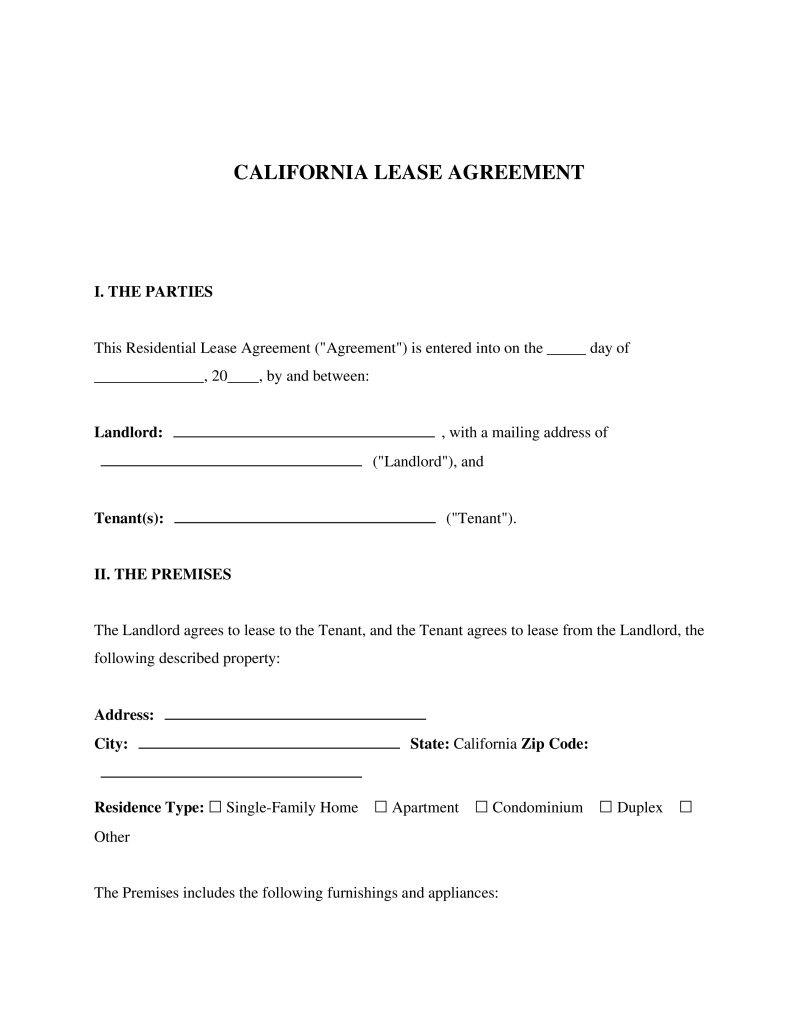
CALIFORNIA LEASE AGREEMENT

I. THE PARTIES

This Residential Lease Agreement ("Agreement") is entered into on , by and between:

Landlord: , with a mailing address of ("Landlord"), and

Tenant(s): ("Tenant").

II. THE PREMISES

The Landlord agrees to lease to the Tenant, and the Tenant agrees to lease from the Landlord, the following described property:

Address:
City: State: California Zip Code:

Residence Type (check one):

The Premises includes the following furnishings and appliances:

III. TERM OF LEASE

The term of this Agreement shall be (check one):

IV. RENT

The Tenant agrees to pay the Landlord rent in the amount of $ per month.

Due Date: Rent is due on the day of each month.

Payment Method: Rent shall be paid by (check all that apply):


Payment Address:

V. SECURITY DEPOSIT

Pursuant to California Civil Code Section 1950.5, the Tenant shall pay a security deposit of $ to the Landlord.

Return of Deposit: The Landlord shall return the security deposit to the Tenant, less any lawful deductions, within twenty-one (21) days after the Tenant has vacated the Premises. The Landlord must provide an itemized statement indicating the basis for, and the amount of, any security received and the disposition of the security.

VI. LATE CHARGES AND RETURNED CHECKS

Late Charge: If rent is not paid by the day of the month, Tenant agrees to pay a late charge of $. The parties agree that this charge represents a reasonable estimate of the costs the Landlord will incur due to the late payment.

Returned Checks: For each check returned by the bank for insufficient funds, the Tenant agrees to pay a charge of $25.00 for the first returned check and $35.00 for each subsequent returned check, pursuant to California Civil Code Section 1719.

VII. UTILITIES AND SERVICES

The parties agree to be responsible for the following utilities and services:

Electricity:


Gas:

Water:

Trash/Recycling:

Sewer:

Cable/Internet:

Landscaping:

VIII. OCCUPANTS AND GUESTS

The Premises shall be occupied only by the Tenant(s) listed in Section I and the following additional occupants:

Guests: Guests may stay on the Premises for no more than consecutive days or days in a twelve-month period without the Landlord's written consent.

IX. MAINTENANCE AND REPAIRS

Tenant Responsibilities: The Tenant shall keep the Premises clean, sanitary, and in good condition. The Tenant is responsible for repairs caused by the Tenant's negligence or misuse.

Landlord Responsibilities: The Landlord shall maintain the Premises in a habitable condition in accordance with California Civil Code Section 1941.1, ensuring effective waterproofing, plumbing, heating, electrical, and gas facilities.

X. RIGHT OF ENTRY

Pursuant to California Civil Code Section 1954, the Landlord may enter the Premises for necessary or agreed repairs, decorations, alterations, or improvements, supplying necessary or agreed services, or exhibiting the dwelling unit to prospective or actual purchasers, mortgagees, tenants, workers, or contractors.

Except in cases of emergency or abandonment, the Landlord shall give the Tenant reasonable notice in writing (usually 24 hours) of the intent to enter and shall enter only during normal business hours.

XI. PETS

(Check one)

XII. CALIFORNIA REQUIRED DISCLOSURES

A. MEGAN'S LAW DISCLOSURE (California Civil Code Section 2079.10a):

Notice: Pursuant to Section 290.46 of the Penal Code, information about specified registered sex offenders is made available to the public via an Internet Web site maintained by the Department of Justice at www.meganslaw.ca.gov. Depending on an offender's criminal history, this information will include either the address at which the offender resides or the community of residence and ZIP Code in which he or she resides.

B. LEAD-BASED PAINT DISCLOSURE:

Housing built before 1978 may contain lead-based paint. Lead from paint, paint chips, and dust can pose health hazards if not managed properly.

Year Built: The Premises was built (check one):

C. BED BUG NOTICE (California Civil Code Section 1954.603):

Information about Bed Bugs:
1. Bed bug Appearance: Bed bugs have six legs. Adult bed bugs have flat bodies about 1/4 of an inch in length. Their color can range from red and brown to copper colored. Young bed bugs are very small. Their bodies are about 1/16 of an inch in length. They have almost no color. When a bed bug feeds, its body swells, may lengthen, and becomes bright red, sometimes making it appear to be a different insect. Bed bugs do not fly. They can either crawl or be carried from place to place on objects.
2. Life Cycle and Reproduction: An average bed bug lives for about 10 months. Female bed bugs lay one to five eggs per day. Bed bugs grow to full adulthood in about 21 days.
3. Bed bugs can survive for months without feeding.
4. Bed bug Bites: Because bed bugs usually feed at night when people are sleeping, most people do not realize they were bitten. A person’s reaction to insect bites is an immune response and so varies from person to person. Sometimes the red welts caused by the bites will not be noticed until many days after a person was bitten or not at all.
5. Common Signs and Symptoms of a Possible Bed bug Infestation: Small red to reddish brown fecal spots on mattresses, box springs, bed frames, mattresses, linens, upholstery, or walls; Molted bed bug skins, white, sticky eggs, or empty eggshells; Very heavily infested areas may have a characteristically sweet odor; Red, itchy bite marks, especially on the legs, arms, and other body parts exposed while sleeping. However, some people do not show bed bug lesions on their bodies even though bed bugs may have fed on them.

D. MOLD NOTIFICATION (California Health & Safety Code Section 26147):

The Landlord has inspected the unit prior to the lease and knows of no damp or wet building materials and knows of no mold or mildew contamination. Tenant agrees to keep the Premises free of moisture and mold.

E. FLOOD HAZARD DISCLOSURE (California Government Code Section 8589.45):

The Landlord discloses that the Premises (check one):

F. TENANT PROTECTION ACT OF 2019 (AB 1482):

California law limits the amount your rent can be increased. See Section 1947.12 of the Civil Code for more information. California law also provides that after all of the tenants have continuously and lawfully occupied the property for 12 months or more or at least one of the tenants has continuously and lawfully occupied the property for 24 months or more, a landlord must provide a statement of cause in any notice to terminate a tenancy. See Section 1946.2 of the Civil Code for more information.

Exemption Status (check one):

XIII. SMOKING POLICY

Smoking of any substance, including tobacco and cannabis, is (check one):

XIV. DEFAULT AND REMEDIES

If the Tenant fails to pay rent or violates any provision of this Agreement, the Landlord may issue a three (3) day notice to pay or quit, or a three (3) day notice to cure or quit, as applicable under California Code of Civil Procedure Section 1161. If the Tenant fails to comply, the Landlord may initiate eviction proceedings.

XV. ENTIRE AGREEMENT

This Agreement constitutes the entire agreement between the parties and supersedes all prior understandings or agreements, written or oral. This Agreement may only be amended in writing signed by both parties.

XVI. GOVERNING LAW

This Agreement shall be governed by and construed in accordance with the laws of the State of California.

XVII. SIGNATURES

IN WITNESS WHEREOF, the parties have executed this Agreement on the dates set forth below.

LANDLORD:
Signature: _________________________
Date:
Print Name: _______________

TENANT:
Signature: _________________________
Date:
Print Name: _______________

What is a California Lease Agreement?

A California Lease Agreement is a legally binding contract executed between a landlord (lessor) and a tenant (lessee) that grants the tenant the right to occupy a specific property for a defined period in exchange for rent. This document serves as the governing instrument for the tenancy, outlining the precise terms, conditions, and rules that both parties must follow to ensure compliance with state and local housing laws. It is utilized for various residential arrangements, including single-family homes, apartments, and condominiums, and provides a legal framework for dispute resolution should conflicts arise regarding property maintenance, payments, or eviction.

Statutory Framework and Legal Requirements

California maintains some of the most comprehensive landlord-tenant laws in the United States, primarily codified in the California Civil Code. To be legally enforceable, a lease for a term longer than one year must be in writing, adhering to the Statute of Frauds. While oral agreements for tenancies under one year are technically valid, written contracts are standard practice to ensure clarity and enforceability. The agreement must comply with the Tenant Protection Act of 2019 (AB 1482), which imposes statewide rent caps and strict "just cause" eviction requirements for applicable properties.

Furthermore, the contract must adhere to federal Fair Housing Acts and the California Fair Employment and Housing Act, prohibiting discrimination based on race, gender, religion, familial status, or disability. Landlords are also restricted from including clauses that waive a tenant's statutory rights, such as the right to a habitable dwelling or the right to a refund of the security deposit under specific conditions. Any provision within a California Lease Agreement that contradicts state law is generally considered void and unenforceable.

Mandatory State Disclosures

Unlike many other states, California requires landlords to provide numerous specific disclosures attached to or included within the lease document. Failure to provide these disclosures can lead to legal penalties or the inability to enforce certain lease provisions. These statutory requirements ensure tenants are fully informed about the condition of the property and their rights.

  • Lead-Based Paint: Required for any property built before 1978, informing tenants of potential lead hazards.
  • Bed Bug Notice: Landlords must provide a specific written notice about bed bugs, including information on how to report suspected infestations.
  • Megan’s Law: A clause advising tenants on how to access the Department of Justice's database regarding registered sex offenders.
  • Mold Notification: Written disclosure is required if the landlord knows of toxic mold that exceeds permissible exposure limits.
  • Shared Utilities: If gas or electric meters are shared between units, the landlord must disclose how costs are allocated.
  • Demolition Permit: If a demolition permit has been applied for, prospective tenants must be informed before signing.

Security Deposit Regulations

California Civil Code Section 1950.5 governs the collection, holding, and return of security deposits. Historically, landlords could charge up to two months' rent for an unfurnished unit and three months' rent for a furnished unit. However, recent legislative changes, specifically Assembly Bill 12 (effective July 1, 2024), generally limit security deposits to one month's rent for residential leases, regardless of whether the unit is furnished or unfurnished, with limited exceptions for certain small landlords.

Upon the termination of the tenancy, the landlord has a strict 21-day window to return the security deposit to the tenant. If any deductions are made for unpaid rent, cleaning, or repairs beyond normal wear and tear, the landlord must provide an itemized written statement along with copies of receipts for charges exceeding a specific threshold (typically $125). Failure to adhere to these timelines can result in the landlord owing the tenant the full deposit plus statutory damages.

Key Components of a Valid Agreement

To ensure a California Lease Agreement is robust and legally sound, it must contain specific elements that define the relationship between the parties. Missing information can lead to ambiguity and potential legal challenges.

  • Identification of Parties: Full legal names of all adults who will reside in the unit and the landlord or property manager.
  • Property Description: The full address, including unit number, and details regarding parking spaces or storage areas.
  • Term of Tenancy: Specification of whether the lease is a fixed-term arrangement (e.g., one year) or a periodic month-to-month tenancy.
  • Rent Details: The exact amount of rent, the due date, acceptable payment methods, and the address where rent must be sent.
  • Late Fee Policy: If late fees are charged, the lease must specify the amount and the conditions under which they apply, ensuring they are reasonable estimates of costs incurred by the landlord.

Rent Control and Limitations on Rent Increases

The Tenant Protection Act of 2019 significantly altered the landscape of rent increases in California. For properties covered by the Act, annual rent increases are capped at 5% plus the local Consumer Price Index (CPI), or 10% of the lowest gross rental rate charged at any time during the 12 months prior to the effective date of the increase, whichever is lower. Landlords must provide proper notice before raising rent. For increases of 10% or less, a 30-day written notice is required. For increases greater than 10% (where legally permissible, such as in exempt properties), a 90-day notice is mandated.

Rights of Entry and Privacy

Under California Civil Code Section 1954, tenants have a right to privacy, and landlords may only enter the rental unit under specific circumstances. Permissible reasons for entry include making necessary or agreed-upon repairs, showing the unit to prospective tenants or buyers, initial inspections before move-out, or in cases of emergency. Except for emergencies, the landlord must provide reasonable written notice, generally presumed to be 24 hours, and entry must occur during normal business hours unless the tenant consents otherwise.

Frequently Asked Questions

Yes, verbal lease agreements are generally valid in California if the tenancy is for a period of less than one year. However, if the lease term is for one year or longer, the agreement must be in writing to be enforceable under the Statute of Frauds.
Under Assembly Bill 12, effective July 1, 2024, landlords are generally limited to charging no more than one month's rent as a security deposit, regardless of whether the unit is furnished or unfurnished. Limited exceptions exist for certain small landlords who own no more than two residential rental properties and four total units.
A landlord may only enter a rental unit without prior permission or notice in the event of a genuine emergency, such as a fire or severe flooding. In all other non-emergency situations, such as repairs or inspections, the landlord must provide reasonable written notice, typically 24 hours.
Yes, late fees are legal, but they must be a reasonable estimate of the cost the landlord incurs due to the late payment. Arbitrary or excessive late fees that serve as a penalty rather than compensation for administrative costs are often found to be unenforceable in court.
Most fixed-term leases in California do not automatically renew for another full term but convert to a month-to-month tenancy upon expiration unless a new lease is signed. However, the specific terms regarding renewal or termination should be explicitly stated in the California Lease Agreement.
California law does not mandate renters insurance, but landlords are legally permitted to require tenants to obtain a policy as a condition of the lease. This requirement must be clearly stated in the written lease agreement, often specifying minimum coverage amounts.

Not the form you're looking for?

Try our legal document generator to create a custom document

Community Discussion

Share your experience and help others

0

Comments (0)

Leave a Comment

Your email will not be displayed publicly. It is used for validation purposes only and will never be used to send unwanted emails or sold to third parties.

No comments yet. Be the first to comment!

Legal Notice: Comments are personal opinions and do not constitute legal advice. Always consult a qualified attorney for matters specific to your situation.