Alabama Lease Agreement
An Alabama Lease Agreement is a legal document that outlines the terms and conditions between a landlord and tenant for the rental of property in Alabama.
Residential Property Type
Select the residential property category that best describes the rental premises.
Use this if the rental property does not fit one of the listed categories.
Table of Contents
What is a Alabama Lease Agreement?
An Alabama Lease Agreement is a legally binding contract executed between a landlord, also known as the lessor, and a tenant, or lessee, regarding the rental of a property within the state of Alabama. This document formalizes the arrangement by outlining specific terms and conditions, including the monthly rental amount, the duration of the tenancy, and the responsibilities of both parties concerning maintenance and utilities. It serves as the primary legal instrument for resolving disputes and ensures that the tenancy complies with the Alabama Uniform Residential Landlord and Tenant Act.
Legal Framework and Statutory Governance
The landlord-tenant relationship in Alabama is primarily governed by the Alabama Uniform Residential Landlord and Tenant Act (AURLTA), found in Title 35, Chapter 9A of the Code of Alabama. This comprehensive set of statutes establishes the minimum duties for landlords and tenants, overriding any lease clauses that attempt to waive these statutory rights. While the AURLTA covers most residential lease agreements, it generally excludes specific living arrangements such as geriatric care facilities, occupancy under a contract of sale, and transient occupancy in a hotel or motel.
In addition to state laws, federal regulations play a significant role in the validity of an Alabama lease agreement. The Fair Housing Act prohibits discrimination based on race, color, national origin, religion, sex, familial status, or disability. Furthermore, federal law mandates specific environmental disclosures for properties constructed prior to certain dates, ensuring tenant safety regarding hazardous materials.
Security Deposit Regulations
Alabama law imposes specific limitations and requirements on security deposits to protect tenants from excessive financial burdens. According to Ala. Code § 35-9A-201, a landlord may not demand or receive a security deposit that exceeds the amount of one month's periodic rent. However, this cap does not apply to deposits specifically designated for pets, changes to the premises, or increased liability risks.
Upon the termination of the tenancy, the landlord is required to return the security deposit, less any allowable deductions for unpaid rent or damages exceeding normal wear and tear. The state provides a relatively generous timeframe for this process compared to other jurisdictions; the landlord must remit the funds or a detailed itemized list of deductions within 60 days of the termination of the tenancy and delivery of possession. Failure to comply with these return requirements can result in the landlord being liable for double the amount of the original deposit.
Landlord Right to Entry and Tenant Privacy
The balance between a tenant's right to quiet enjoyment and a landlord's right to maintain the property is codified in Ala. Code § 35-9A-303. Under an Alabama lease agreement, a tenant generally cannot unreasonably withhold consent for the landlord to enter the premises to inspect, make necessary repairs, supply services, or show the unit to prospective buyers or tenants.
Unless there is an emergency or it is impracticable to do so, the landlord is required to give the tenant at least two days' notice of the intent to enter. Furthermore, the entry must occur at reasonable times. If a landlord abuses this right of access or uses it to harass the tenant, the tenant may obtain injunctive relief or terminate the lease agreement.
Essential Elements of a Valid Alabama Lease
For a rental contract to be enforceable under Alabama law, it must contain specific components that clearly define the relationship and obligations of the involved parties. Missing information can lead to legal ambiguities during dispute resolution.
- Identification of Parties: The full legal names of the landlord and all adult tenants who will occupy the premises.
- Property Description: The complete physical address of the rental unit, including unit numbers where applicable.
- Lease Term: Specific start and end dates for fixed-term leases, or a statement indicating a month-to-month arrangement.
- Rent Details: The exact amount of rent, the due date, accepted payment methods, and the address where rent must be delivered.
- Authorized Agent Disclosure: Pursuant to Ala. Code § 35-9A-202, the lease must disclose the name and address of the person authorized to manage the premises and receive notices.
- Lead-Based Paint Disclosure: Required by federal law (42 U.S. Code § 4852d) for any housing built before 1978, warning tenants of potential lead exposure.
Termination and Eviction Procedures
When a lease violation occurs, the Alabama Uniform Residential Landlord and Tenant Act outlines specific notice periods that must be honored before an eviction lawsuit can be filed. For non-payment of rent, the landlord must provide a seven-day notice to pay or quit (Ala. Code § 35-9A-421). This allows the tenant seven business days to pay the outstanding balance to avoid lease termination.
For other breaches of the lease agreement, such as unauthorized pets or noise violations, the landlord must also provide a seven-day notice to cure or quit. If the tenant remedies the breach within that window, the tenancy continues. However, if the same noncompliance recurs within 12 months, the landlord may terminate the lease with a seven-day written notice without offering the option to cure the issue again.
Frequently Asked Questions
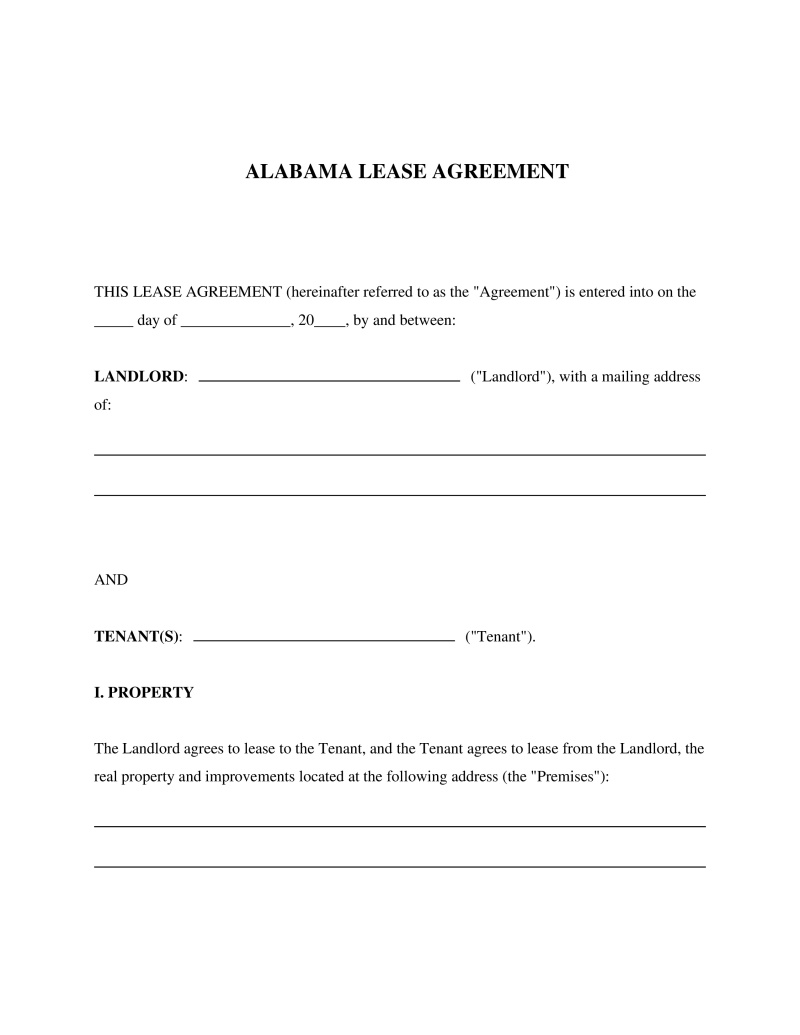
Alabama Lease Agreement Sample
Lease Agreement in other states
Already have a Lease Agreement?
Get it reviewed free — checked against your state's laws in about a minute.
Not the form you're looking for?
Try our legal document generator to create a custom document
Disclaimer: The templates available on this website are provided for general informational purposes only and do not constitute legal advice. They are not intended to be, and should not be interpreted as, compliant with any specific legal, regulatory, or privacy requirements. These templates are not a replacement for professional legal guidance and should not be relied upon for any particular matter or circumstance. Users are strongly encouraged to seek advice from a qualified attorney licensed in their jurisdiction before using, modifying, or relying on any template.
All templates are provided on an "as is," "with all faults," and "as available" basis. The provider disclaims any and all warranties of any kind, whether express, implied, statutory, or otherwise, including without limitation warranties of merchantability, fitness for a particular purpose, title, or non-infringement.
LegalTemplates.com makes no guarantees or representations regarding the accuracy, completeness, expected outcomes, or reliability of the materials contained in these templates or any materials referenced or linked from them.