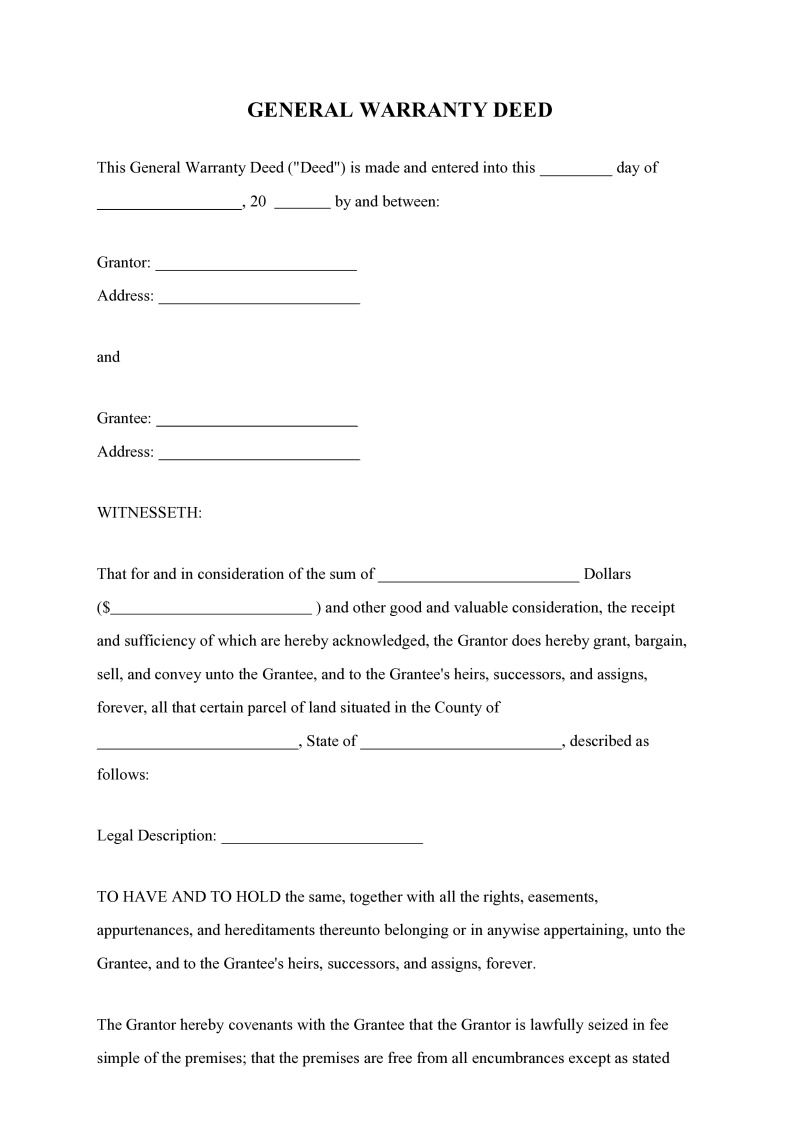
General Warranty Deed
A General Warranty Deed transfers property ownership with a guarantee of clear title, protecting buyers against claims from past owners.
Grantor 1 Full Name
Enter the complete legal name as it should appear on the deed.
Provide the Grantor's current mailing address.
Some jurisdictions require marital status for proper vesting and release of spousal rights.
Select 'Yes' if there are multiple sellers.
Enter the second Grantor's legal name.
Provide the second Grantor's current mailing address.
Some jurisdictions require marital status for proper vesting and release of spousal rights.
Select 'Yes' if there are more than two sellers.
Enter the third Grantor's legal name.
Provide the third Grantor's current mailing address.
Some jurisdictions require marital status for proper vesting and release of spousal rights.
Table of Contents
What is a General Warranty Deed?
A General Warranty Deed is a legal instrument used to transfer ownership of real property from one party (the grantor) to another (the grantee). This type of deed provides the highest level of protection to the grantee by including specific covenants, or promises, from the grantor regarding the property's title. Its primary purpose is to assure the buyer that they are receiving a clear title, free from defects, liens, or encumbrances, regardless of when they arose. General Warranty Deeds are commonly utilized in residential real estate transactions where buyers seek maximum assurance and security in their property investment.
Required Elements of a Valid General Warranty Deed
For a General Warranty Deed to be legally effective and transfer title, it must contain several essential components:
- Grantor's Identification - The full legal name and marital status of the current owner transferring the property.
- Grantee's Identification - The full legal name and marital status of the party receiving the property.
- Words of Conveyance - Clear language indicating the grantor's intent to transfer ownership, often including phrases like "grant, bargain, sell, and convey."
- Legal Description of Property - A precise and unambiguous description of the real estate, typically obtained from previous deeds or surveys, sufficient to identify the property uniquely.
- Consideration - A statement of the value exchanged for the property, which can be the actual purchase price or a nominal amount like "ten dollars and other good and valuable consideration."
- Grantor's Signature - The grantor's handwritten signature, indicating their agreement to transfer the property.
- Acknowledgment - The grantor's signature must be attested to by a notary public or other authorized official, verifying the grantor's identity and that the signature was made voluntarily.
- Delivery and Acceptance - The grantor must physically or constructively deliver the deed to the grantee, and the grantee must accept it, signifying the transfer of ownership is complete.
Covenants of Title
The defining characteristic of a General Warranty Deed is the inclusion of six fundamental covenants of title, which are promises made by the grantor to the grantee. These covenants provide the grantee with legal recourse if a title defect later emerges. These promises extend back through the entire history of the property's title, not just the period of the grantor's ownership:
- Covenant of Seisin - The grantor warrants that they own the property being conveyed and have the right to transfer that ownership.
- Covenant of Right to Convey - The grantor promises that they possess the legal authority to transfer the property to the grantee. This covenant is closely related to the covenant of seisin but specifically addresses the grantor's power to convey.
- Covenant Against Encumbrances - The grantor assures that the property is free from any undisclosed liens, easements, mortgages, or other encumbrances, other than those specifically stated in the deed.
- Covenant of Quiet Enjoyment - The grantor guarantees that the grantee's possession of the property will not be disturbed by any third-party claims to the title, meaning no one else will lawfully claim superior ownership.
- Covenant of Warranty Forever - The grantor pledges to defend the grantee's title against all lawful claims by third parties, regardless of when those claims arose. This is the broadest and most significant covenant.
- Covenant of Further Assurances - The grantor promises to perform any reasonable acts necessary in the future to perfect the grantee's title, such as executing additional documents or correcting errors.
Rights and Obligations of Parties Involved
In a real estate transaction involving a General Warranty Deed, both the grantor and the grantee assume specific rights and obligations that define their legal relationship concerning the property transfer.
The grantor, as the party conveying the property, has the right to receive the agreed-upon consideration for the transfer of title. Their primary obligations include ensuring the property's title is clear and free from undisclosed defects, as guaranteed by the covenants of title. Should any claim arise that breaches these covenants, the grantor is obligated to defend the grantee's title and compensate them for any losses incurred. This responsibility extends to defects that may have originated before the grantor's ownership.
The grantee, as the party receiving the property, has the right to receive a clear and marketable title, free from encumbrances, and to enjoy quiet possession of the property without interference from third-party claims. They are entitled to enforce the covenants of title against the grantor if a defect is discovered. The grantee's main obligation is to provide the agreed-upon consideration for the property. Additionally, the grantee should conduct due diligence, such as obtaining title insurance and a survey, to further protect their interests, even with the strong protections offered by a General Warranty Deed.
How to Complete a General Warranty Deed
The process of preparing and executing a General Warranty Deed involves several critical steps to ensure a legally valid transfer of property ownership.
- Gather Necessary Information - Collect all pertinent details for both the grantor and the grantee, including their full legal names, current addresses, and marital status. Obtain the precise legal description of the property from the previous deed, a survey, or public records. Determine the consideration, or purchase price, for the transaction.
- Draft the Deed Document - Prepare the deed using a standard form or template, ensuring it includes all required elements such as the names of the parties, the words of conveyance, the legal description of the property, and the statement of consideration. Crucially, explicitly incorporate the six covenants of title that define a General Warranty Deed.
- Sign and Acknowledge the Deed - The grantor must sign the deed in the presence of a notary public or other authorized official. The notary will verify the grantor's identity and confirm that the signature is voluntary, then affix their seal and signature, which is known as acknowledgment.
- Deliver the Deed to the Grantee - After signing and acknowledgment, the grantor must deliver the physical deed to the grantee. This act signifies the grantor's intent to transfer title and the grantee's acceptance of ownership. Delivery can be direct or constructive, such as through an escrow agent.
- Record the Deed with the County Recorder - The grantee, or their representative, should promptly record the executed deed with the county recorder's office in the jurisdiction where the property is located. Recording provides public notice of the change in ownership and protects the grantee's interest against subsequent claims or transfers.
Comparison to Other Deed Types
Different types of deeds provide different levels of protection to the buyer (grantee). Understanding these differences is important in any real estate transaction.
🏆 General Warranty Deed (Most Protection)
- Level of Protection: Highest
- What It Guarantees:
- Covers all title defects, claims, and encumbrances
- Applies to the entire history of the property (even before the grantor owned it)
- Who Bears the Risk: Grantor
- Common Use:
- Standard residential sales
- Arm’s-length transactions
- Key Benefit: Full peace of mind for the buyer
⚖️ Special Warranty Deed (Limited Protection)
- Level of Protection: Moderate
- What It Guarantees:
- Covers only issues that arose during the grantor’s ownership
- No protection for problems before that period
- Who Bears the Risk: Shared (buyer takes on past risk)
- Common Use:
- Commercial real estate
- Transfers by executors, trustees, or corporations
- Key Limitation: Buyer assumes risk for earlier title issues
⚠️ Quitclaim Deed (No Protection)
- Level of Protection: None
- What It Guarantees:
- No warranties at all
- Transfers only whatever interest the grantor may have (if any)
- Who Bears the Risk: Grantee (buyer)
- Common Use:
- Transfers between family members
- Divorce settlements
- Fixing title defects
- Key Risk: Grantor may not even own the property
Federal Statutes
While real property law is primarily governed by state statutes, several federal laws impact aspects of property transactions, including those involving a General Warranty Deed:
- Fair Housing Act - Prohibits discrimination in the sale, rental, and financing of housing based on race, color, national origin, religion, sex, familial status, or disability (42 U.S.C. § 3601 et seq.). This act ensures that property transfers, regardless of deed type, adhere to non-discriminatory practices.
- Lead-Based Paint Disclosure Requirements - Mandates that sellers and landlords of residential properties built before 1978 disclose known lead-based paint hazards and provide a federal pamphlet on lead safety to buyers (42 U.S.C. § 4852d). This disclosure is a prerequisite for many property transfers.
- Real Estate Settlement Procedures Act (RESPA) - Governs the process of residential real estate transactions involving federally related mortgage loans, requiring various disclosures to consumers and prohibiting certain practices like kickbacks and unearned fees (12 U.S.C. § 2601 et seq.). RESPA influences the closing process where a General Warranty Deed is typically exchanged.
State Laws and Requirements
State laws predominantly govern the creation, execution, and recording of General Warranty Deeds. While specific statutes vary by jurisdiction, common areas of regulation include:
- Statute of Frauds - Requires that all conveyances of real property, including deeds, be in writing and signed by the grantor to be enforceable (e.g., California Civil Code § 1624).
- Recording Statutes - Dictate the procedures for recording deeds with the county recorder or register of deeds, establishing priority of title based on the order of recording (e.g., Florida Statutes § 695.01). Many states operate under a "race-notice" or "notice" recording system.
- Acknowledgment Requirements - Specify that a deed must be acknowledged before a notary public or other authorized officer for it to be recordable (e.g., Texas Property Code § 12.001).
- Transfer Tax Laws - Impose taxes or fees on the transfer of real property, often collected at the time of recording the deed (e.g., New York Tax Law Article 31).
- Homestead Laws - Provide certain protections for a primary residence against creditors and often require spousal consent for the conveyance of homestead property, even if only one spouse is on the title (e.g., Illinois Compiled Statutes, 735 ILCS 5/12-901 et seq.).
Penalties for Non-Compliance
Failure to comply with the legal requirements for a General Warranty Deed or the underlying real estate transaction can lead to significant consequences. If a deed lacks essential elements such as a proper legal description or valid acknowledgment, it may be deemed invalid, rendering the attempted transfer of title ineffective. This can result in the grantor still legally owning the property, or the title remaining encumbered, leading to complicated legal disputes known as quiet title actions. Grantors who breach the covenants of title in a General Warranty Deed can be held liable for damages, potentially including the cost of clearing the title, legal fees, and the diminished value of the property. Additionally, intentional misrepresentation or fraudulent acts during a property transfer can result in criminal charges, severe financial penalties, and civil liability for damages to the wronged party.
Frequently Asked Questions
Not the form you're looking for?
Try our legal document generator to create a custom document
Ask about a General Warranty Deed
Example questions:
Disclaimer: The templates available on this website are provided for general informational purposes only and do not constitute legal advice. They are not intended to be, and should not be interpreted as, compliant with any specific legal, regulatory, or privacy requirements. These templates are not a replacement for professional legal guidance and should not be relied upon for any particular matter or circumstance. Users are strongly encouraged to seek advice from a qualified attorney licensed in their jurisdiction before using, modifying, or relying on any template.
All templates are provided on an "as is," "with all faults," and "as available" basis. The provider disclaims any and all warranties of any kind, whether express, implied, statutory, or otherwise, including without limitation warranties of merchantability, fitness for a particular purpose, title, or non-infringement.
LegalTemplates.com makes no guarantees or representations regarding the accuracy, completeness, expected outcomes, or reliability of the materials contained in these templates or any materials referenced or linked from them.