Codicil to Will
A Codicil to Will is a testamentary instrument that modifies, explains, or revokes specific provisions of a previously executed Last Will and Testament.
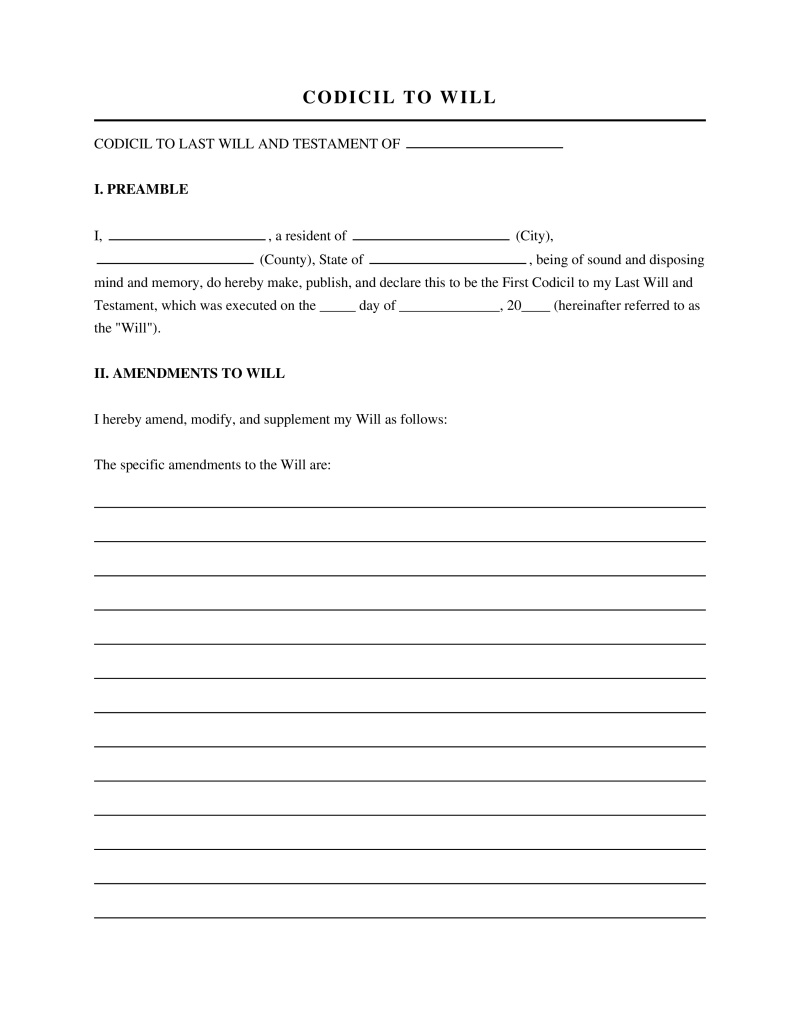
Codicil Type
Select the main purpose for this Codicil. You can add more details later.
Provide a brief description if you selected 'Other'.
Table of Contents
What is a Codicil to Will?
A codicil to will is a legal document that modifies, adds to, or partially revokes an existing earlier will. It serves as an amendment, allowing a testator to make specific changes without having to rewrite the entire original will. Because a codicil is legally considered a will itself, it must be executed with the same legal formalities as the original will to be valid.
Purpose and Common Modifications
The primary purpose of a codicil is to update or alter a will efficiently when only minor changes are required. It prevents the need for creating an entirely new document, which can be beneficial for testators seeking to make precise adjustments to their estate plan. Common reasons for executing a codicil include:
- Changing Beneficiaries - Adding new beneficiaries, removing existing ones, or altering the distribution percentages of assets among them.
- Appointing or Replacing Fiduciaries - Naming a new executor, guardian for minor children, or trustee, or designating alternates if the primary choices are unable to serve.
- Adding or Removing Specific Bequests - Modifying specific gifts of property or money, such as adding a new heirloom to be given to a particular individual or revoking a previous bequest.
- Updating Personal Information - Correcting minor errors in names, addresses, or other descriptive details within the original will.
- Reflecting Changes in Circumstances - Adjusting the will to account for events like marriage, divorce, birth of children, death of a beneficiary, or acquisition/disposal of significant assets.
Execution Requirements
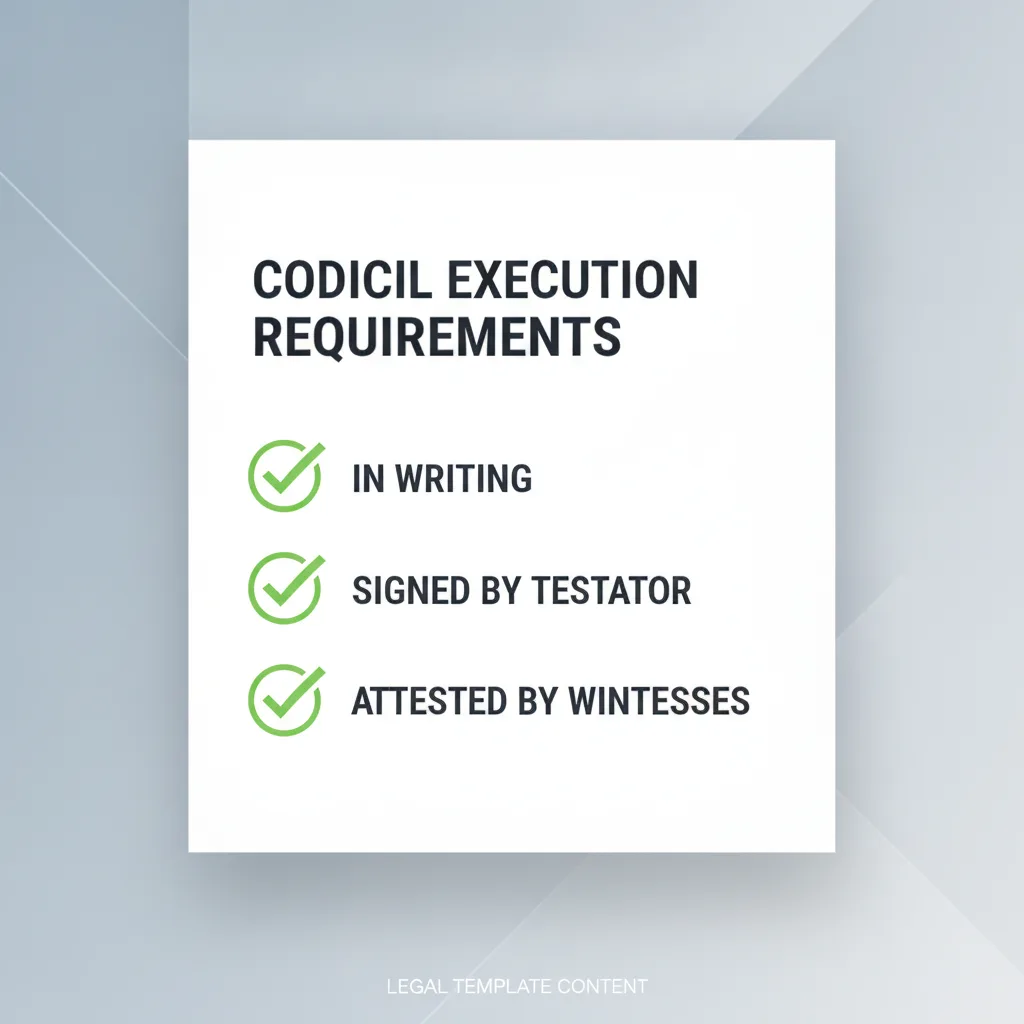
For a codicil to be legally binding and effective, it must be executed with the same legal formalities as a will. These formalities are typically outlined in state statutes and generally require the document to be in writing, signed by the testator, and witnessed. Failure to adhere to these requirements can render the codicil invalid, meaning the original will's provisions would remain in effect.
Examples of state-specific execution requirements include:
- Virginia Execution Requirements - No will, including a codicil, is valid unless it is in writing and signed by the testator, or by another person in the testator's presence and by their direction. This signature must clearly indicate it is intended as such, and the will must be attested to by at least two competent witnesses in the testator's presence (§ 64.2-403).
- Florida Execution Requirements - Every will must be in writing and signed by the testator at the end, or by another person in the testator's presence and by their direction. The testator's signing, or acknowledgment of the signature, must occur in the presence of at least two attesting witnesses, who then sign the will in the testator's presence and in the presence of each other (Chapter 732 Section 502).
Codicil vs. New Will
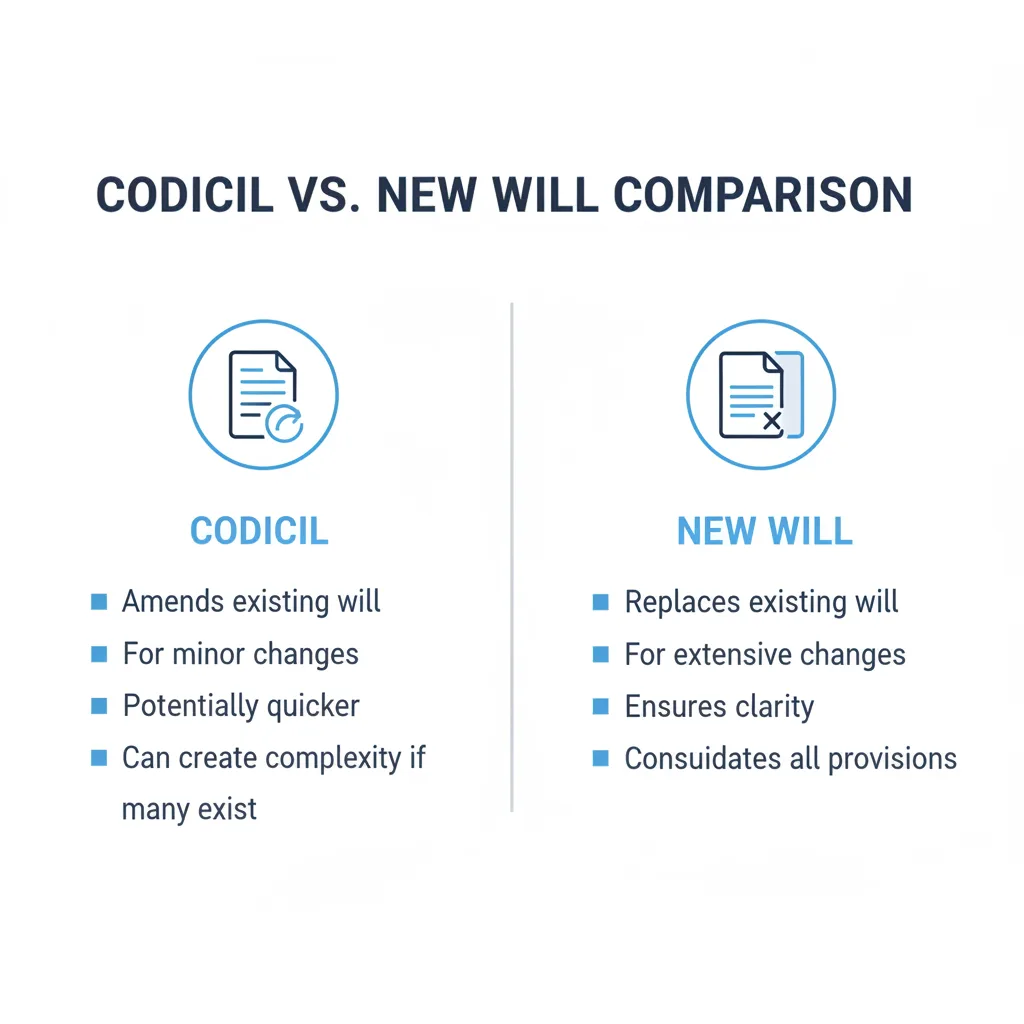
When a testator wishes to alter their existing estate plan, they generally have two options: executing a codicil or drafting an entirely new will. The choice between these two depends on the extent and complexity of the desired changes.
- Codicil - This is typically suitable for minor or isolated amendments, such as changing a single beneficiary, updating an executor, or adding a specific gift. It is often less time-consuming and costly than preparing a new will, as it only addresses the specific modifications. However, if multiple codicils are created over time, they can lead to a complex and potentially confusing set of documents that may be difficult for an executor to interpret, increasing the risk of ambiguity or legal challenges.
- New Will - Drafting a new will is generally recommended when the desired changes are extensive, involve significant alterations to the overall distribution scheme, or when the original will is outdated. A new will completely supersedes all previous testamentary documents, including prior wills and codicils, ensuring that all provisions are consolidated into a single, clear, and comprehensive document. This approach minimizes the risk of contradictory clauses and simplifies the probate process for the executor.
Revocation of Codicils
Like any other testamentary instrument, a codicil can be revoked by the testator. Revocation can occur through various legal means, ensuring that the testator's most current wishes are reflected in their estate plan. The methods for revoking a codicil are generally the same as those for revoking a will:
- By Subsequent Testamentary Instrument - A later will or another codicil can explicitly revoke an earlier codicil, either entirely or in part, by containing language that directly contradicts or revokes its provisions.
- By Physical Act of Destruction - A codicil can be revoked through a physical act performed by the testator with the intent to revoke it, or by another person at the testator's direction and in their presence. Examples of such acts include cutting, tearing, burning, obliterating, cancelling, or destroying the codicil or its signature (Virginia Code § 64.2-410).
Revival of Prior Wills
The concept of revival addresses whether a previously revoked will becomes valid again if the document that revoked it is itself revoked. Generally, the revocation of a subsequent will or codicil that had revoked a former will does not automatically revive the former will. This principle prevents confusion and ensures that a testator's intent is clearly established through affirmative action.
For instance, Florida statutes clarify this point:
- Florida Revival of Wills - The revocation by the testator of a will that revoked a former will does not revive the former will, even if the former will is still in existence at the date of the revocation of the subsequent will (Chapter 732 Section 508). To revive a previously revoked will, specific legal steps, such as re-execution or execution of a codicil expressly stating the intent to revive, are typically required.
Frequently Asked Questions
Sources
- RCW 11.02.005: Definitions and use of terms - Defines 'codicil' as a will that modifies or partially revokes an existing earlier will.
- § 64.2-403. Execution of wills; requirements - Outlines requirements for executing wills, including codicils, in Virginia.
- § 64.2-410. Revocation of wills generally - Details the revocation of wills and codicils in Virginia.
- Chapter 732 Section 502 - 2007 Florida Statutes - The Florida Senate - Discusses the execution of wills and codicils in Florida, including requirements for validity.
- Chapter 732 Section 508 - 2025 Florida Statutes - The Florida Senate - Addresses the revival of wills and codicils in Florida.
Not the form you're looking for?
Try our legal document generator to create a custom document
Disclaimer: The templates available on this website are provided for general informational purposes only and do not constitute legal advice. They are not intended to be, and should not be interpreted as, compliant with any specific legal, regulatory, or privacy requirements. These templates are not a replacement for professional legal guidance and should not be relied upon for any particular matter or circumstance. Users are strongly encouraged to seek advice from a qualified attorney licensed in their jurisdiction before using, modifying, or relying on any template.
All templates are provided on an "as is," "with all faults," and "as available" basis. The provider disclaims any and all warranties of any kind, whether express, implied, statutory, or otherwise, including without limitation warranties of merchantability, fitness for a particular purpose, title, or non-infringement.
LegalTemplates.com makes no guarantees or representations regarding the accuracy, completeness, expected outcomes, or reliability of the materials contained in these templates or any materials referenced or linked from them.