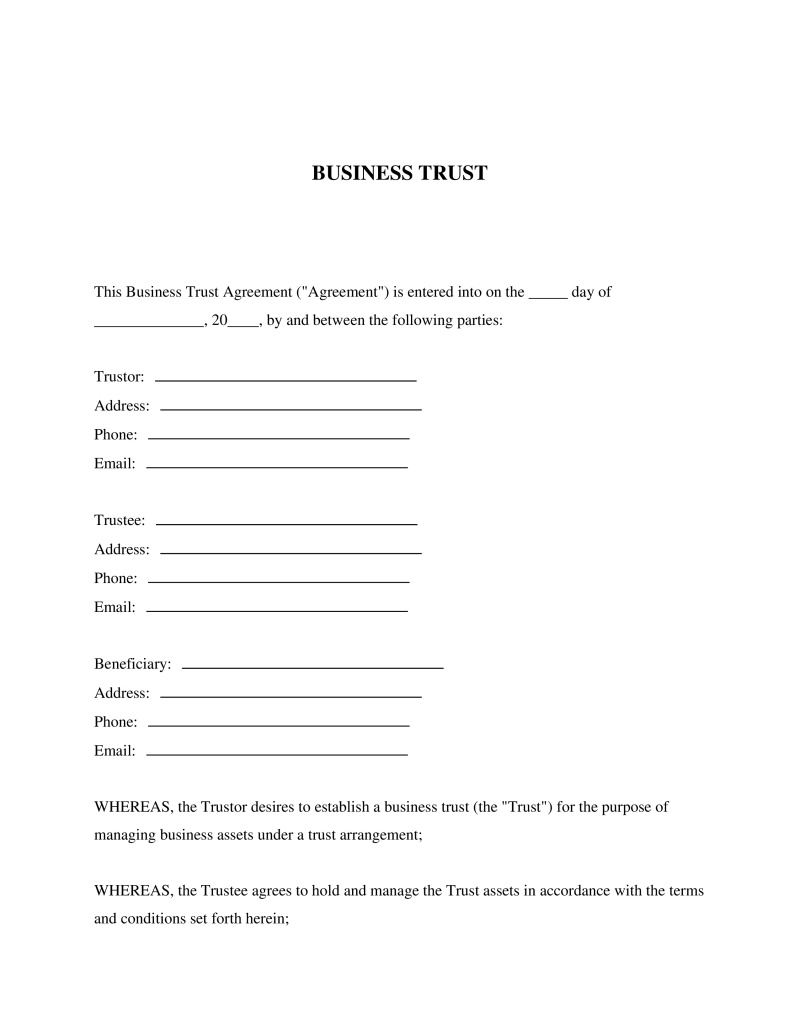
Business Trust
A Business Trust is a legal entity created by a trust agreement to conduct business for the benefit of its beneficiaries.
Is New Trust
Select 'Yes' if this is for a new trust. Select 'No' if amending an existing trust.
Table of Contents
What is a Business Trust?
A Business Trust is a legal entity wherein the business is managed by trustees for the benefit of its beneficiaries, who may also be the owners or investors. This structure provides a unique mix of control and flexibility, allowing for efficient management and asset protection. Typically, individuals or entities looking to manage assets in a way that separates them from personal liability, while still maintaining operational control, will find a Business Trust especially beneficial. Compared to traditional corporate structures or partnerships, it offers distinct advantages in terms of taxation, confidentiality, and estate planning.
Key Features
Important Provisions
- Definition of terms section that clarifies key terminology used throughout the document.
- Appointment, powers, and obligations of trustees detailing how they are chosen, their authority, and their duties towards the trust.
- Beneficiary rights section explaining how benefits are distributed among beneficiaries including any restrictions or conditions.
- Indemnification clauses that protect trustees against liabilities arising from their actions within their role, provided they act in good faith.
Pros and Cons
Pros
- +Offers a high degree of asset protection from creditors as assets are held in the trust's name, not the individual beneficiaries'.
- +Potentially favorable tax treatment depending on jurisdiction and specific setup.
- +Enhanced privacy since trust documents generally do not need to be publicly registered unlike corporate documents.
- +Flexibility in management and control can be tailored to suit the specific needs of the business or family.
- +Can be an effective tool for estate planning, allowing for a smoother transition of assets.
Cons
- -Setting up a Business Trust can be more complex and potentially costly compared to simpler structures like sole proprietorships.
- -The need for meticulous record-keeping and administration to maintain the trust's status and comply with legal requirements.
- -Potential for conflicts among trustees or between trustees and beneficiaries if not properly managed.
Common Uses
- Real estate investment where properties are held within the trust for profit generation.
- Family businesses looking to separate personal assets from business liabilities while planning for succession.
- Investment ventures where multiple parties contribute capital but wish to limit personal liability and maintain anonymity.
- Holding intellectual property or patents in a secure entity separate from operational business risks.
- Managing charitable activities alongside for-profit ventures under one umbrella without compromising either's objectives.
- Asset protection strategies aiming to safeguard wealth against lawsuits or creditors.
Frequently Asked Questions
Not the form you're looking for?
Try our legal document generator to create a custom document
Disclaimer: The templates available on this website are provided for general informational purposes only and do not constitute legal advice. They are not intended to be, and should not be interpreted as, compliant with any specific legal, regulatory, or privacy requirements. These templates are not a replacement for professional legal guidance and should not be relied upon for any particular matter or circumstance. Users are strongly encouraged to seek advice from a qualified attorney licensed in their jurisdiction before using, modifying, or relying on any template.
All templates are provided on an "as is," "with all faults," and "as available" basis. The provider disclaims any and all warranties of any kind, whether express, implied, statutory, or otherwise, including without limitation warranties of merchantability, fitness for a particular purpose, title, or non-infringement.
LegalTemplates.com makes no guarantees or representations regarding the accuracy, completeness, expected outcomes, or reliability of the materials contained in these templates or any materials referenced or linked from them.