Debt Verification Letter
A Debt Verification Letter is a document requesting proof of debt from a creditor, ensuring accuracy and validating financial obligations.
Debt Type
Select 'Individual' if the debt is in your personal name. Select 'Business Entity' if the debt is in a company or organization's name.
Table of Contents
What is a Debt Verification Letter?
A Debt Verification Letter is a formal written request sent by a consumer to a third-party debt collector demanding proof that a specific debt is valid, accurate, and legally owed. This document serves as a critical consumer protection tool exercised under federal law to pause collection activities until the agency provides adequate documentation supporting their claim. Individuals utilize this correspondence after receiving an initial communication from a collection agency to ensure they are not falling victim to scams, paying incorrect amounts, or settling debts that belong to someone else.
Legal Basis and Consumer Rights
The foundation for debt verification lies within federal consumer protection statutes designed to curb abusive debt collection practices. These laws establish clear protocols that collectors must follow when a consumer challenges the validity of a financial obligation. The primary mechanism for this process involves the consumer formally disputing the debt in writing.
Upon receipt of a timely dispute, the collection agency faces specific legal restrictions:
- Cessation of Collection Efforts - The collector must stop all attempts to collect the debt, including calls and letters, until they provide the requested verification (15 U.S.C. § 1692g(b)).
- Verification Requirement - The agency must obtain verification of the debt or a copy of a judgment from the original creditor and mail it to the consumer.
- Credit Reporting Restrictions - If the debt has been reported to credit bureaus, the collector must notify those bureaus that the item is under dispute (15 U.S.C. § 1692e(8)).
The 30-Day Validation Window
Time plays a central role in the debt verification process. Federal law grants consumers a specific timeframe to request validation to trigger the automatic cease-collection requirement. The clock begins ticking from the date the consumer receives the initial communication, often called the validation notice, from the debt collector.
Key timelines regarding the verification process include:
- Initial Dispute Window - Consumers have 30 days from the receipt of the initial validation notice to request verification in writing (15 U.S.C. § 1692g(a)).
- Assumption of Validity - If the consumer fails to dispute the debt within the 30-day period, the debt collector may assume the debt is valid.
- Post-Window Disputes - Consumers may still dispute a debt after 30 days, but the collector is not legally required to cease collection efforts during the investigation period.
- Collector Response Time - The law does not impose a specific deadline for the collector to respond, but they cannot resume collection activities until they do so.
How to Complete a Debt Verification Letter
Drafting and sending a verification letter requires attention to detail to ensure it triggers the necessary legal protections. The goal is to clearly communicate the dispute without acknowledging ownership of the debt.
- Review the Validation Notice - Examine the initial letter received from the debt collector to identify the account number, the amount claimed, and the name of the collection agency. This information serves as the reference point for the dispute letter and ensures the collector identifies the correct file.
- Draft the Dispute Statement - Write a clear statement indicating that the debt is disputed. Avoid using language that admits liability or acknowledges the debt belongs to you. Phrases such as "I am disputing this debt" or "I request validation of this alleged debt" are appropriate and legally sufficient.
- Request Specific Documentation - List the specific items required to verify the debt, such as the name and address of the original creditor, the original account number, and a breakdown of the balance including principal, interest, and fees. Requesting proof of the collector's license to operate in your state is also a prudent step.
- Send via Certified Mail - Mail the letter using a service that provides a return receipt or tracking number. This step creates a paper trail proving exactly when the collector received the dispute, which is vital for establishing a violation if they continue collection efforts before verifying.
Standard of Verification
A common point of confusion involves the level of detail a collector must provide to satisfy the legal requirement of verification. Courts have generally held that the standard is relatively low. The verification does not necessarily need to include original contracts or wet-ink signatures to meet the minimum threshold under the Fair Debt Collection Practices Act.
Acceptable forms of verification typically include:
- Itemized Statements - A document showing the principal balance, interest, fees, and total amount owed.
- Original Creditor Information - The name and address of the entity that originally extended the credit.
- Account History - Records indicating the date the account was opened and the date of the last payment or default.
- Judgment Copies - If the debt has already gone to court, a copy of the court judgment serves as valid verification.
Consequences of Non-Verification
When a debt collector cannot or chooses not to provide the requested verification, specific legal consequences follow. The inability to validate the debt effectively paralyzes the collection process for that specific agency.
Outcomes resulting from a failure to verify include:
- Permanent Cessation - The collector must indefinitely refrain from contacting the consumer regarding the debt.
- Credit Report Removal - If the debt cannot be verified, the collector generally cannot maintain the negative trade line on the consumer's credit report, as doing so would violate accuracy requirements.
- Unenforceability - Without proper documentation, the collector lacks the evidence necessary to prevail in a lawsuit, making legal action unlikely.
- Sale of Debt - The agency may return the account to the original creditor or sell it to a different buyer, potentially restarting the cycle with a new entity.
Federal Statutes and Regulations
The debt verification process is governed primarily by federal statutes that supersede conflicting state laws. These acts provide the framework for consumer rights and collector responsibilities.
- Fair Debt Collection Practices Act - Establishes the consumer's right to dispute debts and obtain validation within 30 days of initial contact (15 U.S.C. § 1692g).
- Fair Credit Reporting Act - Mandates that furnishers of information to credit bureaus must investigate disputes and verify the accuracy of reported data (15 U.S.C. § 1681s-2).
- Electronic Fund Transfer Act - Regulates the use of electronic means to collect payments and prohibits unauthorized transfers (15 U.S.C. § 1693 et seq.).
- Telephone Consumer Protection Act - Restricts the use of automated dialing systems and pre-recorded messages in debt collection calls (47 U.S.C. § 227).
Frequently Asked Questions
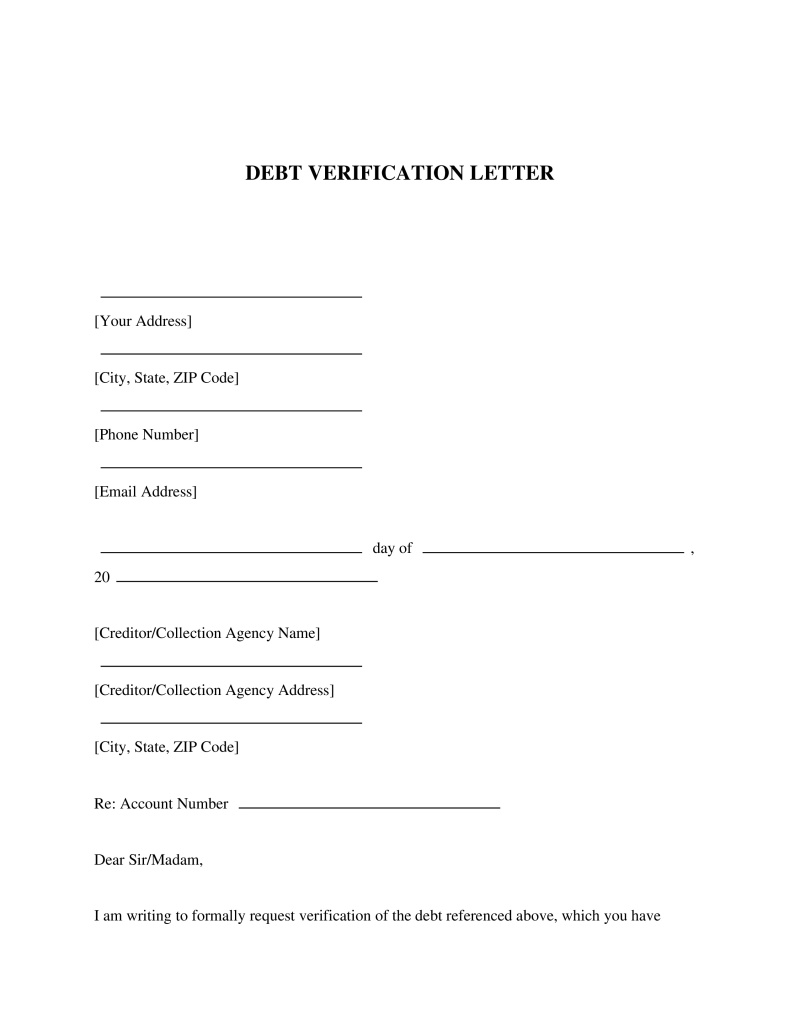
Debt Verification Letter Sample
Not the form you're looking for?
Try our legal document generator to create a custom document
Disclaimer: The templates available on this website are provided for general informational purposes only and do not constitute legal advice. They are not intended to be, and should not be interpreted as, compliant with any specific legal, regulatory, or privacy requirements. These templates are not a replacement for professional legal guidance and should not be relied upon for any particular matter or circumstance. Users are strongly encouraged to seek advice from a qualified attorney licensed in their jurisdiction before using, modifying, or relying on any template.
All templates are provided on an "as is," "with all faults," and "as available" basis. The provider disclaims any and all warranties of any kind, whether express, implied, statutory, or otherwise, including without limitation warranties of merchantability, fitness for a particular purpose, title, or non-infringement.
LegalTemplates.com makes no guarantees or representations regarding the accuracy, completeness, expected outcomes, or reliability of the materials contained in these templates or any materials referenced or linked from them.